
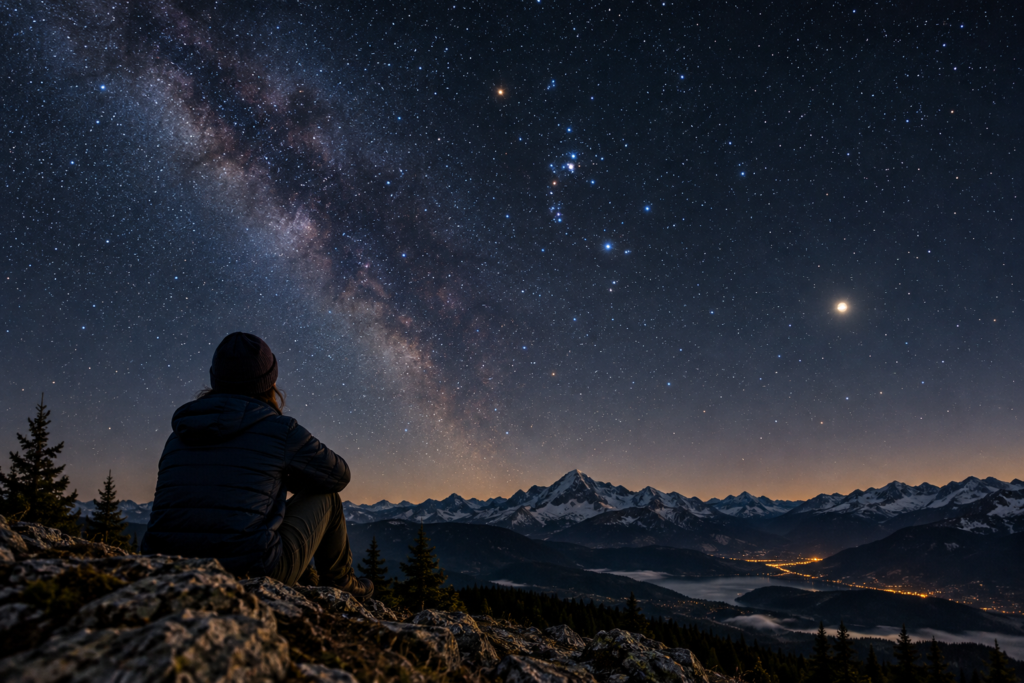
A bright star near the horizon can look surprisingly restless. It flashes, seems to change color, and briefly becomes brighter or dimmer. Nearby, another bright point may look almost perfectly calm.
The difference is usually less about what those objects are doing and more about what their light encounters during its final journey to your eyes. The last stretch, through our own atmosphere, can make an otherwise steady source look lively.
The atmosphere is an uneven optical medium
Air is transparent, but that does not mean it leaves every light ray completely unchanged. Its optical properties vary slightly with conditions such as temperature and density. When light passes through regions with different properties, its direction and wavefront can change.
The atmosphere is also in motion. Rising warm air, winds, and mixing continually rearrange those regions. A star therefore shines through a shifting optical environment rather than a perfectly uniform window.
NASA’s StarChild explanation describes how this moving air makes starlight appear unsteady. The star does not need to brighten and fade to produce the familiar effect.
A useful comparison is looking through moving water. The comparison is imperfect, but it captures an important idea: a changing medium can alter the appearance of something beyond it without changing the object itself.
Why a huge star behaves like a tiny point
Stars are enormous physical objects, yet their distances make their apparent angular sizes extremely small. To the unaided eye, an ordinary nighttime star acts much more like a point of light than a resolved round surface.
That distinction matters. There is very little visible area over which atmospheric fluctuations can average out. Changes in the light reaching the observer are easier to notice as flickering.
Apparent size is different from actual size. A nearby object can occupy a larger patch of your view than a far larger object at an immense distance. Holding a small coin in front of a distant building illustrates the geometric principle without suggesting the two objects are physically comparable.
The star’s size on the sky, rather than its impressive diameter in space, helps determine how atmospheric disturbance affects its appearance.
Planets provide many overlapping contributions
A planet may look like a point to your eyes, but optically it generally presents a larger apparent disk than a distant star. Light arrives from different parts of that disk.
Atmospheric changes affecting one contribution do not always affect every other contribution in exactly the same way. Their combined brightness is consequently more stable than the light from an effectively pointlike source.
This averaging is explained in the Optical Society’s educational treatment of twinkling. It does not require planets to produce their own visible light. The familiar planets shine mainly by reflecting sunlight.
The distinction is a useful skywatching clue, not a perfect identification rule. A planet can still shimmer noticeably under difficult atmospheric conditions, especially when it is low in the sky. A sky chart provides a more reliable identification than steadiness alone.
The horizon adds a longer atmospheric journey
Look upward and then toward the horizon: the atmosphere extends around Earth, so these directions do not take light through equivalent paths. Light from a low object generally crosses more air before reaching you.
That longer route creates more opportunity for optical disturbance. It helps explain why a star may look especially lively shortly after rising or before setting, while looking steadier when higher overhead.
The Lunar and Planetary Institute’s stars guide highlights this relationship between viewing direction and twinkling.
The effect does not mean the star approaches Earth as it rises. Its changing position relative to your horizon changes the line of sight through the atmosphere. Local conditions can add further disturbance, including warm air rising from roofs or paved surfaces along the viewing path.
Why a star can flash different colors
The atmosphere can alter different wavelengths of light in slightly different ways. As the incoming light is continually redirected, its changing mixture can make a bright star appear to flash red, blue, or other colors.
That rapid flashing is different from the star’s underlying color. A star’s overall spectrum contains information about its physical properties; a momentary colored sparkle is not evidence that its surface temperature has suddenly swung between extremes.
This is another reason to distinguish the source from the viewing conditions. A camera, telescope, and human eye may also render the same light differently because of exposure, focus, and sensitivity.
Night-sky color is therefore a combination of the object’s light, the atmosphere’s effects, and the observing system. The familiar sparkle is only one part of that larger chain.
Astronomers try to correct the disturbance
Twinkling is attractive to observers, but atmospheric distortion complicates precise astronomy. Small details can blur even when a telescope has an excellent mirror.
ESO’s adaptive optics overview describes systems that measure distortion and rapidly change a deformable mirror to reduce its effect. This is a correction to the arriving wavefront, not a change to the star.
Observatories also benefit from suitable locations and conditions. A large telescope cannot simply make the atmosphere disappear, so its surroundings are part of the instrument’s practical performance.
Space telescopes avoid Earth’s atmospheric turbulence by observing above it. That removes this particular source of distortion, although instrument design and other limitations still matter. Ground and space observatories therefore solve overlapping problems using different approaches.
Twinkling is different from a variable star
Some stars really do change brightness. Their output may vary, or something may pass in front of them. Those are astronomical changes rather than the ordinary atmospheric shimmer described here.
The two effects can exist together. Light from a genuinely variable star still has to cross the atmosphere before a ground-based observer measures it.
For that reason, astronomy does not treat every apparent fluctuation as a discovery about the star itself. Measurements, comparison objects, repeated observations, and an understanding of atmospheric conditions help distinguish competing explanations.
For casual viewing, the key lesson is simpler: rapid sparkling in an ordinary star is generally a feature of looking through moving air. You can appreciate the spectacle while recognizing that the drama is happening much closer to home.
Frequently asked questions
Can planets ever twinkle?
Yes. Their larger apparent disks usually reduce the effect, but strong turbulence and a low position in the sky can still make planets visibly shimmer.
Do stars twinkle the same way from space?
Not from Earth’s atmosphere when observed above it. Intrinsic stellar variability and instrument effects are separate matters.
Is a flashing star changing temperature every second?
The usual rapid color flashes are atmospheric effects, not repeated enormous temperature changes at the star.