
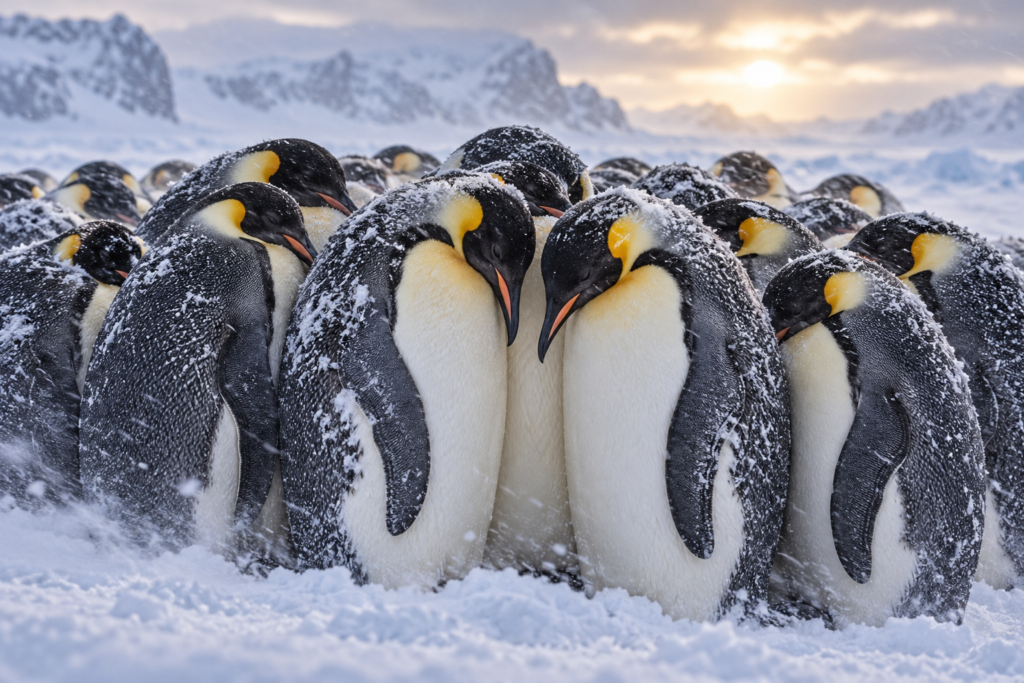
From a distance, a winter penguin colony can look like a dark patch pressed into a white landscape. Move closer in an image and the patch resolves into birds standing shoulder to shoulder, many with their heads lowered.
That group is more than a crowd. It changes the physical conditions experienced by the individuals within it. To understand how emperor penguins stay warm, it helps to connect the structure of one bird with the behavior of the colony.
Keeping warm means slowing the loss of heat
An emperor penguin produces heat through its metabolism. In a cold environment, the challenge is to retain enough of that heat without spending energy faster than it can be replaced.
Insulation does not create energy. It slows heat transfer, allowing a warm interior to remain different from its colder surroundings for longer. This distinction is familiar from clothing: a coat helps conserve the wearer’s heat rather than functioning like an independent furnace.
For a bird on Antarctic sea ice, moving air adds another challenge. Wind can carry heat away from exposed surfaces. Body structure and sheltering behavior therefore address related parts of the same problem.
There is no single magical feature behind survival. Several measures combine, and each becomes more understandable when treated as part of an energy budget.
Feathers provide a specialized outer barrier
Emperor penguins are birds, so their covering is feathers rather than mammalian fur. Those feathers form a dense, overlapping coat that helps maintain insulation.
The Australian Antarctic Program’s emperor penguin profile describes the importance of this protective plumage. The outwardly smooth shape conceals a more complex insulating system.
Air held within the feather covering contributes to reducing heat transfer. Keeping that covering in good condition matters because a disrupted barrier does not behave like an intact one.
It is useful to avoid imagining a penguin as a warm animal simply touching freezing air with bare skin. Much of the body is separated from the environment by a carefully maintained covering. The visible surface and the bird’s core are not the same thermal location.
Stored energy matters as much as insulation
Body fat contributes insulation and also serves as an energy reserve. These roles are related but not identical: reducing heat loss is one benefit, while supplying fuel during periods without feeding is another.
Breeding adults face changing demands over the season. Emperor penguins do not have unlimited energy simply because they are adapted to the cold. Time spent fasting makes conservation particularly important.
The Australian Antarctic Program’s breeding account explains how feeding trips and incubation are organized during the reproductive cycle.
Thinking about stored fuel helps explain why a huddle is valuable. A modest reduction in heat loss repeated over many hours can influence how quickly reserves are used. The benefit concerns the duration of survival as well as immediate comfort.
A huddle changes exposure to wind and air
A bird standing alone presents exposed surfaces to the environment. In a compact group, neighbors shelter one another and reduce the area directly facing the cold surroundings.
The outer birds still experience different conditions from those deeper inside. That difference helps explain why a huddle must be understood as a structured group rather than a collection of identical positions.
The American Museum of Natural History’s Antarctic adaptations resource places huddling alongside the bird’s physical insulation.
A huddle is not a sealed room with one fixed temperature. Its conditions vary with weather, density, location within the group, and movement. Statements that assign every huddle a single temperature miss that variability.
Tiny movements keep a dense group from becoming stuck
A tightly packed huddle creates another problem: an individual cannot easily take a large step if every nearby space is occupied. Remaining completely rigid would make rearrangement difficult.
A 2011 study of coordinated huddle movements used time-lapse observations to show small steps propagating through the group as waves. Those observations reveal movement that is easy to miss at normal viewing speed.
The finding does not mean every penguin colony follows one perfectly timed schedule in all weather. It demonstrates a mechanism by which a dense group can move collectively without requiring every bird to push a separate large gap open.
The comparison with a crowd is helpful: small adjustments can travel farther than the movement of any one participant, changing the organization of the whole group.
Breeding makes protection especially demanding
Emperor penguins breed during the Antarctic winter. After the egg is transferred, the male supports it on his feet beneath a protective skin fold while the female returns to feed.
This arrangement keeps the egg away from direct contact with the ice and places it close to the adult’s protected body. It is an example of behavior and anatomy working together.
A photograph of the colony should not be interpreted as every adult doing the same job throughout the year. The breeding cycle includes different stages, and the thermal demands change as eggs hatch and chicks grow.
Adults, eggs, and chicks also differ in size and protection. Their needs cannot be reduced to one universal statement that penguins never become cold. Survival involves ongoing care under demanding conditions.
Being adapted to cold does not mean wanting maximum heat
Temperature regulation includes avoiding excessive heat as well as conserving it. A bird’s useful response depends on conditions, activity, and its current state.
Huddles can change shape, loosen, or break apart. A living group is not a permanent sculpture, and crowding is not automatically beneficial at every moment.
This is why insulation and movement should be considered adjustable parts of a system. A heavily insulated animal still needs ways to regulate heat exchange rather than retain every possible unit of heat indefinitely.
For observers, the lesson is to resist a simple story of permanent suffering or permanent comfort. The birds respond to an environment that changes, using adaptations that make those responses possible but do not eliminate the challenge.
One species does not represent every penguin
The emperor penguin is an especially striking example of cold adaptation, but penguins occupy different environments. Not every species breeds in the same setting or faces the same seasonal conditions.
Even within Antarctica, local weather and sea-ice conditions differ. A fact about a particular emperor colony should not automatically become a claim about every penguin everywhere.
The broader principle does travel well: an animal’s survival can depend on the interaction between physical traits, stored resources, and behavior. Looking only at feathers misses the huddle; looking only at the huddle misses the insulating body that makes each participant viable.
That combination turns the familiar image of penguins packed together into a richer example of how living systems manage energy.
Frequently asked questions
Do penguins generate heat by huddling?
Each bird generates metabolic heat. Huddling mainly helps conserve that heat by changing exposure and the local environment.
Are huddles completely motionless?
No. Small coordinated steps and larger reorganizations can change the group over time.
Do all penguins live in Antarctic winter conditions?
No. Species live in different regions and have different adaptations and breeding patterns.