
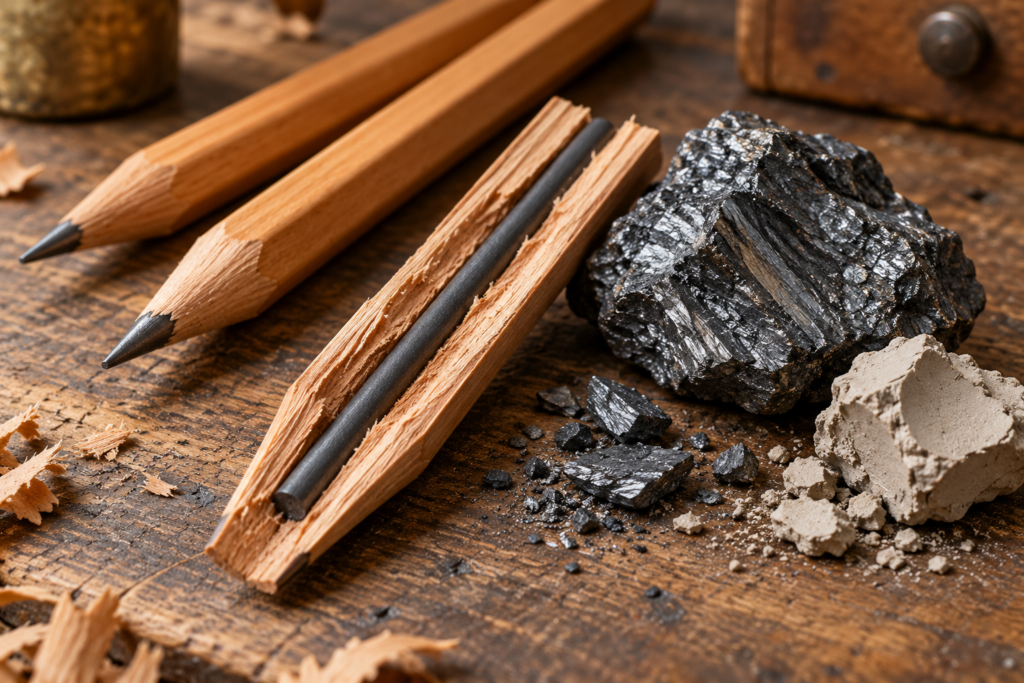
A pencil sharpener exposes a narrow dark core inside a wooden shell. Most people call that core lead, even though an ordinary graphite pencil contains a different material.
The mismatch is a small piece of history carried in everyday language. Understanding it brings together older writing tools, a useful mineral, and the manufacturing changes that made pencils more consistent.
The name is older than the modern material
Metallic lead and graphite are not two names for the same substance. Lead is a chemical element; graphite is a form of carbon. A familiar label should not be mistaken for a chemical description.
The British Library’s history of the pencil discusses older pointed lead tools used for marking and planning manuscripts. Those predecessors help explain why the language of lead persisted.
This does not mean every modern pencil descends from a single moment when someone removed a lead rod and inserted graphite. The history involves several tools, names, and methods developing over time.
Everyday vocabulary often outlives the technology that first made it useful. In this case, the continued word is much less reliable than the material actually inside the pencil.
Graphite offered a useful kind of mark
Graphite is dark, relatively soft, and capable of leaving visible material on a surface. High-quality deposits in Borrowdale, England, became important to pencil history.
Early users could work with pieces of the mineral, but handling a soft, brittle stick was not ideal. A holder or wrapping made it easier to control and helped keep the marking material usable.
The story illustrates a distinction between discovering a useful substance and designing a convenient tool. A material may perform its basic task well while still needing protection, shaping, or a handle.
Wooden casings addressed that practical problem. They allowed a narrow core to be held comfortably and sharpened as it wore down. The result joined a writing material to a supporting structure rather than asking one substance to do both jobs.
A layered structure helps graphite reach the paper
Graphite’s carbon atoms form sheets with strong bonding within each layer and weaker interactions between layers. Under the rubbing action of writing, small amounts of graphite-rich material can transfer onto paper.
The American Chemical Society’s pencil explanation connects the core material with the mark and the action of an eraser.
A pencil line is therefore a deposit of material, not a thin cut made by a metal point. Pressure, the core’s formulation, and the paper surface influence what gets left behind.
This also explains why the line behaves differently from ink. The material sits in and on the paper’s surface rather than arriving as a liquid that must dry. Different papers can still hold the same pencil mark in noticeably different ways.
Mixing graphite with clay made the core adjustable
Relying only on naturally convenient pieces of graphite limited what makers could control. A manufactured mixture provided a way to use processed graphite and create cores with chosen properties.
Late eighteenth-century developments associated with Nicolas-Jacques Conté helped establish the graphite-and-clay approach used in modern pencil manufacture. The mixture could be shaped, fired, and enclosed in wood.
Faber-Castell’s manufacturing history describes fired graphite-and-clay leads fitted between wooden boards that are then cut into pencils.
The important advance was not simply putting powder in a wooden tube. A controlled recipe and production process turned variable raw material into a repeatable product. That made it possible to offer different writing and drawing behaviors deliberately.
Hardness grades describe a formulation, not a metal
The balance between graphite and clay influences how a core behaves. More clay generally produces a harder core and a lighter mark, while a softer formulation generally deposits material more readily.
Faber-Castell’s pencil FAQ explains the familiar H and B grades and notes that exact classifications can differ between manufacturers.
H is associated with hardness and B with blackness. Numbers extend the scale, so a 6H is generally harder than a 2H within a maker’s range, while a 6B is generally softer and darker than a 2B.
HB occupies a middle position in the familiar system. These labels are useful guides, but they do not guarantee identical performance across every brand, paper, pressure, and manufacturing process.
A more restrained mark
Often useful for fine, light lines.
A richer deposit
Often useful for darker shading and expressive drawing.
The wooden shell is part of the engineering
The casing protects a core that would otherwise be awkward to hold and easy to damage. It gives the fingers a larger surface while allowing only a small writing point to touch the page.
Sharpening removes casing and core together to renew the working tip. A core runs through the pencil; it is not added anew each time the point becomes dull.
Manufacturing can create the casing from grooved wooden pieces joined around the core. The finished shape may be round, hexagonal, or another form chosen for handling and production.
This arrangement is a useful example of complementary materials. Wood provides support and grip, while the graphite mixture supplies the marking behavior. Their different properties are the reason the combination works.
Erasability depends on material and surface
An eraser removes much of a pencil mark by lifting graphite-rich particles from paper. It does not reverse time or restore every fiber to its original condition.
A lightly applied mark may come away cleanly, while heavy pressure can leave indentations or work material more deeply into the surface. Repeated erasing can also disturb paper.
That is why erasability is not a simple yes-or-no property of the pencil alone. It emerges from the interaction of the core, paper, eraser, and the way the mark was made.
Artists and draftspeople make use of these differences. A tool that can create a subtle line, a broad tone, and a partially removable mark offers possibilities beyond simply recording words.
The label should not be treated as a safety guarantee
Knowing that graphite pencil lead is not metallic lead corrects one misconception, but it does not make every pencil-related situation harmless.
A sharp point can still cause a puncture, and small pieces can present physical hazards. Colored pencil cores and specialty marking products may use different formulations from an ordinary graphite pencil.
The sensible conclusion is about identity: the usual dark core is a manufactured graphite material, not a rod of metallic lead. It is not an invitation to chew, swallow, or handle damaged products carelessly.
Seen this way, a familiar pencil becomes a compact record of changing materials and stable language. The chemistry evolved into a dependable everyday tool, while a much older name remained attached to its center.
Frequently asked questions
Does an ordinary graphite pencil contain a metallic lead core?
No. Its writing core is generally a graphite-and-clay formulation, with other ingredients depending on the product.
Does a higher B number usually mean a darker mark?
Within a manufacturer’s range, higher B grades generally indicate softer, darker-writing cores. Pressure and paper still matter.
Are colored pencil cores the same as graphite cores?
No. Colored pencils use pigments and binders, and their formulations differ from ordinary graphite pencils.