
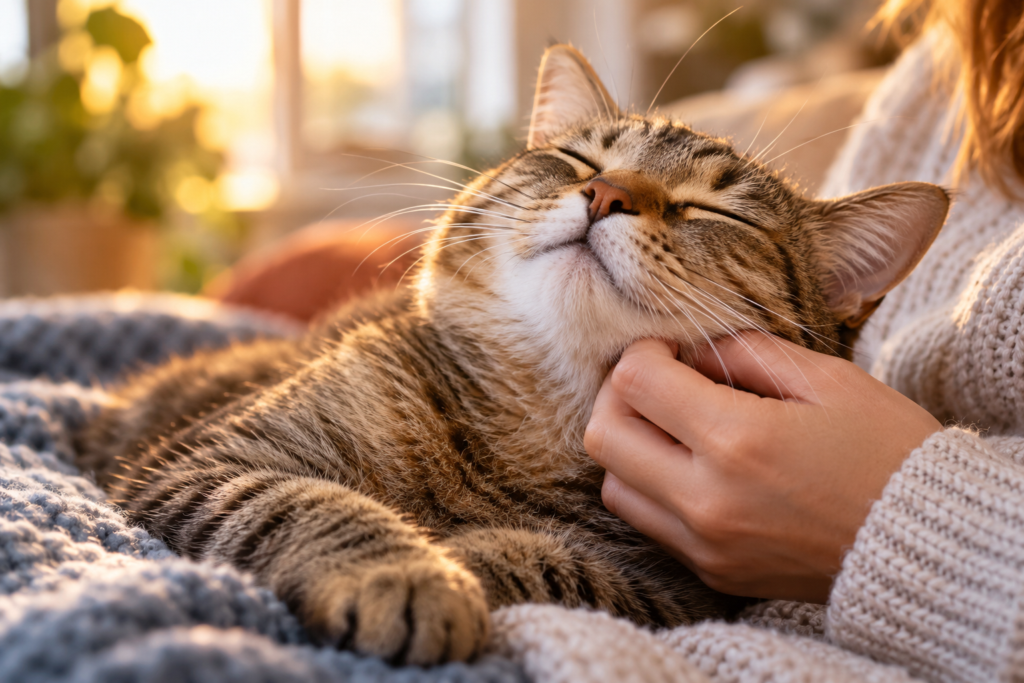
A cat curls up beside you and begins to rumble. The sound feels like a clear message: everything is comfortable. In that setting, contentment is a reasonable interpretation.
But the same kind of sound can occur in very different circumstances. Understanding purring means separating three questions: what the cat is doing, how the sound is generated, and what we can actually infer from hearing it.
Comfort and social contact are common settings
Cats frequently purr during familiar, relaxed interactions. Petting, rubbing against a trusted companion, settling down, and resting in a warm environment can all accompany the sound.
That association explains why people often hear a purr as an expression of pleasure. It is a useful starting point when the rest of the situation fits.
A veterinary behavior expert at NC State University describes purring across positive cat-human and cat-cat interactions. The same discussion notes that the range of contexts is broader than contentment alone.
Think of purring as one part of an interaction. The setting supplies information that the sound cannot provide by itself.
Purring appears in early social life
Mother cats can purr while nursing, and kittens purr during nursing too. The behavior therefore belongs to the cat’s own social world rather than being a sound invented only for human listeners.
Its appearance in close contact between mothers and young is consistent with a role in communication and maintaining contact. That does not give every purr a single translation.
An adult cat may use the same broad category of vocalization in a new setting. A behavior can retain connections to early life while serving several functions later on.
This is a recurring challenge in understanding animal communication: a recognizable signal does not always correspond to one word or one emotion.
Some purrs sound more urgent than others
A purring cat may be asking for something as well as expressing a comfortable state. Research on “solicitation purring” examined sounds produced when cats sought food.
In the 2009 study, The cry embedded within the purr, researchers identified a higher-frequency voiced component within some solicitation purrs. Human listeners judged these sounds as more urgent and less pleasant than comparison purrs.
Removing that component reduced perceived urgency. This provides evidence that differences within a purr can influence how a human responds.
It does not prove that cats formulate a human-like plan to manipulate their owners. The narrower conclusion is that some vocal features are effective at eliciting attention.
A cat can purr when it is not feeling well
Cats have also been observed purring while injured or in distress. For that reason, hearing the sound cannot establish that an animal is comfortable or pain-free.
An animal behaviorist at UC Davis describes purring as potentially involved in soliciting care, attention, or comfort from a social companion.
Context changes the interpretation. A purr while a cat voluntarily settles beside a familiar person is different evidence from purring alongside a marked change in normal behavior.
Neither case gives a perfect window into the animal’s internal state. The practical lesson is to avoid making the sound the only thing you notice.
The larynx produces unusually low vibrations
Purring involves the larynx, or voice box, and can continue across breathing in and out. Explaining exactly how a small cat produces such low-frequency vibrations has been an active research question.
One longstanding account emphasized rapid, repeated contractions of laryngeal muscles. A 2023 laboratory study added an important complication: eight excised domestic-cat larynges could produce vibrations in the purring range without repetitive neural input.
The researchers also identified connective-tissue structures within the vocal folds that may help enable these low frequencies.
The result showed what the tissue can do under experimental conditions. It did not fully resolve how all components interact in a living, spontaneously purring cat.
Sound production
Laryngeal tissues and airflow are central to producing the vibration.
Behavioral function
Social context and the cat’s condition help explain when the sound occurs.
A physical mechanism is not a complete explanation of purpose
The University of Veterinary Medicine Vienna’s account of the larynx research emphasizes that purring is more complex than previously assumed.
That is a useful reminder to distinguish observations from broader claims. Demonstrating a frequency does not, by itself, demonstrate a particular effect on bone healing, tissue repair, or human health.
Popular descriptions sometimes turn proposed benefits into established explanations. To test a benefit, researchers need evidence of the outcome, not just a vibration that could sound compatible with a hypothesis.
The most defensible account is therefore a layered one: cats purr in multiple contexts, their sounds can influence listeners, and the production mechanism is still being investigated.
Listen while also watching the rest of the cat
Compare the situation with what is normal for that individual. Notice whether the cat chooses contact, moves normally, and behaves as it usually does. A purr is useful information, but it is one piece of a larger picture.
The American Animal Hospital Association recommends contacting a veterinarian when unusual purring accompanies changes in behavior. The sound should not be used to dismiss a concern.
At the same time, there is no need to treat an ordinary, relaxed purr as evidence of trouble. The point is careful interpretation rather than assigning every sound the same meaning.
Frequently asked questions
Does purring always mean happiness?
No. Comfortable interactions are common settings, but cats can purr in other circumstances, including distress.
Can purring be a request for food?
Yes. Research has identified acoustic features in some food-solicitation purrs that make them sound more urgent to humans.
Have scientists completely solved how cats purr?
No. Laboratory work has revealed important features of laryngeal vibration, while questions remain about the complete process in living cats.