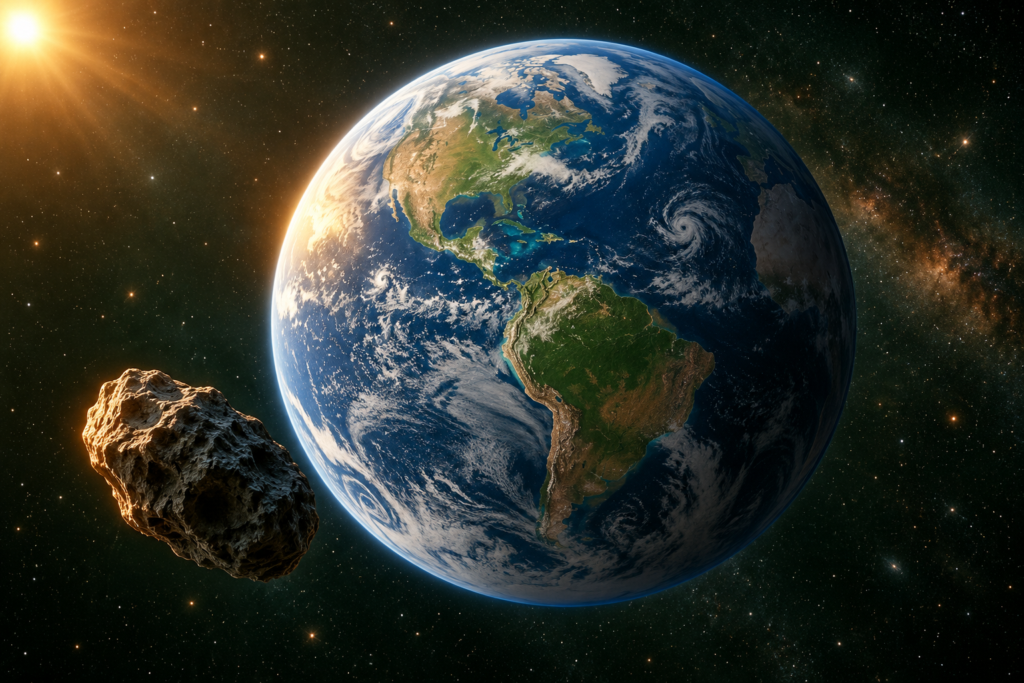
Look at pictures of Earth, Mars, Jupiter, and Neptune. Their colors and surfaces differ enormously, but each has a rounded outline. A small asteroid, meanwhile, may look more like a battered potato.
The contrast is not a coincidence. Shape reflects a competition between gravity, material strength, rotation, and history. The same physics that lets a rock keep a jagged corner prevents an entire planet from keeping a gigantic one.
Every part of a planet contributes to its gravity
Gravity is an attraction between masses. A planet’s pull is not produced by a separate machine at its center; it results from all the matter making up the body.
For an approximately spherical world, the combined attraction near the surface points roughly toward the center. Matter is pulled inward from every side rather than toward one preferred corner.
NASA’s explanation of planetary roundness describes this large-scale inward organization. As a forming body gains mass, its own gravity becomes increasingly important in determining its overall shape.
The result is not an empty shell wrapped around a central magnet. It is a body whose components attract one another throughout its volume.
Material strength can resist weak self-gravity
A stone does not become spherical merely because gravity acts on it. Chemical bonds and the mechanical strength of its material can support an irregular shape against its relatively weak self-gravity.
Scale changes that balance. In a much larger body, the weight of overlying material creates greater internal stresses. A vast protrusion becomes harder for the underlying material to support.
The Chandra astronomy explanation frames shape in terms of competing forces, including gravity and the forces that give solid material its strength.
So “gravity acts on everything” and “not everything is round” are compatible statements. The question is whether gravity can overcome the resistance to reshaping at the scale involved.
Large irregularities tend to settle toward a balanced shape
Imagine an enormous rocky cube. Its corners extend much farther from its center than the middle of each face. Those protruding regions would place tremendous demands on the material beneath them.
For a sufficiently massive body, the structure cannot indefinitely support that arrangement. Material deforms, moves, or collapses toward a more compact configuration.
The European Space Agency’s discussion of cosmic shapes explains why gravity favors roundness in large bodies.
A sphere is the useful starting case when there is no preferred direction from rotation or external forces. Real planets add complications, but the basic tendency remains: gravity suppresses enormous unsupported departures from a rounded shape.
Internal support balances the inward pull
A planet does not keep shrinking without limit simply because it has gravity. Internal pressure and material resistance provide support.
The term hydrostatic equilibrium describes a balance between gravity and pressure in a body behaving sufficiently like a fluid. Planetary-shape discussions use this concept to explain why self-gravity can produce a nearly rounded figure.
NASA’s account of planet classification includes sufficient self-gravity to overcome rigid-body forces among the criteria used for Solar System planets and dwarf planets.
This does not mean a rocky planet must be liquid everywhere today. Material can deform over long timescales, and a world’s earlier, hotter history can influence the shape that later solid structures inherit.
A rotating planet is usually wider around its equator
Rotation introduces a preferred axis. In the rotating frame, the balance that determines shape differs between the equator and the poles.
A planet can therefore become slightly flattened at the poles and wider across the equator. Jupiter and Saturn show this more prominently than Earth.
This is an important correction to the image of planets as perfect marbles. They are nearly round, but the amount of flattening varies with rotation and internal structure.
A compact overall shape
Inward attraction limits large, unsupported irregularities.
A modified figure
Spinning can produce a wider equator and flattened poles.
Earth is close to an ellipsoid, with additional irregularities
NOAA describes Earth as an irregularly shaped ellipsoid. That captures both the equatorial bulge and the fact that the actual surface is more complicated than a simple mathematical solid.
Mountains, ocean trenches, tides, and movements within the planet add differences. At the same time, those features are small compared with Earth’s full diameter.
Scientists choose different models for different tasks. A sphere may be adequate for a broad illustration, while an ellipsoid and gravity-based reference surfaces are needed for precise measurements.
The geoid, for example, is a reference surface related to gravity and mean sea level. It is not a claim that Earth looks like an exaggerated lumpy teaching model from space.
Small bodies preserve more of their individual history
In smaller objects, self-gravity may be too weak to erase large irregularities. Collisions, fragments, and the way material accumulated can remain visible in their outlines.
There is no single universal diameter that turns every object into a sphere. Composition, temperature, rotation, and history affect the balance.
Some smaller worlds are nevertheless nearly round. NASA’s comparison of dwarf planets and asteroids uses Ceres and Vesta to illustrate differences among bodies in the asteroid belt.
Frequently asked questions
Does the Sun squeeze planets into spheres?
The main explanation is a planet’s own gravity. External gravity can affect shape, but it is not needed to explain ordinary planetary roundness.
Are all round objects planets?
No. Moons and dwarf planets can also be nearly round. Classification involves more than shape.
Do mountains contradict a round Earth?
No. Local surface relief can coexist with an approximately spherical global shape.