A flower offers a watery drop of nectar. Inside a hive, that raw material can become a thick, fragrant food that lasts far longer than the original liquid. The transformation takes both chemistry and coordinated work.
Honey is not simply something bees discover ready-made inside flowers. It is a processed food reserve built from repeated collecting trips, changes in sugar composition, and careful removal of water.
Nectar supplies the starting material
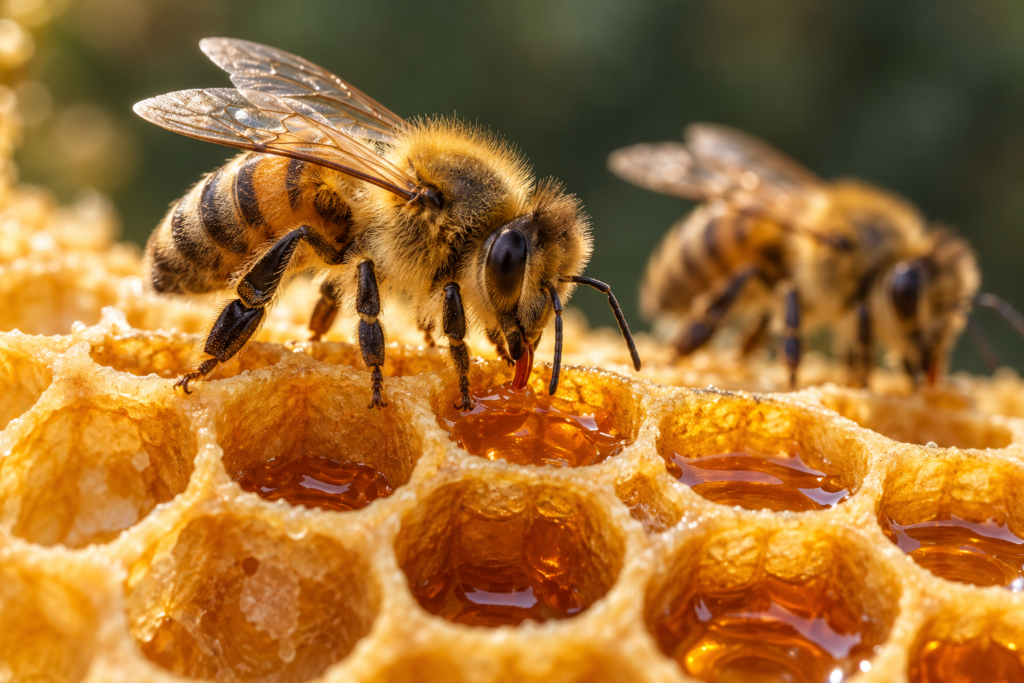
Many flowers produce nectar, a solution containing water and sugars. Visiting honey bees use their mouthparts to collect it.
The recipe varies among plants. Nectar is not always the same concentration or mixture, which helps explain why the resulting honey differs with floral sources.
Morgridge Institute’s explanation of honey production begins with this plant-produced liquid. Flowers supply the raw material, while bees carry out the processing.
Pollen is different. It is another important resource collected by bees, but the familiar nectar-to-honey sequence is not a process of melting pollen into syrup.
A specialized crop carries the load
A foraging worker stores collected nectar in its crop, often called the honey stomach. This pouch is distinct from the main digestive stomach.
The distinction matters because the worker is transporting a resource for the colony, not simply consuming the whole load as a meal. Some collected food can support the bee’s own needs, but the transported nectar has another destination.
NC State’s account of honey making describes the transfer from a forager to a processor bee near the hive entrance.
A single collecting trip is one contribution to a much larger supply chain. The finished store combines the work of many workers and many visits to flowers.
The sugar mixture changes during processing
Enzymes added by bees help transform the nectar. One important enzyme, invertase, breaks sucrose into simpler sugars, glucose and fructose.
This is a chemical change, distinct from merely concentrating a liquid by drying it. Both processes contribute to the final product.
As nectar is handled and passed among workers, it encounters bee secretions that participate in processing. The mouth-to-mouth transfer of liquid food is called trophallaxis.
Washington State University’s explanation follows this cooperation between the returning forager and workers within the colony.
The process is biologically ordinary for the bees, even if its mechanics sound unusual when described from a human dining perspective.
Workers turn a dilute liquid into a concentrated reserve
Fresh nectar can contain much more water than mature honey. Removing that water changes the liquid’s consistency and its suitability for storage.
Workers spread and handle nectar, while ventilation helps evaporation. Fanning with their wings moves air through the hive and across the stored material.
Evaporation removes water molecules into the air; it does not remove the sugars in the same way. The remaining liquid becomes more concentrated.
The WSU description of honey production highlights this use of wing-driven airflow. The thick honey we recognize is the outcome of processing rather than the initial consistency of every flower’s nectar.
Change the sugars
Enzymes help alter the mixture of sugars present in nectar.
Remove much of the water
Evaporation concentrates the processed liquid into honey.
Wax cells organize and protect the food supply
Honeycomb provides a network of cells in which workers can store the liquid. When honey has ripened sufficiently, workers generally cover the cell with a wax cap.
The cap helps protect the store from its surroundings. Keeping excess moisture out matters because honey can absorb water from the air.
Low water availability helps limit microbial growth, but honey should not be described as sterile or impossible to spoil under every condition. Water content and storage conditions still matter.
That distinction is useful beyond the hive: a food can resist spoilage because of its physical and chemical environment without being entirely free of microorganisms.
Stored honey bridges gaps in fresh nectar
Flowers do not provide a constant supply throughout every day and season. Cold weather or other unfavorable conditions can limit foraging and nectar availability.
Honey serves as a stored energy source that the colony can use during those gaps. The biological purpose comes before the human use of honey as a sweetener.
The Natural History Museum’s guide to honey places the food within the life of honey bees and their colonies.
It is therefore misleading to say that bees make honey for people. Beekeeping takes advantage of the colony’s storage behavior; it does not explain why that behavior exists.
Plant sources influence the finished mixture
The nectar source contributes to honey’s flavor, aroma, and color. Different plants provide different starting mixtures and minor compounds.
A honey associated with one floral source may still contain some nectar from other flowers. A label suggesting one dominant plant does not mean each worker visited only that species.
Sugar composition can also affect crystallization. Honey becoming grainy or partly solid is not automatically evidence that it has spoiled; glucose can form crystals within the mixture.
These differences are a reminder that honey is not one laboratory formula reproduced identically in every hive.
Most bee species do not build large honey stores
Honey bees are one group within a much broader diversity of bees. Many species are solitary and have different nesting and food-storage habits.
NC State’s entomology material on social bees explains that honey production belongs to particular bee groups and social arrangements.
Seeing an insect visit a flower does not establish that it will return to a hive and make a large reserve of harvestable honey. Pollination and honey production overlap, but they are not interchangeable categories.
Frequently asked questions
Is nectar already honey?
No. Bees process nectar chemically and reduce its water content before it becomes mature honey.
Is honey made from pollen?
The usual starting material is nectar. Pollen is a different resource used by bees.
Do all bees make honey?
No. The familiar large stored supplies are associated with particular social bees, especially honey bees.