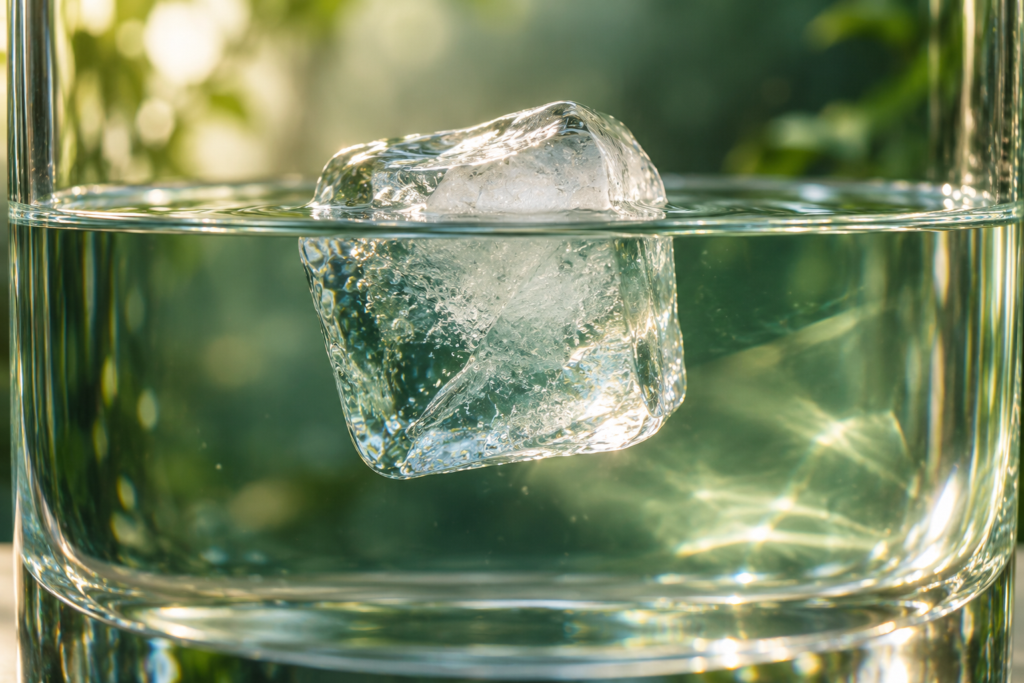
An ice cube seems solid and substantial, yet it rises to the top of a glass. A pebble dropped into the same water sinks. The difference is not simply that one object feels harder or colder.
To explain the cube, we need two connected ideas: why ordinary ice has a lower density than water, and how a liquid supports an object that displaces it.
Density compares mass with the space it occupies
Density is mass divided by volume. It tells us how much material is packed into a given amount of space.
A large block can have a lower density than a much smaller stone. Size alone does not tell us which will float.
The U.S. Geological Survey’s guide to water density identifies ordinary ice as less dense than liquid water. For the same mass, ice occupies a larger volume.
Imagine equal-size containers, one holding compactly arranged objects and the other holding the same kind of objects in an open arrangement. The second container holds less mass. This comparison illustrates the role of spacing, although actual water molecules are not loose objects stacked by hand.
Hydrogen bonds favor an open crystal structure
A water molecule contains two hydrogen atoms and one oxygen atom. Attractions between neighboring molecules, called hydrogen bonds, help organize them.
In familiar ice, the arrangement is relatively open. In liquid water, the molecular network continually changes, allowing molecules to pack more closely on average.
The European Commission’s explanation of floating ice describes how the geometry and flexibility of hydrogen bonds contribute to this difference.
The molecules do not become larger individual balloons when they freeze. It is their collective arrangement that changes the volume occupied by a given amount of water.
A familiar exception to the usual cooling pattern
Many materials contract as they cool and become denser when they solidify. Water behaves unusually near its freezing point.
At ordinary pressure, pure liquid water reaches its greatest density near 4°C. Cooling it further begins to reduce its density, and freezing produces an additional expansion.
The International Association for the Properties of Water and Steam explains that freezing increases the volume by about nine percent under familiar conditions.
This is why a rigid container filled completely with water can be damaged when that water freezes. The change involves increased volume, not the creation of extra water molecules.
Floating happens when upward buoyancy balances weight
Water exerts pressure on an immersed object. The combined pressure produces an upward buoyant force equal to the weight of the displaced water.
As an ice cube sinks farther into the water, it displaces more liquid. Because ice is less dense, the displaced water can weigh as much as the whole cube before the cube is completely submerged.
At that point, the upward force can balance the cube’s weight. The cube floats rather than continuing downward.
The U.S. Coast Guard’s explanation of iceberg buoyancy applies this principle at a much larger scale. A floating cube and a floating iceberg obey the same basic balance of forces.
The weight of the ice
Gravity acts on the whole floating object.
The buoyant force
Displaced liquid determines the upward support.
The density difference is significant, but not enormous
Ordinary ice is only moderately less dense than liquid water. A floating piece therefore needs to displace a substantial volume of water to balance its weight.
That is why most of it remains below the surface. In common conditions, roughly nine tenths of the volume may be submerged, although the exact fraction depends on the densities involved.
Salinity, temperature, and air trapped in the ice can affect the comparison. A seawater iceberg and a clear cube in freshwater need not have precisely the same exposed fraction.
The visible tip is therefore only part of the object. Its shape above the surface cannot reliably reveal the full outline beneath it.
A surface layer can separate cold air from liquid water below
Because ice floats, freezing commonly creates a cover at the surface of a lake rather than a pile of ice sinking to the bottom.
That cover can slow the loss of heat from the water underneath. Liquid water may remain below it, providing habitat through winter.
OpenStax’s account of water’s properties connects the lower density of ice with its ecological importance.
This does not mean every pond is protected from freezing solid. Depth, climate, duration of cold, snow, and other conditions matter. Floating ice changes the thermal situation without guaranteeing the same outcome in every body of water.
The comparison depends on both the ice and the surrounding liquid
Floating is a relationship between densities. Changing the surrounding fluid can change the result, even if the object itself stays the same.
There are also forms of ice produced under high pressures whose structures differ from familiar freezer ice. The everyday explanation concerns ordinary ice in ordinary liquid water.
An additional example is heavy-water ice, discussed by the USGS. Changing the isotopic composition can change the density enough to produce a different floating behavior in ordinary water.
These examples do not undermine the familiar rule. They show why specifying the material and conditions makes a scientific explanation more precise.
Frequently asked questions
Does an iceberg float because it contains air?
Air can affect density, but ordinary pure ice is already less dense than liquid water. Air is not required for the basic effect.
Does freezing create more mass?
No. The same water can occupy more volume without gaining mass.
Is surface tension holding up the cube?
For an ordinary floating cube, buoyancy is the main explanation. Surface tension is a different effect.