
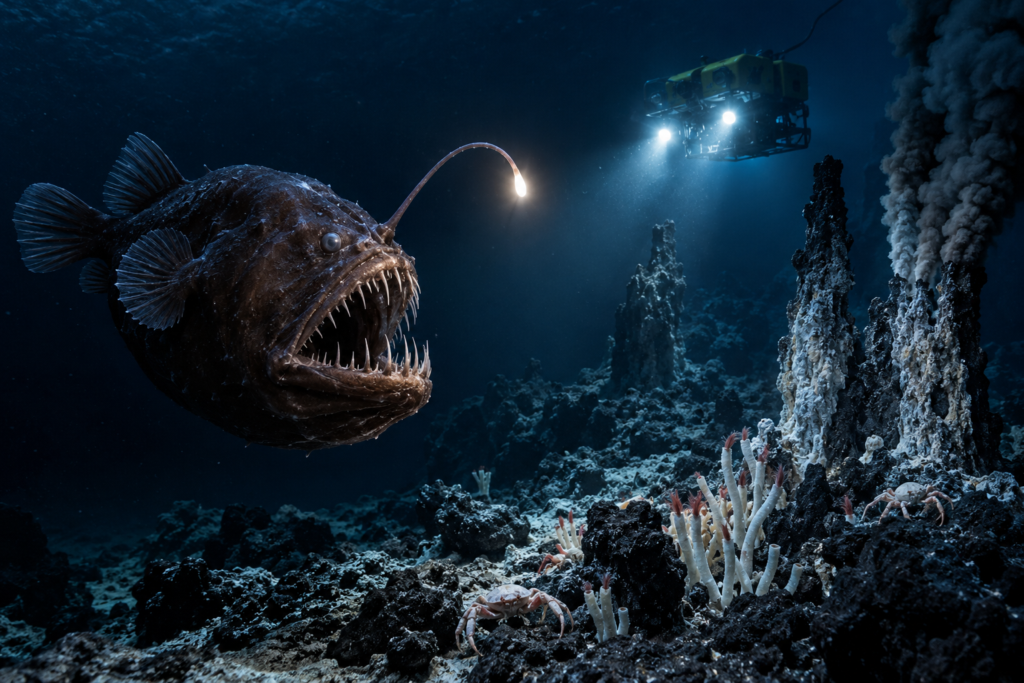
Lower a camera into the ocean, and the familiar world gradually disappears. Sunlight fades, pressure rises, and the scenery becomes increasingly difficult for humans to visit.
But darkness does not mean emptiness. The deep ocean contains landscapes, food webs, and organisms whose lives unfold under conditions very different from those at the surface.
Understanding what lives there starts with an important distinction: the deep sea is not one uniform place. A broad abyssal plain and the bottom of a narrow ocean trench are different environments, even though both lie far beyond sunlight.
The deepest trenches reach almost eleven kilometers down
Challenger Deep, in the Mariana Trench of the western Pacific, is the deepest known part of the ocean. Its depth is approximately 10.9 kilometers, or about 6.8 miles.
Exact published measurements vary because locating and measuring the deepest point requires careful surveying and corrections. “About eleven kilometers” communicates the scale without suggesting that every estimate is identical.
Scientists divide the ocean into depth zones. Boundaries can vary somewhat between classifications, but a common scheme places the abyssal zone around 4,000 to 6,000 meters and the hadal zone below approximately 6,000 meters.
| Zone | Approximate depth | Typical setting |
|---|---|---|
| Abyssal | 4,000–6,000 meters | Extensive deep seafloor and surrounding waters. |
| Hadal | Below about 6,000 meters | Ocean trenches and other exceptionally deep areas. |
These labels describe broad depth ranges, not perfectly identical habitats. Conditions also depend on location, geology, currents, and the supply of organic material.
The bottom is a landscape, not a bottomless hole
The ocean floor includes broad plains, ridges, mountains, slopes, and trenches. Some regions are covered by fine sediment, while others expose rock.
Abyssal plains can look relatively level at large scales. Trenches descend into elongated depressions, with slopes leading toward their deeper floors.
Sediment accumulates as material settles through the water or moves downslope. The resulting seafloor is an environment in which organisms can live on the surface or within the sediment.
A camera view of mud may therefore hide more biological activity than it reveals. Not everything important is large enough to recognize in a passing video.
Life faces darkness, low temperatures, and enormous pressure
Sunlight does not reach the abyssal plains or hadal trenches. Organisms there cannot rely on sunlight arriving from above to see their immediate surroundings or support local photosynthesis.
Deep water is generally cold, often only a few degrees above freezing. Hydrothermal environments create important local exceptions, but they do not make the entire deep ocean hot.
Pressure increases by roughly one atmosphere for every ten meters of seawater. At the greatest depths, it exceeds a thousand times atmospheric pressure at sea level.
That pressure affects biological processes as well as equipment. Deep-living organisms require adaptations involving their cells, membranes, proteins, and body structures.
Keeping pressure outside
A crewed submersible needs a carefully engineered space that protects its occupants.
Functioning at ambient pressure
Animals living at depth operate under the pressure of their environment rather than inside a human-style cabin.
Microbes and specialized animals inhabit the depths
The answer to “What lives down there?” changes with depth and location. Not every deep-sea animal can survive in the deepest trench.
Microorganisms inhabit deep water and sediments, where they participate in the processing of organic matter and chemical substances.
Hadal environments also support animals such as amphipods, small crustaceans that can act as scavengers. Sea cucumbers and other invertebrates occur in particular deep habitats.
Their presence does not mean the same community extends uninterrupted from the continental slope to Challenger Deep. Species have different environmental limits and distributions.
Fish reach remarkable depths, but not every depth
Researchers reported filming a snailfish at 8,336 meters in the Izu-Ogasawara Trench. That observation demonstrates an extraordinary capability, but it is still far above the deepest seafloor.
It is therefore misleading to picture familiar deep-sea fish swimming at the bottom of every trench. A record for one group of animals does not define the limits of all ocean life.
Much of the food begins its journey near the surface
Without sunlight at these depths, ordinary photosynthesis cannot supply food locally. Yet organic material can sink from the productive waters above.
Scientists call this falling mixture marine snow. It includes dead plankton, waste, and other organic particles. As it sinks, organisms consume and transform it.
Larger remains can also deliver food to the seafloor. This connects deep communities with events occurring far above them.
The connection is important: a habitat can be beyond sunlight without being independent of surface ecosystems.
Some communities use chemical energy
At hydrothermal vents and cold seeps, certain microorganisms use energy from chemical reactions to produce organic matter. This process is called chemosynthesis.
These microorganisms can support distinctive food webs. However, vents and seeps are particular environments, not a description of the entire deep seafloor.
Scientists use instruments as well as cameras
Exploring the deep ocean requires more than shining a light into the water. Researchers need to locate features, measure conditions, and collect evidence.
Different tools answer different questions:
- Sonar mapping. Sound measurements help reveal the shape and depth of the seafloor.
- Robotic vehicles. Equipped vehicles can carry cameras, sensors, and sampling equipment.
- Free-falling landers. Instruments can descend to the seabed to record conditions or observe visiting animals.
- Water and sediment samples. Laboratory analysis can reveal organisms and chemistry that video cannot identify.
Each method has limits. A camera might observe an animal without obtaining a specimen. A sample might contain biological evidence without showing how the organism behaves.
Combining methods produces a fuller picture than treating one dramatic dive as a complete survey of an ecosystem.
Human influence reaches even remote trenches
Depth does not isolate these habitats from everything happening above. Materials can travel through ocean systems, including human-made pollutants.
A study of amphipods from six Pacific trenches documented ingested microplastics and synthetic particles. It showed that such material was available to animals in exceptionally deep environments.
Woods Hole Oceanographic Institution also describes a hadal amphipod whose analysis revealed a plastic microfiber in its gut. Researchers named the species Eurythenes plasticus to draw attention to the issue.
These findings do not mean every trench has identical contamination. They demonstrate that remoteness and depth are not guarantees of protection.
Frequently asked questions
Is the deepest ocean completely empty?
No. Deep trenches contain microbial life and specialized animals. The organisms present vary with the location, depth, and habitat.
Do fish live at the bottom of Challenger Deep?
Fish have been observed at extraordinary depths, but the reported 8,336-meter snailfish observation is well above Challenger Deep. Other forms of life can occupy depths beyond documented fish observations.
Are hydrothermal vents found everywhere down there?
No. They occur in particular geological settings. Much of the deep seafloor depends on other food supplies, including organic material arriving from above.
Is every deep-sea animal bioluminescent?
No. Producing light is one adaptation found among some marine organisms, not a universal feature of animals living in darkness.
Does the lack of sunlight mean there is no oxygen?
No. Sunlight and dissolved oxygen are different environmental factors. Deep-water oxygen conditions depend on circulation and biological processes, not simply whether light reaches a particular depth.