
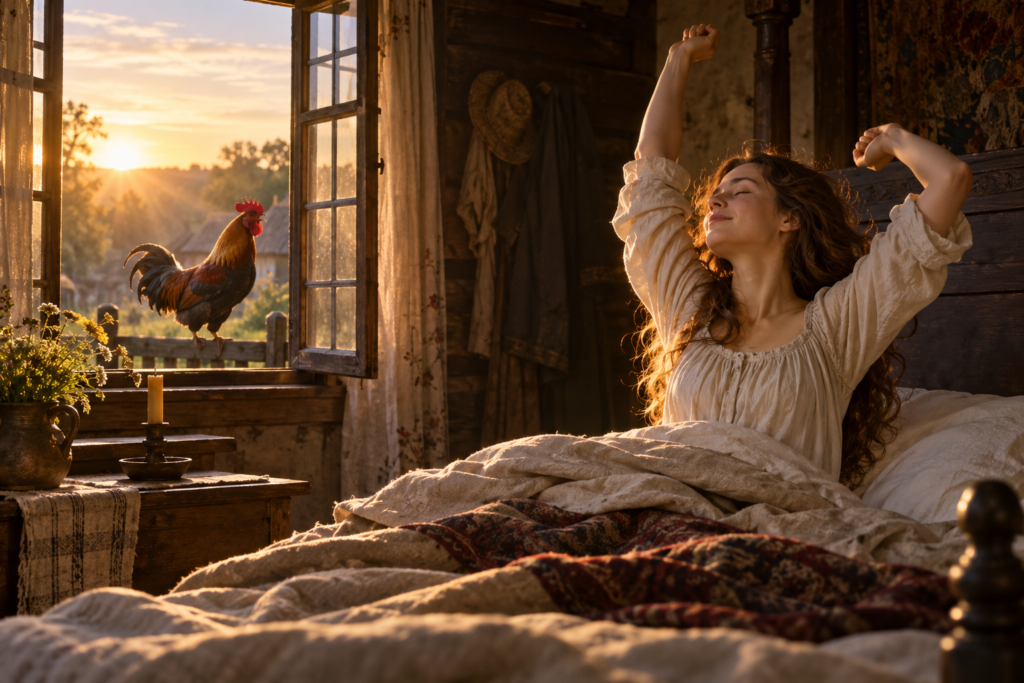
Setting an alarm takes only a few seconds. You choose a time, put the phone down, and expect a sound to interrupt your sleep the next morning.
Without that familiar convenience, waking for an early shift or a journey sounds surprisingly difficult. Did people simply trust themselves to open their eyes at the right moment?
Sometimes natural waking helped, but history offers a much broader answer. Waking was often connected to other people, shared sounds, and local routines. The question also needs a distinction: life before smartphone alarms was not necessarily life before mechanical alarms.
The answer depends on where and when someone lived
A farmer, a monastery resident, and a nineteenth-century factory worker did not necessarily need the same waking arrangement. Their obligations, surroundings, and access to equipment differed.
Even the phrase “before alarm clocks” covers several situations. Someone might live before a particular alarm mechanism existed, before it became affordable, or simply without owning one.
These situations should not be merged into a single period when everyone followed the same routine. Historical technologies also overlapped: a person could pay for a wake-up service while other households already owned mechanical clocks.
A useful way to approach the question is therefore to ask what resources a particular person could use, rather than searching for one replacement for the modern phone.
Daylight and biological rhythms helped, but were not exact alarms
Humans have an internal timing system that helps regulate sleep and wakefulness. Its roughly twenty-four-hour rhythm is influenced by environmental cues, especially light and darkness.
This makes natural waking part of the explanation. A person with a regular routine may wake near a familiar time without an external sound. Daylight can also help signal the changing phase of the daily cycle.
However, the body clock is not a programmable timer. It does not guarantee that someone will wake at an unfamiliar hour, particularly after disrupted or insufficient sleep.
Sunrise also changes through the year. A schedule tied to first light is different from a commitment to the same clock time every morning.
That distinction matters when imagining a winter worker who must leave before dawn. “They woke with the Sun” cannot explain every historical obligation.
Waking could be a shared responsibility
An alarm does not have to be a machine. Another person can provide the same immediate function: noticing the time and interrupting someone’s sleep.
Think of a household in which one person is already awake. Waking someone else requires no additional clock in the second person’s room. This illustrates why access to timekeeping and personal ownership are different questions.
Audible signals could also communicate time beyond the household. A bell can reach people who cannot see the clock connected to it.
Surviving historical clocks demonstrate this public role. The National Trust’s description of the Cotehele turret clock, for example, explains that it tells time by striking a bell.
Such a signal supplies shared information, although hearing it depends on location and circumstances. A public clock striking does not prove that every sleeping resident woke at the intended moment.
Some workers paid a person to wake them
One of the most memorable solutions was the knocker-upper, a professional wake-up caller associated with industrial Britain.
Customers arranged to be awakened, and the caller visited their homes. Long poles allowed tapping on upstairs windows without entering the building.
The service addressed a practical problem: a worker needed an external interruption at a particular time, even without a personal alarm clock.
Mary Smith, a well-known East London example, used a pea shooter to send dried peas toward customers’ windows. Historical photographs helped preserve this unusual method in public memory.
A device follows the setting
You choose a time, and a mechanism or application produces the alert.
A person follows an arrangement
You agree on a wake-up time, and someone visits to get your attention.
It was not a universal occupation found in every society. Its importance lies in showing how waking could become a paid local service.
People had timekeeping tools before modern alarms
Mechanical bedside clocks belong to a much longer history of measuring intervals and marking time.
Museum collections preserve water clocks, sand timers, and other devices that worked differently from a modern clock face. Candle clocks measured time through the progress of a burning candle.
The Royal Society discusses a historical candle-based alarm proposal in which a candle’s measured burning provided the timing mechanism. Such examples show experimentation, not necessarily widespread everyday use.
There is an important distinction between measuring time and waking someone. A device that displays an elapsed interval still needs a way to attract a sleeper’s attention.
| Resource | What it could provide | Important limitation |
|---|---|---|
| Daylight | An environmental cue. | Its timing changes seasonally. |
| A striking clock | An audible time signal. | It must be audible to the sleeper. |
| A household member | A personal wake-up call. | Someone else must already be awake. |
| A knocker-upper | A scheduled visit. | The service must be locally available. |
| An interval-measuring device | A way to track passing time. | Measurement alone does not guarantee an alarm. |
“On time” did not always mean an exact minute
Consider the difference between “begin at first light” and “arrive at 5:45.” Both establish an expectation, but they require different kinds of information.
One refers to an observable condition. The other relies on a shared clock system and a sufficiently precise wake-up arrangement.
This does not mean earlier societies lacked deadlines or that nobody cared about lateness. It means we should investigate what a particular obligation actually required.
The knocker-upper is especially revealing here: the service makes sense in a setting where starting times matter but a personal alarm is not the chosen solution.
Historical waking practices are therefore also about work, access, and coordination—not just ingenious gadgets.
Three assumptions to avoid
- “Everyone naturally woke at sunrise.” Natural rhythms mattered, but they do not explain every schedule, season, or individual.
- “Human wake-up callers existed everywhere.” Knocker-uppers are a documented example from particular communities, not a universal stage of human history.
- “Alarm clocks appeared only with electricity.” Mechanical alarm devices existed before electric bedside clocks. Electricity changed the technology, not the basic idea of a timed alert.
Avoiding these assumptions produces a more realistic picture: people used whatever combination of routines, relationships, and technology their circumstances allowed.
Frequently asked questions
Did people really hire human alarm clocks?
Yes. Knocker-uppers provided paid wake-up calls in parts of Britain. They could tap windows using long poles, and Mary Smith became known for using a pea shooter.
Who woke the knocker-upper?
There is no single answer that applies to everyone in the occupation. A caller needed an arrangement compatible with early rounds, but one person’s routine should not be assumed for the entire profession.
Could people depend entirely on their body clocks?
Natural rhythms can support regular waking, but they are not precise programmable alarms. Unusual schedules and disrupted sleep make that distinction particularly important.
Were candle clocks the same as alarm clocks?
Not necessarily. Tracking a candle’s progress measures time; waking a sleeper requires an additional alerting mechanism. Historical designs should be evaluated individually.
Did people still oversleep?
No historical method made waking infallible. A routine, a caller, or a device could fail. These solutions addressed the problem rather than eliminating it completely.