
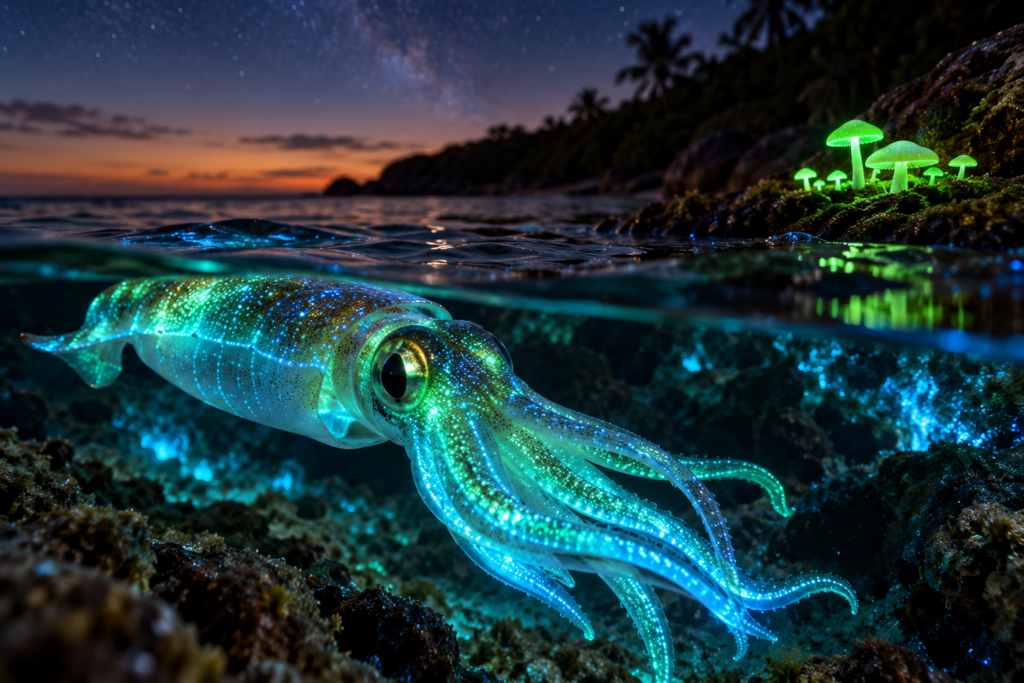
A firefly flashes above a field. A mushroom gives off a faint green glow. Far below the ocean’s surface, an animal produces a burst of blue light.
These scenes look almost magical, but their light comes from chemistry. Living organisms can convert chemical energy into visible light without becoming hot like the filament of an incandescent bulb.
The interesting question is not only how they do it, but why. A light that reveals an organism’s location might seem dangerous. Yet under the right conditions, producing light can help an organism survive or reproduce.
Bioluminescence turns chemical energy into light
Bioluminescence is a biological form of chemiluminescence: light produced by a chemical reaction. During the reaction, a molecule reaches an excited energy state. As it returns to a lower-energy state, it can release a photon.
Many systems involve a light-producing substance called a luciferin and an enzyme called a luciferase. Oxygen also participates in the familiar reactions described for organisms such as fireflies.
However, those names do not identify one universal chemical recipe. Different organisms use different molecules and mechanisms, and some systems involve specialized photoproteins.
The shared feature is the conversion of chemical energy into emitted light. The details vary across the living world.
Glowing life includes much more than fireflies
Fireflies are familiar examples, but bioluminescence occurs across several groups of organisms. These include certain bacteria, fungi, marine microorganisms, invertebrates, and fish.
It is especially widespread in marine environments. Some jellyfish, crustaceans, squid, and fish produce light or obtain it through associations with bacteria.
Certain microscopic marine organisms can flash when disturbed. When enough are present, their combined light can make moving water appear to sparkle at night.
On land, some fungi produce a greenish glow. Other terrestrial examples include particular beetles and the luminous larvae of certain insects.
These organisms do not all descend from one glowing ancestor that passed an identical mechanism to every group. Bioluminescence evolved independently multiple times.
Light can be a signal, a lure, or a defense
A biological feature can serve different functions in different species. There is no single answer that explains every glowing organism.
Finding a mate
Many fireflies use light in courtship. Flash patterns can help potential partners communicate and recognize appropriate signals. A flashing abdomen can therefore function as a message.
Attracting food
Certain deep-sea anglerfish carry a luminous lure near the mouth. The light can attract the attention of nearby prey. What looks like a point of interest becomes part of a feeding strategy.
Responding to danger
Some organisms release luminous material or produce flashes during encounters with predators. Depending on the species, the display can distract, startle, or complicate an attack.
Researchers distinguish between functions supported by experiments and those proposed from observations. Seeing an organism glow is not, by itself, proof of exactly what the light accomplishes.
Surprisingly, making light can help an animal disappear
Imagine looking upward underwater. Where faint daylight still reaches, an animal above you can appear as a dark silhouette against the brighter surface.
Some marine animals produce light along their undersides to reduce that contrast. This strategy is called counterillumination.
Instead of illuminating themselves brightly in every direction, they use light to better match the background seen from below.
A visible silhouette
An animal can block the faint light arriving from above.
Less contrast
Light from the underside can make the outline harder to detect.
This works in a particular viewing situation. It does not mean that glowing makes every animal invisible from every direction, especially where no background daylight remains.
Sometimes the animal hosts the real light producers
A glowing animal does not necessarily perform the chemical reaction entirely with its own cells.
Some animals house bioluminescent bacteria in specialized structures. The bacteria provide light while receiving a suitable environment and resources from their host.
The Hawaiian bobtail squid is a well-known example of this kind of association. Bacterial light contributes to its camouflage strategy.
Certain anglerfish also host luminous bacteria in their lures. The visible result belongs to an interaction between organisms, rather than the fish acting alone.
Bioluminescence and fluorescence are different
An organism appearing bright under ultraviolet or blue illumination is not necessarily producing light through bioluminescence.
Fluorescence occurs when a substance absorbs incoming light and quickly emits light at a longer wavelength. It needs an excitation source.
Bioluminescence instead draws its light-producing energy from a chemical reaction. It does not need an external lamp to supply the excitation.
| Feature | Bioluminescence | Fluorescence |
|---|---|---|
| Energy source | A chemical reaction. | Absorbed light. |
| External illumination needed? | Not to power the light emission. | Yes, for excitation. |
| Possible example | A flashing firefly. | A coral fluorescing under suitable illumination. |
The distinction can become more interesting: an organism can combine bioluminescent and fluorescent components. Chemically generated light can interact with a fluorescent protein before the final color emerges.
The chemistry and environment influence the color
Different light-producing systems release photons with different energies. That helps determine whether the glow appears blue, green, yellow, or another color.
Blue and blue-green bioluminescence are common in the ocean, where those wavelengths generally travel effectively through seawater. Other colors, including red, also occur.
Firefly light can appear yellow-green or other shades, while many luminous fungi produce green light. There is no rule that all living light must be blue.
Why does the glow stand out at night?
Visibility depends on contrast. A faint light is easier to notice against a dark background than in bright daylight.
That does not mean darkness automatically switches on every luminous organism. Some systems flash in response to particular conditions, while others follow different patterns.
Describing the trigger therefore requires knowing the species. The same explanation should not be applied indiscriminately to a firefly, a fungus, and a marine microorganism.
Frequently asked questions
Do bioluminescent organisms need sunlight to recharge?
Not in the way a glow-in-the-dark object may store energy from illumination. Bioluminescence depends on chemical reactions and the resources required to maintain them.
Does every jellyfish produce its own light?
No. Bioluminescence is not universal among jellyfish. Some species produce light, while fluorescence is another property that should be distinguished from it.
Why do some waves glow blue?
Dense populations of certain bioluminescent microorganisms can produce visible flashes when the water is disturbed. The light comes from organisms, not from seawater itself.
Is every glowing mushroom attracting insects?
That should not be assumed. Proposed functions need evidence for the species being studied. Discovering a glow and demonstrating its ecological role are different research questions.
Does producing light always make an organism easier to find?
Not necessarily. Light can attract attention, distract an attacker, or reduce contrast through counterillumination. Its effect depends on the observer and situation.