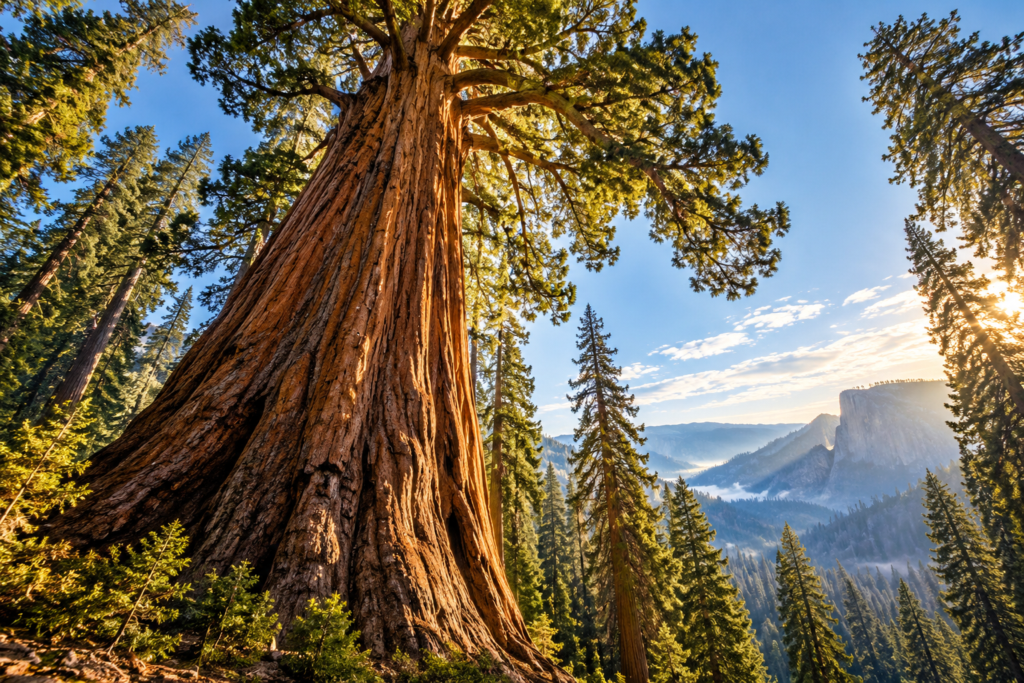
Look up into the crown of a giant tree and consider the journey a drop of soil water must make. It may travel through roots, ascend a towering trunk, enter a branch, and finally reach a leaf dozens of meters above the ground.
Gravity opposes that journey. The narrow pathways inside the wood also resist flow. Yet a healthy tree can continuously supply its upper foliage when conditions allow.
The explanation combines evaporation, molecular attraction, and specialized anatomy. Surprisingly, much of the driving force begins near the top of the tree rather than at its base.
The tree contains a network of water-conducting pathways
Water moves through tissue called xylem. Depending on the species, its conducting cells include tracheids, vessel elements, or both.
Many of these cells are dead at maturity. Their reinforced walls remain, forming pathways through which water can move. Openings and connections allow movement between neighboring parts of the network.
This is not one hollow pipe extending uninterrupted from root to leaf. It is a branching system built from many microscopic structures.
In a woody trunk, the active water-conducting region is generally associated with the sapwood. The central heartwood of many species no longer performs the same transport role.
Evaporation from leaves helps pull water upward
Leaves contain small pores called stomata. These openings allow gases to move between internal leaf spaces and the surrounding air.
Water evaporates from moist surfaces inside the leaf, and water vapor can escape through the stomata. This loss is called transpiration.
As evaporation draws water from those surfaces, it creates tension that is transmitted through connected water in the xylem. More water moves toward the leaf, drawing on supplies from lower parts of the plant.
The process links the atmosphere, leaves, trunk, roots, and soil. Conditions at one end of that pathway can influence flow elsewhere.
A useful starting picture is a continuous supply line responding to water loss at its upper end. However, the actual network contains branches, storage, and resistance rather than behaving like a perfect rigid tube.
Water molecules transmit the tension
Water molecules attract one another through hydrogen bonding. This attraction, called cohesion, helps liquid water transmit tension through the xylem.
Water also interacts with the walls of the conducting pathways. This attraction to other surfaces is called adhesion.
Together with the tree’s anatomy, these properties allow water to remain connected while being pulled under negative pressure.
Evaporation creates demand
Water loss produces tension and draws replacement water toward the foliage.
Cohesion transmits the pull
Attraction between water molecules helps connect the movement along the transport pathway.
Capillary action is relevant to water in narrow spaces, but saying “the tree works like a paper towel” is incomplete. Capillarity alone does not explain the sustained supply to the crowns of the tallest trees.
Roots supply water, but do not push it all the way up
Water enters roots along differences in water potential, a measure that incorporates several influences on water movement. It then reaches the root’s conducting tissue.
The availability of soil water matters. Water held tightly in drying soil becomes harder for the plant to obtain, even if some moisture remains present.
Roots are living structures that regulate transport and interact with their surroundings. They are not simply open drinking straws inserted into the ground.
Some plants can develop positive root pressure under suitable conditions. However, root pressure is not the main explanation for lifting water into the highest leaves of giant trees.
Nor does the tree contain a pump repeatedly squeezing its trunk. Its energy use supports growth, regulation, and other processes, while transpiration provides the main physical driving mechanism described here.
Leaves balance access to carbon dioxide against water loss
Opening stomata helps carbon dioxide enter a leaf for photosynthesis. The same openings also allow water vapor to leave.
A tree therefore faces a trade-off. Keeping stomata open can support photosynthesis, but it can increase water loss when the air is dry.
Guard cells regulate the openings. Their responses depend on signals and environmental conditions, rather than following one identical schedule in every species.
| Factor | Why it matters |
|---|---|
| Soil moisture | Determines how accessible the water supply is. |
| Atmospheric dryness | Influences the demand for water leaving the leaves. |
| Stomatal opening | Regulates gas exchange and water loss. |
| Transport anatomy | Affects resistance and vulnerability to disruption. |
Water stored in tissues can also buffer short-term differences between root uptake and loss from the crown. A tree is a dynamic reservoir as well as a transport network.
Getting taller makes the hydraulic challenge harder
Greater height increases the gravitational cost of moving water upward. A longer pathway also adds resistance to flow.
Water near the top can therefore experience greater tension. If gas enters or forms within conducting pathways, it can interrupt transport. Gas blockage is commonly described as an embolism.
Trees have anatomical features that help contain or tolerate such problems, but their transport systems are not invulnerable.
Research on tall coast redwoods found that increasing water stress associated with height could constrain leaf expansion and photosynthesis, even when the soil supplied ample moisture.
Water transport is therefore part of the explanation for why trees cannot simply keep growing upward without limit. Height must be supported physiologically as well as structurally.
Frequently asked questions
Does a tree pump water like a heart?
No. The main mechanism in tall trees relies on transpiration-generated tension, water cohesion, and the xylem network. It does not require a central beating pump.
Does all the water stay inside the leaves?
No. Water serves important biological functions, but much of the water moving through a transpiring plant eventually leaves as vapor.
Is the entire trunk actively carrying water?
Not necessarily. In many woody trees, sapwood performs active water transport, while older central heartwood has a different role.
Does water always move at the same speed?
No. Flow changes with environmental demand, water availability, regulation, and the characteristics of the transport network.