
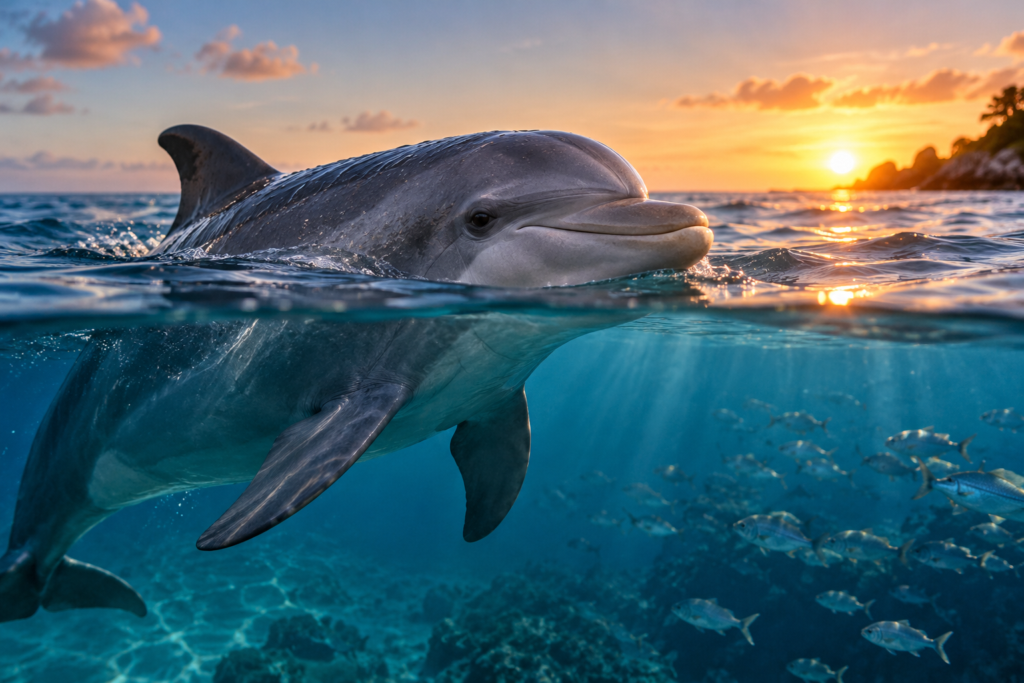
A dolphin keeps swimming. A bird remains airborne over the ocean. A jellyfish continues pulsing through the night. To a casual observer, these animals might look permanently awake.
But movement is not a universal test of wakefulness. Neither are closed eyes, lying down, or finding a quiet place to rest.
Asking whether an animal sleeps therefore requires more than watching for a human-style bedtime. Scientists first need to define what sleep looks like in that species and decide how to measure it.
Sleep cannot be defined by appearance alone
In mammals and birds, recordings of brain activity help identify sleep states. Researchers can combine these measurements with observations of movement and behavior.
For other animals, scientists often use behavioral criteria. They look for a reversible state of reduced activity, a reduced response to ordinary stimulation, and evidence of increased sleep after the state has been disrupted.
These features help distinguish sleep from simple inactivity. An animal standing still may be alert, while another showing some movement may be asleep.
Reversibility also matters. Sleep should not be confused with paralysis or a state from which an animal cannot readily recover.
Dolphins can sleep with one hemisphere at a time
Dolphins provide a clear example of why continuous activity does not prove continuous wakefulness. They can exhibit unihemispheric slow-wave sleep.
In this state, one cerebral hemisphere shows sleep-related activity while the other remains relatively wakeful. This permits a combination of sleep and ongoing behavioral functions.
Researchers have shown that dolphins can maintain an echolocation-based vigilance task for extended periods. In one study, a dolphin performed a fifteen-day testing session without a significant decline in performance.
The striking result does not mean the dolphin remained entirely sleepless. Unihemispheric sleep is part of the explanation for how extended vigilance may be possible.
It is better to say that dolphins can combine sleep with certain forms of activity than to describe them as animals that never sleep.
Some birds can sleep without landing
A long flight creates an obvious question: must a bird remain awake until it returns to land?
Researchers studying great frigatebirds recorded brain activity during flights over the ocean. They found that the birds could sleep while airborne.
The recordings revealed sleep involving one hemisphere at a time and, during some episodes, both hemispheres. Flight therefore did not imply uninterrupted wakefulness.
The bird remains in flight
A distant observer might assume that being airborne means staying fully awake.
Sleep occurs during the journey
Direct recordings reveal states that behavior alone cannot establish.
This finding should not be extended automatically to every bird species or every kind of flight. Evidence from one animal answers a specific research question, not all related questions at once.
Some animals temporarily sacrifice much of their sleep
Sleep amount can vary with circumstances. Breeding, migration, and environmental demands can produce unusual patterns in particular species.
Male pectoral sandpipers have been studied during their intense Arctic breeding period. Some remained active for as much as ninety-five percent of the time across a period of roughly three weeks.
Researchers linked reduced sleep with reproductive success in that setting. The birds could maintain demanding behavior despite sharply reducing sleep.
However, temporary reduction is not lifelong elimination. Nor does an animal’s adaptation establish what would be safe or useful for a human.
The context matters as much as the number of sleeping hours. A seasonal strategy should be described with its limits intact.
Even animals without a centralized brain can show sleep-like states
It might seem that sleep requires a complex brain. Research on simpler nervous systems challenges that assumption.
Scientists studying the upside-down jellyfish Cassiopea identified a sleep-like state. Its activity decreased, responsiveness changed, and disrupting the state produced subsequent changes consistent with sleep regulation.
Researchers have also described sleep-like behavior in Hydra, a small freshwater animal with a nerve net rather than a centralized brain.
These findings are important because they suggest that fundamental features of sleep may have deep evolutionary roots.
They do not imply that a jellyfish experiences sleep exactly as a person does. Shared criteria and identical subjective experiences are different claims.
Proving that an animal never sleeps is unusually difficult
To demonstrate complete absence, researchers would need confidence that their methods could detect whatever form sleep takes in the species.
Brief episodes, partial-brain sleep, and unfamiliar behavior can all complicate observation. Limited monitoring adds another problem: not seeing sleep during a short study does not establish its absence over a lifetime.
| Observation | What it cannot establish alone |
|---|---|
| The animal keeps moving. | That its entire brain remains awake. |
| Very little sleep is measured. | That sleep is completely unnecessary. |
| No sleep is detected during a study. | That the species never sleeps under any conditions. |
| The animal lacks a centralized brain. | That sleep-like states cannot occur. |
The careful answer is therefore not a confident list of supposedly sleepless animals. It is that sleep has more forms and more flexibility than human bedtime suggests.
The question also depends on the animal being studied
Animals differ enormously in nervous-system organization. Criteria designed for mammals cannot simply be imposed on every organism without considering whether they make biological sense.
That leaves genuine open questions. Uncertainty is not proof that a species never sleeps, but it also should not be replaced by an unsupported claim that every animal has identical needs.
Frequently asked questions
Do dolphins ever sleep?
Yes. Their unihemispheric sleep allows one cerebral hemisphere to show sleep-related activity while the other remains relatively wakeful.
Can a bird sleep while flying?
Yes. Brain recordings have demonstrated sleep during flight in great frigatebirds. This does not establish the same behavior in all birds.
Does sleep require closed eyes?
No. Eye appearance is not a universal diagnostic test. Researchers use species-appropriate behavioral or physiological measurements.
Does a jellyfish sleep exactly like a human?
No. A sleep-like state can meet important behavioral criteria without reproducing all the features of human sleep.
Can humans copy these low-sleep adaptations?
Findings about another species do not show that humans can safely adopt its sleep pattern. Evolutionary adaptations are specific to the animals involved.