
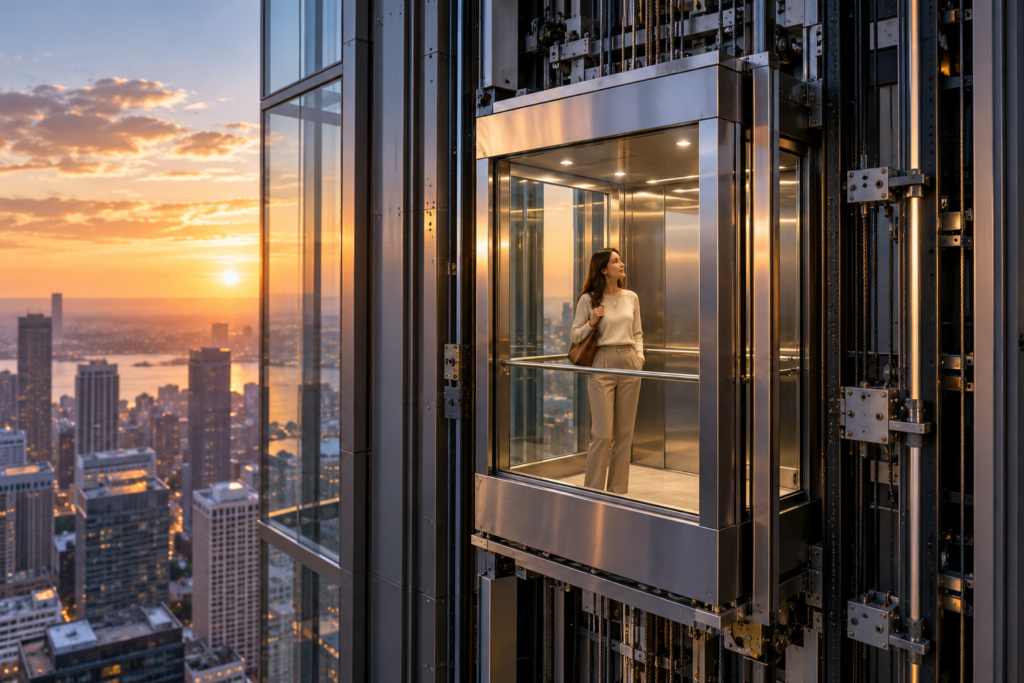
You press the button for the seventh floor. The elevator accelerates, passes several landings, slows down, and opens its doors with the floor almost perfectly aligned.
That sequence looks simple from inside the car. Behind it, several systems answer different questions: where should the elevator go, where is it now, how fast is it moving, and when should it begin slowing?
The elevator does not simply run its motor for a fixed number of seconds and hope to arrive. Modern systems use measured information and coordinated control.
The button tells the system what you want
Pressing a floor button creates an input for the control system. A controller records the request and decides how it fits into the elevator’s current work.
A conventional landing button usually tells the system that someone wants to travel up or down. A button inside the car identifies a destination floor.
Some buildings use destination control instead. Passengers select their floor before entering, and the system assigns a particular elevator.
In either arrangement, requesting a floor and physically locating the car are separate tasks. The controller needs both kinds of information.
Position sensors give the controller a reference
Elevators use different combinations of equipment to determine position and movement. There is no single sensor arrangement shared by every installation.
Some systems detect markers placed at known locations in the shaft. Others read a coded strip or tape that provides position information along the travel path.
An absolute positioning system can identify a location from a unique code rather than relying only on counting movement from a previous reference.
For example, manufacturer Kübler describes elevator positioning equipment that reads a coded band mounted in the shaft. Its position measurement does not depend on traction-cable movement alone.
Other measurements, including encoder signals, can provide information about motor rotation, speed, or travel. What a particular encoder measures depends on where and how it is installed.
How is the system moving?
Encoder and drive feedback can help track motion and control speed.
Where is the car?
Shaft references or position sensors relate the car’s location to the building.
The controller must begin slowing before the target floor
An elevator traveling at speed cannot arrive comfortably by waiting until it reaches a floor and then stopping instantaneously.
It needs distance to reduce speed. The control system therefore coordinates a motion profile: acceleration, travel, deceleration, and a final approach.
Think of bringing a bicycle to a painted line. You begin braking before reaching it, adjusting your movement as the distance closes. An elevator performs an engineered version of controlled arrival.
In a modern traction elevator, the drive regulates the motor during this sequence. Hydraulic elevators use different machinery, including control of hydraulic flow, to manage movement.
The general principle remains the same: measured position and movement guide the approach. It is not merely an elapsed-time countdown.
Leveling is the precise final part of arrival
Getting close to the requested floor is not enough. The car floor must align closely with the landing to provide a usable threshold.
The final positioning process is called leveling. Depending on the system, dedicated landing information or continuous position measurements support this step.
Some elevators can also make controlled releveling adjustments when their position changes. Passenger loading and the mechanical behavior of the installation can influence alignment.
It is important to distinguish this normal positioning function from assuming that any visible mismatch is acceptable. A noticeable step at the threshold should be reported to building management.
| Stage | Purpose |
|---|---|
| Destination selection | Identify the floor to serve. |
| Position tracking | Determine where the car is during travel. |
| Deceleration | Reduce speed before reaching the landing. |
| Leveling | Bring the car into close alignment with the floor. |
| Holding and door operation | Maintain the required conditions for passenger transfer. |
The doors are coordinated with position and safety information
The controller also receives information about door-lock states and other operating conditions. These inputs are distinct from the passenger’s destination request.
Normal operation coordinates the car’s arrival with the conditions required for door opening. Exact sequences and permitted leveling behavior depend on the installation.
Doorway sensors perform another job: detecting an obstruction in the closing path. A light curtain can help prevent the doors from closing on a person, but it does not replace the equipment that locates the car in the shaft.
Otis’s overview of high-rise elevator safety systems describes controllers, sensors, software, and mechanical components as interacting parts of the installation.
Knowing where to stop is different from choosing the next stop
An elevator may know its exact position while still having several outstanding requests. Deciding their order is a dispatching problem.
A conventional system may serve requests while continuing in its current direction. A group controller can distribute calls among several cars.
Destination-control systems can group passengers traveling to similar floors. KONE describes this approach as a way to reduce unnecessary stops and manage passenger flow.
Imagine three people traveling to floors six, seven, and eight. Assigning them together might produce a different service pattern from assigning each to a separate car.
That example illustrates scheduling, not a universal rule used by every controller. Traffic conditions, access permissions, and the building’s configuration affect the actual decisions.
- Dispatching selects a service plan. It addresses which car should answer and which requests should be served.
- Motion control executes the journey. It manages the car’s movement toward the selected destination.
- Positioning confirms location. It supplies the information needed to approach and align with the landing.
Separating these jobs makes the apparently simple action of pressing a button much easier to understand.
Frequently asked questions
Does an elevator count the seconds between floors?
Modern elevators generally use position and movement feedback rather than relying only on a fixed travel time. Timing may contribute to control logic, but it is not the whole positioning system.
Does every elevator use magnets to identify floors?
No. Magnetic references are one possible method. Other systems use different sensors or coded positioning equipment.
Is the floor display the sensor?
No. The display presents information supplied by the system. Showing a floor number is different from measuring the car’s position.
Why might a car adjust its position after arrival?
Some systems use controlled releveling to maintain alignment. A noticeable or persistent mismatch should still be reported for inspection.