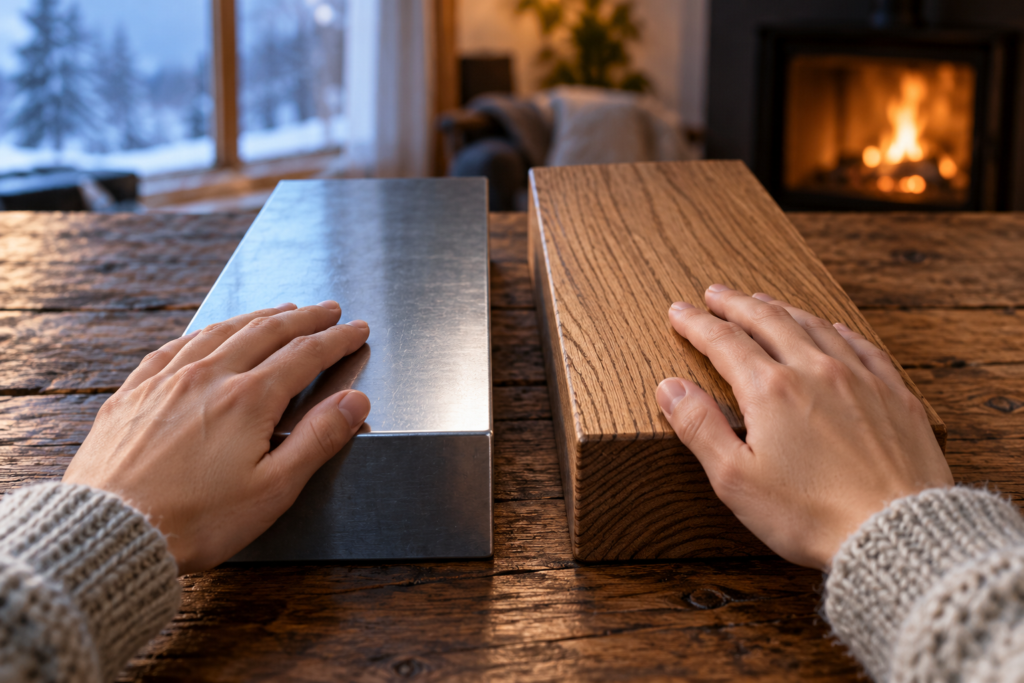
Touch a metal chair leg and then a wooden tabletop in the same room. The metal often feels distinctly colder, as though the two objects have been sitting in different environments.
A suitable temperature measurement can reveal that they are approximately equal in temperature. Your hand has detected a difference, but not necessarily the difference you assumed.
The explanation begins with a distinction between temperature and the transfer of heat. Touch puts your skin into a changing thermal interaction with the surface.
Temperature and heat transfer describe different things
Temperature describes a thermal condition. Heat is energy transferred because of a temperature difference.
If two objects have remained in a stable room long enough, without separate heating or cooling influences, they tend toward thermal equilibrium with their surroundings.
A metal object and a wooden object can therefore begin at similar temperatures despite feeling different.
Your hand changes the situation. If your skin is warmer, touching either object allows energy to flow from your hand into the material.
The American Physical Society’s metal-and-wood demonstration uses this contrast to distinguish measured temperature from perceived coldness.
Metal carries energy away from the contact area efficiently
Metals are generally good thermal conductors. Energy entering a cooler metal surface can spread into the surrounding material relatively quickly.
That redistribution helps the region touching your skin continue accepting heat. The surface does not simply warm locally and immediately end the exchange.
As energy leaves your skin, its temperature falls. Thermal sensory responses contribute to your perception of cold.
Notice the direction of transfer: the metal is not sending a substance called “cold” into your hand. Heat is leaving the warmer skin.
The University of Illinois explains the metal-versus-insulator contrast in terms of how readily the materials transfer heat during contact.
Wood limits the rate of heat flow
Wood is generally a much poorer thermal conductor than common metals. Its structure limits how rapidly energy spreads through it.
When you touch cooler wood, the small region near your fingers can warm without carrying that energy into the rest of the object as quickly.
Your skin consequently loses heat less rapidly than during comparable contact with metal. The wood feels warmer by comparison.
Faster energy transfer
Heat spreads efficiently away from the contact region, cooling the skin more rapidly.
Slower energy transfer
The contact region warms more readily while energy spreads into the material more slowly.
“Warmer to the touch” therefore does not require the untouched wood to have a higher starting temperature.
Conductivity matters, but it is not the only property
Thermal conductivity is the familiar starting explanation. A more complete account of brief contact also considers density and specific heat capacity.
These properties combine in a quantity called thermal effusivity. It helps describe how a material exchanges thermal energy with another material at their contact surface.
In a simplified model, a high-effusivity object has a stronger influence on the initial contact temperature than a low-effusivity object.
Research on the tactile warmth of wood examines this property in explaining contact sensations.
Real contact adds complications. Surface finish, coatings, moisture, pressure, and contact area can influence the exchange.
The effect can reverse when the object is hotter than your skin
The direction of heat flow depends on the temperature difference. Cooler metal removes energy from your hand; hotter metal transfers energy into it.
Its ability to transfer energy rapidly can therefore make hot metal feel especially hot. Metal does not possess a permanent tendency to feel cold.
This is one reason thermal sensation should not be treated as a material label. The same metal can feel cold, neutral, or hot under different conditions.
| Object compared with skin | Heat flow | Possible sensation |
|---|---|---|
| Cooler | From skin into the object. | Cold. |
| Similar temperature | Little initial net transfer. | Closer to thermally neutral. |
| Hotter | From the object into skin. | Hot. |
Do not test this by touching heated objects. A surface can cause injury before casual touch provides useful information.
A simple comparison makes the distinction easier to notice
Choose an ordinary metal object and a wooden object that have remained indoors in the same stable surroundings. Avoid anything recently heated, chilled, or exposed to direct sunlight.
Briefly touch both with similar parts of your hand. The metal will often feel cooler, provided the objects are below your skin temperature.
If you measure their temperatures, use an instrument and method suitable for the surfaces. Infrared readings from shiny metal can be misleading without accounting for surface properties.
The purpose is not to demonstrate that the senses are useless. Your hand is detecting a real difference in the interaction. The mistake is interpreting that sensation as a complete measurement of starting temperature.
Why the conditions matter
- Starting temperatures must be comparable. An object from a refrigerator is not a fair comparison with one from a warm room.
- Objects need time to equilibrate. Sharing a room does not immediately give them identical temperatures.
- External energy sources matter. Sunlight or a nearby heater can create genuine temperature differences.
- Geometry can affect the exchange. A tiny metal piece may warm differently from a large metal surface.
Controlling these factors helps isolate the material response from unrelated temperature differences.
Frequently asked questions
Is metal always colder than wood?
No. The materials can have the same temperature. Their different heat-transfer behavior can produce different sensations during contact.
Why does a tiled floor feel colder than a rug?
The same general principle applies. They can draw heat from your feet at different rates, even at similar starting temperatures.
Does wood produce heat when I touch it?
It does not need to produce heat to feel relatively warm. Slower heat loss from your skin is enough to explain the comparison.
Can I determine exact temperature by touch?
No. Sensation depends on contact conditions and your skin, not solely on the object’s temperature. Use an appropriate measuring instrument.
Why are some handles made from wood or plastic?
Their relatively low thermal conductivity can reduce heat transfer to the hand. Actual safety still depends on the handle’s design and operating conditions.