
Today, a message can cross an ocean before you put your phone down. For much of history, long-distance communication required a very different kind of journey.
Either someone or something carried the information, or a chain of observers passed a visible signal across the landscape. Each approach solved one problem while introducing others.
The story is not a simple progression from slow letters to instant electricity. Earlier systems could be highly organized, and several methods continued operating alongside newer technologies.
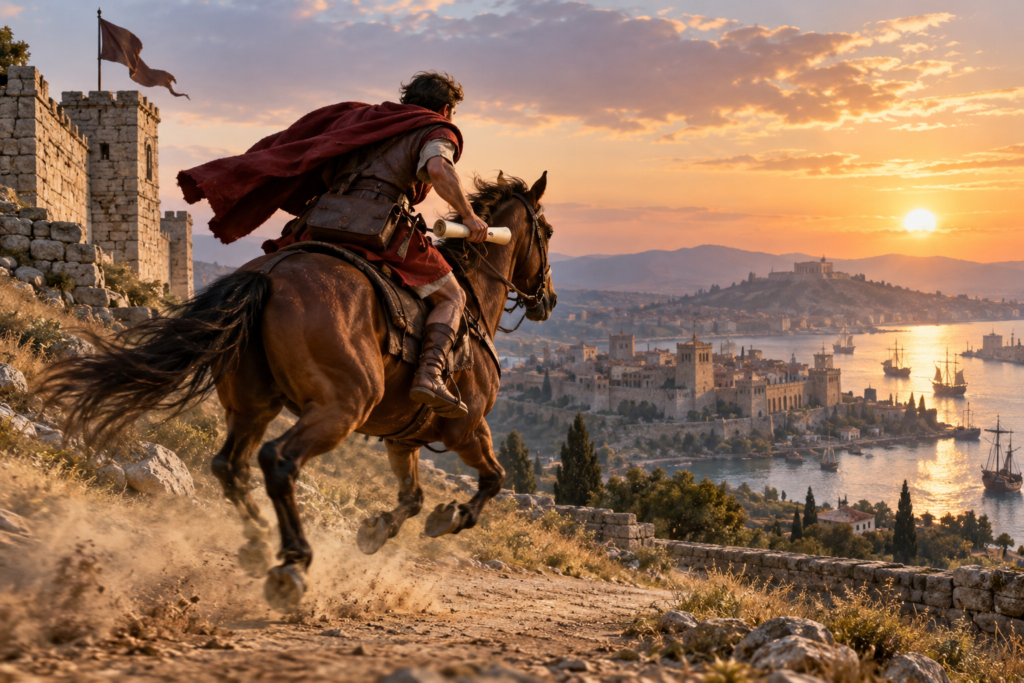
The simplest method was to send someone with the message
A messenger could carry spoken information, a written document, or an object whose meaning was understood by the recipient.
Written messages offered an important advantage: the recipient could inspect the recorded wording rather than relying entirely on someone’s memory.
But writing did not solve transportation. A letter still needed a route, a carrier, and a way to reach the intended destination.
Walking worked where other transport was unavailable. Horses could improve speed under suitable conditions. Roads, weather, terrain, and access all shaped the journey.
Relay systems let a message outlast one carrier’s endurance
A long-distance network did not always require one person to complete the entire route. Fresh messengers could take over at designated points.
The Inka road system provides a well-documented example. Runners called chaskis carried messages through an organized relay network.
The Smithsonian’s National Museum of the American Indian describes relay stations called chaskiwasis along the road system. Messages and goods could pass between runners.
The advantage comes from dividing the physical demand. One runner does not have to maintain the same pace across the full distance.
However, relays require organization. Stations, staffing, supplies, and route knowledge are infrastructure, even when no electrical wire is involved.
Postal systems turned individual journeys into regular services
An organized postal route could collect many letters and carry them together. Scheduled movement made communication more predictable than finding a separate traveler for every message.
In Britain, mounted post riders preceded the mail-coach network. The Science Museum Group dates the introduction of British mail coaches to 1784.
Coaches combined road transport with an organized service. They did not eliminate weather, road conditions, or the physical limits of travel.
Across water, ships carried correspondence. A distant recipient might need to wait for a departure, the voyage, and onward delivery.
This creates a useful distinction between travel time and total message delay. A letter could spend time waiting for transport before its main journey even began.
The carrier is moving
The message advances along a road or sea route.
The next stage is not ready
Collection schedules, connections, or departures add delay.
Homing pigeons carried messages toward a familiar home
A homing pigeon does not receive an arbitrary street address and decide where to deliver a letter.
The useful behavior is its ability to return toward its established loft. To send information there, people first transported the bird away from that home.
A small written message could then travel with the released pigeon. The destination depended on the bird’s home, not the sender choosing any location.
Museum accounts of messenger pigeons explain their later military use as well. The method continued after electric telegraphy existed, illustrating how communication technologies overlap.
Pigeons offered advantages in particular settings, but their routes and reliability still faced environmental and logistical limits.
Visible signals could move information without moving a letter
A messenger transports the physical message. A signaling network instead changes something visible and lets an observer interpret it.
Fires, flags, and other optical signals have appeared in different historical systems. Their usefulness depends on shared meanings and visibility.
A single signal might communicate a limited warning. A more elaborate code can represent a larger set of messages.
It is therefore misleading to assume every signal fire could transmit any sentence. The code and procedure determine the information it can carry.
| Method | Advantage | Limitation |
|---|---|---|
| Courier with a document | Can carry detailed written content. | Requires physical travel. |
| Relay network | Replaces tired carriers along a route. | Requires maintained stations and coordination. |
| Homing pigeon | Can carry a small message toward its loft. | Does not offer arbitrary destination selection. |
| Optical signaling | Can relay information without transporting a letter. | Depends on sight lines, conditions, and a shared code. |
Telegraphs existed before the electric telegraph
The word telegraph does not inherently mean an electrical instrument. Optical telegraphy transmitted information visually across a chain of stations.
Claude Chappe’s French system, developed in the 1790s, used movable structures whose positions represented coded information.
An operator observed the neighboring station and reproduced its signal. Repetition carried the information along the line.
The Smithsonian Libraries’ history of optical telegraphy places Chappe’s system decades before electric telegraph networks.
This approach could move information faster than a courier over an equipped route. But fog, darkness, terrain, and station placement constrained its operation.
Electric telegraphy changed the relationship between distance and delay
Electrical signaling allowed information to move along a connected line without a person, horse, or ship carrying it between each station.
It also removed the requirement for adjacent optical stations to see one another.
But sending an electrical signal was only part of delivering a message. Someone might still need to submit, encode, receive, transcribe, and physically deliver it.
The transformation was therefore substantial without instantly creating the direct, personal messaging experience familiar today.
- Transmission became separate from transport. The information no longer needed to accompany a vehicle across the connected route.
- Infrastructure remained essential. Lines, instruments, operators, and offices were necessary.
- Older methods remained useful. Physical delivery still served places and purposes outside the connected network.
The history of messaging is best understood as expanding options rather than one invention making every previous method disappear.
Frequently asked questions
Did every message require a traveler?
No. Optical signaling could relay information without physically transporting a written message along the whole route.
Could a pigeon deliver to any address?
No. Homing pigeons return toward a familiar loft. People had to organize their transport and release around that behavior.
Were postal services invented after the telegraph?
No. Organized carriage of correspondence long preceded electric telegraphy. British mail coaches, for example, began operating in 1784.
Was Chappe’s telegraph electrical?
No. It was an optical system that transmitted coded information through visible mechanical positions.
Did the electric telegraph eliminate letters?
No. Different communication methods continued serving different purposes. Fast transmission did not remove the need for physical documents or delivery.