
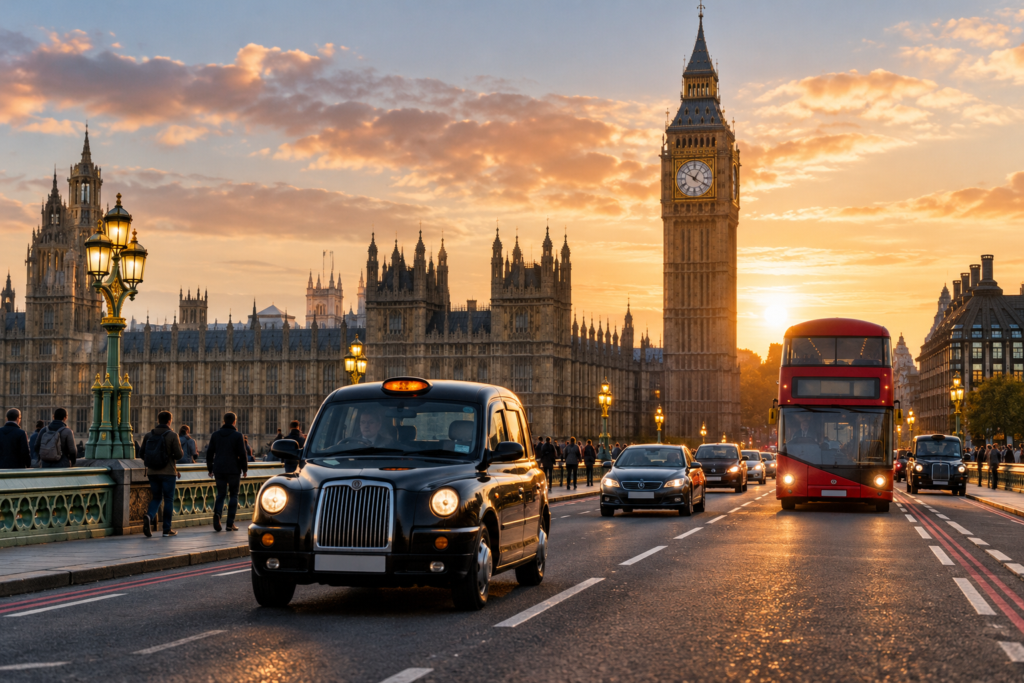
Arrive in a country that drives on the opposite side from home, and an ordinary road can suddenly require extra attention.
Vehicles approach from an unfamiliar direction, intersections look different, and the driver’s seat may be on the other side. Both systems can seem natural to the people who use them every day.
The difference is historical rather than a response to opposite physical laws. Understanding it means separating road customs, steering-wheel placement, and the difficulty of changing an established convention.
The choice of side is older than the automobile
People shared roads long before cars existed. Riders, carts, coaches, pedestrians, and animals needed ways to pass one another.
Local customs could develop without one national rule being enforced everywhere. Road width, surface condition, and the vehicles involved affected practical behavior.
As traffic increased, relying on individual negotiation became less workable. Standardized rules made the expected passing movement more predictable.
Motor vehicles inherited many existing arrangements rather than forcing every country to make a fresh choice.
The sword explanation is memorable, but not a complete history
A familiar story says right-handed travelers preferred keeping left so their weapon hand faced an approaching stranger.
The National Motor Museum presents this as a possible explanation for early customs, not a documented account covering every road system.
Other explanations concern how drivers handled teams of horses, where they sat, and how they judged passing clearance.
These ideas can describe particular practical influences. They should not be combined into a universal claim that every society began on the left for exactly the same reason.
The same caution applies to stories assigning the whole world’s traffic pattern to one emperor or conqueror. Political influence mattered, but countries followed different paths.
Britain formalized left-side traffic and helped spread it
Britain’s left-side practice became increasingly formalized as road traffic required consistent regulation.
The National Motor Museum’s historical overview identifies stages including London Bridge rules in 1756 and wider legislation in 1835.
British administration also influenced traffic arrangements in many territories. This helps explain why left-side traffic appears in countries with historical British connections.
However, political history is not a perfect one-to-one map. Later decisions, neighboring systems, and local circumstances also shaped the outcome.
It is therefore safer to say that imperial influence spread an established convention than to claim that every former British territory necessarily kept the same rule forever.
Right-side traffic has its own history of vehicles and regulation
In the United States, historical accounts connect right-side travel with wagon-driving practices and the position of drivers handling horse teams.
A driver positioned toward the left could judge clearance differently when passing oncoming traffic. Such practices contributed to the preference for keeping right.
The Federal Highway Administration’s history of the rule of the road discusses these influences alongside legislation. It identifies a Pennsylvania turnpike requirement in 1792 and a statewide New York rule in 1804.
This history also shows why it is inaccurate to credit the automobile alone with choosing the American traffic side.
Cars developed within a road environment that already contained conventions and rules. Vehicle design and traffic regulation subsequently reinforced one another.
The side of the road and the side of the driver are different
“Left-hand traffic” means vehicles normally keep to the left side of the road. “Left-hand drive” describes the position of the steering controls inside the vehicle.
The terms are easy to confuse because their common pairing is opposite: left-side traffic often uses right-hand-drive vehicles, while right-side traffic often uses left-hand-drive vehicles.
This generally puts the driver nearer the road’s center rather than the outer edge. Exceptions exist, including imported or specialized vehicles.
| Term | What it describes |
|---|---|
| Left-hand traffic | The normal side used by vehicles on the road. |
| Right-hand traffic | The opposite road-traffic convention. |
| Left-hand-drive vehicle | A vehicle with the driver’s controls on the left. |
| Right-hand-drive vehicle | A vehicle with the driver’s controls on the right. |
The steering wheel therefore does not, by itself, tell you which legal traffic rule applies in a particular place.
Changing sides means changing a coordinated system
Sweden provides a well-documented example of a national change. On September 3, 1967, road traffic switched from left to right.
Swedish transport-history records describe the planning and temporary traffic restrictions surrounding the change. Authorized vehicles stopped and moved carefully to the other side before right-side operation began.
The event was not simply a nationwide instruction to improvise. Information, supervision, and operational changes accompanied it.
Consider what a hypothetical switch would require in any modern road network:
- Signs and markings. Instructions must remain consistent with the new traffic direction.
- Junction design. Turning movements and traffic controls need to work together.
- Public transport. Vehicle operation and passenger boarding arrangements require attention.
- Public understanding. Drivers, cyclists, and pedestrians must all anticipate the new pattern.
These coordination costs help explain why an established convention can persist. A system does not need to be uniquely ideal to be expensive to replace.
Is one side inherently correct?
There is no universal physical rule requiring all vehicles to keep left or right. The central requirement is a coherent arrangement that people understand and follow.
Comparing safety between countries involves far more than traffic side, including road design, speeds, vehicles, and behavior. Side alone cannot explain every outcome.
Frequently asked questions
Did cars create the left-versus-right distinction?
No. Road conventions and regulations existed during the era of horses, carts, and coaches. Cars inherited many of those arrangements.
Does everyone agree on the earliest reason for keeping left?
No. Several explanations are proposed. A plausible account of one practice should not be treated as a proven origin for every country.
Has a country changed sides in modern times?
Yes. Sweden’s 1967 transition from left to right is a prominent documented example.
Does right-hand drive mean driving on the right?
No. It describes the location of the driver’s controls, not the side used by traffic.
Why does the difference still exist?
Existing infrastructure, vehicle fleets, habits, and the costs of transition make maintaining a familiar system practical.