
Open a refrigerator today, and a controlled cold space is available immediately. Milk, vegetables, and leftovers can share the same appliance without anyone delivering a new block of ice.
Before that convenience became widespread, keeping food cool was often a task involving buildings, weather, water, deliveries, and regular attention.
It is also important to avoid imagining that every earlier household had an alternative refrigerator. Access differed, and much food management depended on avoiding the need for prolonged cold storage in the first place.
Buildings could provide cooler, more stable conditions
A shaded room or underground cellar can behave differently from a kitchen exposed to daytime heat. Soil and building materials moderate temperature changes.
Households could take advantage of these differences when deciding where to store particular foods. A cellar was not necessarily cold by modern refrigerator standards, but it could be cooler than other available spaces.
The Smithsonian describes households using cellars, porches, and window-box arrangements to exploit seasonal temperatures.
The word seasonal matters. A useful winter location might become unsuitable during a warm spell. Outdoor conditions do not provide a stable thermostat setting.
Winter ice could become a resource for warmer months
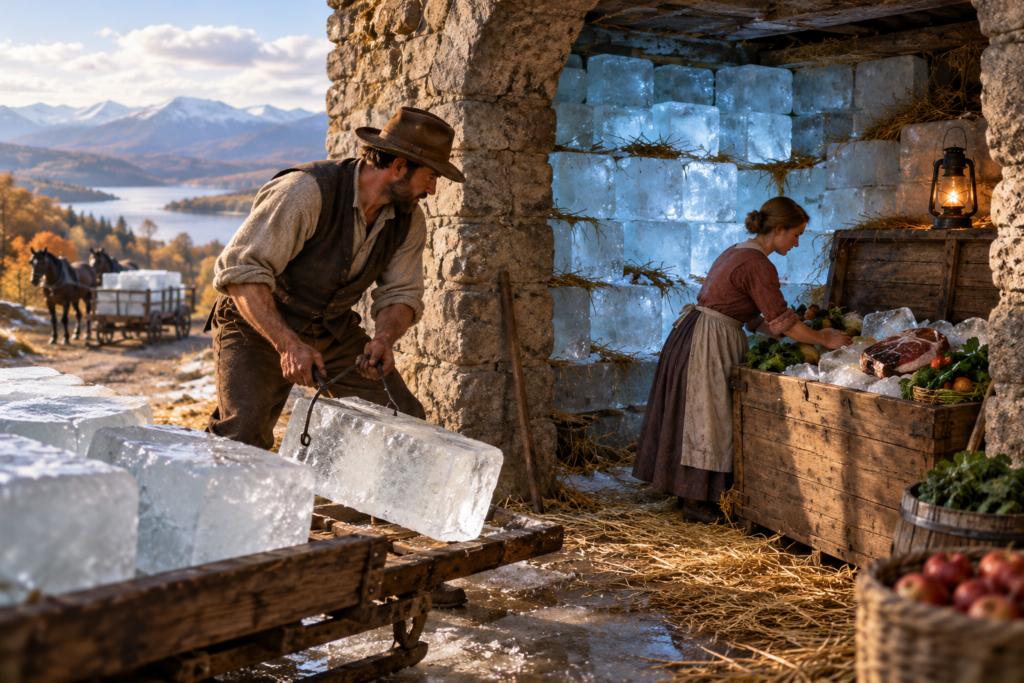
In places with freezing weather, workers harvested ice from ponds and lakes. The blocks could then be moved into protected storage.
Ice houses used combinations of insulation, shade, and partially underground construction to slow melting. Their design varied with location and period.
George Washington’s Mount Vernon documents an ice house with straw insulation . It provides a specific example of the effort invested in retaining seasonal ice.
Insulation did not stop all melting. It reduced heat transfer enough to make storage useful. The supply still needed managing.
This arrangement also required labor before the ice reached a household cooling space: harvesting, lifting, transporting, and storing it were all part of the system.
An icebox brought stored ice into the home
A household icebox was an insulated cabinet with space for food and a block of ice. It did not use an electric compressor to maintain cooling.
As the ice absorbed heat, it melted. The household needed replacement ice and a way to manage the meltwater.
The National Park Service describes historical iceboxes insulated with materials such as cork, sawdust, or straw . Construction details differed among models.
Deliveries made the cabinet part of a larger supply network. The cold in the kitchen depended on obtaining another block before the existing one was exhausted.
A cooling supply is consumed
Ice absorbs heat and melts, requiring replacement.
A powered system moves heat
Mechanical refrigeration transfers heat out of the food compartment.
This explains why the two can look similar while operating very differently. An insulated cabinet is only one part of refrigeration.
Evaporating water provided another form of cooling
Evaporation requires energy. When water evaporates from a surface, it can take heat from the surrounding material and produce cooling.
The effectiveness depends strongly on conditions, especially humidity and airflow. Dry air generally offers more opportunity for evaporative cooling than air already close to saturation.
One historical example is the Australian Coolgardie safe, developed in the late nineteenth century.
The Western Australian Museum describes water moving through its hessian covering. Evaporation helped cool the food-storage space.
This was not a miniature electric refrigerator. It could not provide the same controlled temperature under every weather condition.
Its usefulness demonstrates adaptation to local conditions rather than a universal solution for every household.
Keeping food cold was only one preservation strategy
People also managed food through drying, salting, fermentation, smoking, and, in later periods, canning. These approaches did not all require low storage temperatures.
They work through different mechanisms and cannot be treated as interchangeable. Drying reduces available moisture, while other methods change conditions that influence microbial growth.
Food choices also reflected what could be obtained and stored. A household without reliable cooling faced different constraints from one with a regular ice delivery.
| Approach | Main principle | Limitation |
|---|---|---|
| Cellar storage | Use a cooler, more stable location. | Temperature depends on the building and climate. |
| Icebox | Absorb heat with melting ice. | Requires replacement ice and maintenance. |
| Evaporative safe | Use evaporation to remove heat. | Performance depends on humidity and airflow. |
| Preservation methods | Change the food or its storage environment. | Requires a suitable, reliable process for that food. |
This is historical context, not a set of instructions for preserving modern leftovers. A traditional method’s existence does not establish that an improvised version is safe.
Modern refrigeration changed consistency as well as convenience
A refrigerator removes heat from its interior using a powered refrigeration cycle. Controls help maintain the intended temperature range.
The major advantage is not simply that food can feel cold. It is the ability to maintain suitable conditions more consistently without depending on a new ice delivery.
The Smithsonian’s history of ice harvesting and electric refrigeration describes a gradual transition, rather than every household changing appliances at once.
Cost, reliability, electricity access, and existing habits influenced adoption. Iceboxes remained in use while electric models became more practical and affordable.
Consider the work hidden inside an ordinary meal
- Someone had to obtain the cold source. That could mean harvesting ice or arranging a delivery.
- The storage environment needed attention. Doors, insulation, meltwater, or wet coverings required management.
- Weather affected the available options. A useful cooling method could change with the season.
- Food still required judgment and care. Cold storage did not eliminate contamination or spoilage.
Modern refrigeration reduced much of that daily logistical burden. It did not remove the need for appropriate storage practices.
Frequently asked questions
Was an icebox the same as an electric refrigerator?
No. An icebox relied on ice that melted and needed replacement. An electric refrigerator uses a powered system to remove heat.
Could people keep ice during summer?
Yes. Suitable insulated storage could slow melting enough to preserve winter ice for later use. Results depended on the design and conditions.
Did every household own an icebox?
No. Access depended on income, location, supply networks, and historical period. Household experiences varied substantially.
Was a cellar always safe for milk or meat?
No. Being cooler than a kitchen does not guarantee an appropriate storage temperature for perishable food.
Did evaporative coolers work equally well everywhere?
No. Humidity, airflow, and temperature affected their performance. They were particularly suited to some environments rather than all climates.