
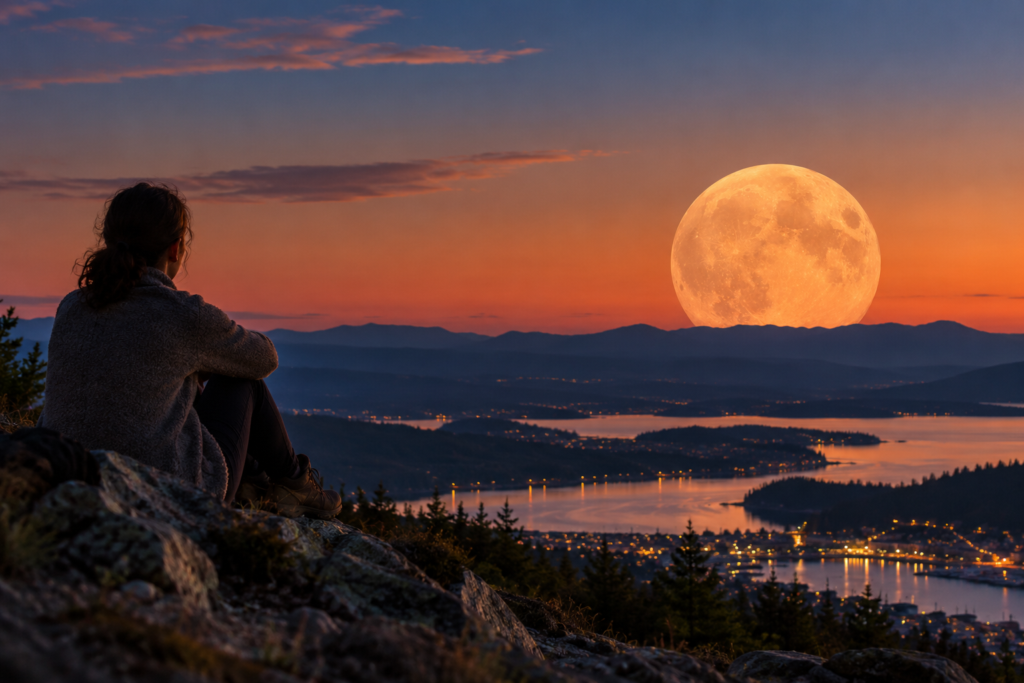
You notice a huge Moon rising behind a row of buildings. Hours later, it looks smaller high overhead. Nothing dramatic has happened to the Moon itself, but your experience of its size has changed.
This is a useful example of a distinction we rarely need to make in everyday life: how large something feels is not always the same as how much of your field of view it occupies.
Angular size and perceived size are different measurements
Angular size describes the angle an object spans in your view. A nearby coin and a distant circular object can cover similar angles even though their actual diameters are very different.
Perceived size is your visual experience of how large something appears. That judgment can incorporate context as well as the image entering your eyes.
For the Moon illusion, the striking observation is that the horizon Moon can feel much larger without showing a corresponding increase in photographed width. Calling it an illusion does not mean you imagined seeing it. The experience is real; the apparent enlargement does not match the measurement.
NASA’s overview of the Moon illusion emphasizes this difference. A fixed camera setup provides a useful check against the immediate impression.
The horizon supplies a complicated visual scene
Near the horizon, the Moon may share your view with trees, rooftops, hills, or distant buildings. High overhead, it often sits in a relatively featureless patch of sky.
One family of explanations suggests that the visual system interprets these scenes differently. Familiar depth cues and relationships between objects can influence judgments of size and distance.
A comparison often used is the Ponzo illusion. Two equal lines placed across a drawing of converging railway tracks can appear unequal because the surrounding perspective suggests different distances.
That demonstration shows how context can change size perception. It does not establish that railway-track geometry is the complete explanation for the Moon.
There is no universally accepted complete explanation
Researchers have examined several possibilities, including relative-size comparisons, assumptions about the shape and distance of the sky, and effects associated with looking in different directions.
A 2023 study of perceived sky geometry tested how participants related landmarks on the ground to positions in the sky. Its findings challenged a simple version of the idea that everyone experiences the sky as a flattened dome.
This illustrates why a neat one-sentence explanation can be misleading. Models make predictions, and observations do not always fit them.
NASA likewise states in its expert discussion of the phenomenon that there is no consensus. The measured mismatch is well established; the precise combination of perceptual processes remains under investigation.
Those statements can coexist. Being confident that an effect is perceptual does not require knowing every step that produces it.
The atmosphere changes color and shape, but does not create the enlargement
A low Moon often looks yellow, orange, or reddish because its light follows a longer path through the atmosphere. Scattering removes more shorter-wavelength light from the direct beam.
Atmospheric refraction can also make the lunar disk look vertically compressed near the horizon. The bottom and top of the disk are affected differently, producing a flattened appearance.
These are physical changes in the light reaching you. They should not be confused with the Moon illusion. The atmosphere is not acting as a magnifying glass that makes the whole lunar disk much larger.
Color and flattening
Atmospheric scattering and refraction can change the low Moon’s appearance.
A surprisingly large Moon
The strong impression of enlargement exceeds the change in angular width.
Use a consistent camera setup to compare the two views
You can investigate the illusion without deciding which perceptual theory is correct. Photograph the Moon near the horizon and again when it is higher on the same night.
- Use the same camera and lens, with the same focal length or zoom setting.
- Keep the original image files and compare them at the same display scale.
- Measure the Moon’s horizontal width in pixels rather than judging the size of the surrounding scene.
- Avoid automatic lens changes, different crops, or separately resizing the two photographs.
NASA’s photography exercise recommends comparing horizontal diameters because a low Moon may be vertically flattened.
The widths should be very similar, allowing for small geometric differences. Your eyes may still insist that the low Moon looks enormous. That contrast is the observation you are testing.
A dramatic landscape photograph is not automatically a controlled comparison. Changing the lens, crop, or viewpoint can change the Moon’s relationship to foreground objects.
A supermoon involves a different, measurable change
The Moon’s orbit is elliptical, so its distance from Earth varies. Its nearest point is called perigee; its farthest is apogee. A nearer Moon genuinely spans a larger angle than a farther one.
The term “supermoon” commonly describes a full Moon occurring near perigee. NASA’s supermoon guide explains this orbital effect.
That is different from the horizon illusion during one evening. One comparison concerns changes in distance around an orbit; the other concerns how the Moon looks in different parts of the sky.
A full Moon near perigee can also rise near a visually striking horizon. The two effects can occur together, but neither should be used as a substitute explanation for the other.
Frequently asked questions
Does the Moon physically expand when it rises?
No. The horizon illusion does not involve the Moon changing its actual diameter.
Does a photograph always show what I felt I saw?
No. A camera records an image through its lens; it does not reproduce every aspect of your visual perception. Consistent settings are essential for comparing angular size.
Is the explanation simply that trees make it look bigger?
Foreground context is one proposed contributor. It is not a complete, universally accepted explanation for the phenomenon.