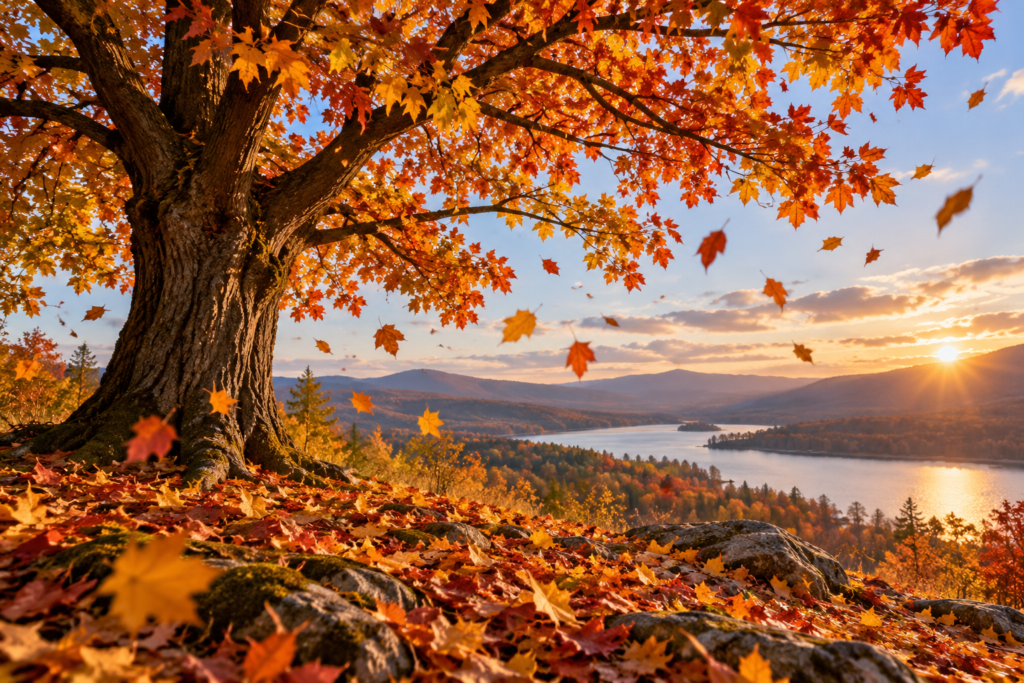
An autumn tree can look as though it is losing a battle. Its green canopy fades, leaves dry out, and bare branches take over. For a healthy deciduous tree, however, that transformation is usually part of its normal seasonal strategy.
The leaves are temporary equipment. They are valuable during the growing season, but the conditions that make them useful do not last all year. Leaf fall helps the tree get through a difficult season and return to growth later.
A broad leaf brings benefits and risks
Leaves capture light for photosynthesis, the process that uses light energy to build sugars from carbon dioxide and water. Their large surface area is useful during favorable growing conditions.
That surface also loses water. In winter, frozen soil can make water difficult for roots to obtain, even when the landscape contains plenty of ice or snow. Delicate leaf tissues are also vulnerable to freezing.
As light and temperature become less favorable, maintaining a canopy of broad leaves can offer a poor return. Shedding them reduces exposure and water loss while the tree enters its winter phase.
The Open University’s explanation of deciduous trees describes leaf loss as a way to avoid these seasonal problems. What looks like abandonment can be an effective survival strategy.
Seasonal changes trigger an organized response
A tree does not consult a calendar. It responds to environmental signals, including changes in day length and temperature. The importance and timing of those signals vary among species and conditions.
As autumn progresses, many deciduous trees begin leaf senescence: an organized aging process in which the leaf’s components are dismantled and its functions change.
This is different from a leaf being suddenly killed by a severe freeze. Normal autumn senescence allows a gradual transition before the leaf is released.
That distinction also explains why the first cold night is not a universal starting gun. Two trees on the same street may follow different schedules because their species, growing conditions, and individual responses differ.
The tree reclaims useful materials before letting go
Building a leaf requires resources. If the tree can recover some of those resources before leaf fall, it has less to replace when growth resumes.
During senescence, complex molecules are broken into smaller compounds. Useful materials can then move from the aging leaf into other parts of the tree for storage and later use.
University of Illinois Extension describes this recovery as part of leaf senescence. The leaf is undergoing a managed shutdown rather than simply switching off all at once.
Changing pigments make the transition visible
During the growing season, green chlorophyll dominates many leaves. As chlorophyll production declines and existing chlorophyll breaks down, other pigments become easier to see.
Carotenoids contribute yellow and orange tones. These pigments are already present in many green leaves, although the stronger green appearance usually masks them.
Reds and purples often involve anthocyanins, which some trees produce during autumn. It is therefore misleading to describe every autumn color as something that was hidden in the leaf all summer.
Kew’s explanation of autumn color discusses how pigment changes accompany the recovery of valuable chemicals. Color is a visible part of a larger physiological transition, not the reason every leaf must fall.
Chlorophyll declines
The pigment that dominated the summer canopy becomes less prominent.
Pigments differ among trees
Yellow, orange, red, and purple depend on the pigments present or produced.
A separation zone loosens the leaf’s attachment
The leaf stalk, called the petiole, joins the leaf to the branch. During autumn leaf fall, changes at its base create a controlled separation zone, commonly called the abscission layer.
Connections weaken as the process advances, and the tree protects the exposed attachment site. Eventually the leaf can detach under its own weight or with help from wind and rain.
The National Park Service describes this weakening attachment as part of the preparation for winter. A gust may deliver the final pull, but the tree has already changed the connection.
This is why “the wind knocks all the leaves off” is an incomplete explanation. Summer leaves withstand many breezes. Autumn leaf fall depends on a biological change that makes release much easier.
Evergreen trees use a different resource strategy
Keeping leaves can also be advantageous when those leaves are built to last. Many conifers have narrow needles and protective surfaces that reduce water loss and help them tolerate difficult conditions.
The investment in tougher foliage can pay off over several growing seasons. An evergreen does not have to rebuild its entire canopy each spring.
However, evergreen does not mean a tree keeps every individual leaf forever. Older foliage is replaced over time, and some evergreen trees have broad leaves rather than needles.
The Open University’s discussion of evergreen plants highlights the importance of water-conserving adaptations. Deciduous and evergreen habits represent different ways to manage seasonal costs.
Weather changes the timing and quality of the display
Seasonal patterns do not produce an identical autumn every year. Sunlight, temperature, precipitation, and soil moisture influence how leaves develop color and when they fall.
NOAA’s guide to autumn foliage notes that drought can trigger early shutdown, while hard freezes can damage leaves and shorten the display. Cool nights are not the same as severe frost.
Wind and heavy rain can also remove leaves once their attachments weaken. A tree may therefore lose much of its canopy before an observer sees the brightest colors they expected.
The familiar temperate autumn is one pattern, rather than a schedule followed by every tree everywhere. Species and local climate matter when interpreting what a particular canopy is doing.
Frequently asked questions
Does losing its leaves mean a tree is dead?
No. Seasonal leaf loss is normal for deciduous trees. Bare branches alone do not establish whether a tree is healthy or dead.
Does frost paint the leaves red?
No. Pigments and physiological changes produce autumn colors. Severe frost can damage leaf tissues and interrupt the display.
Do evergreens lose leaves too?
Yes. Their leaves or needles have limited lifespans. Keeping foliage across seasons is different from keeping every leaf permanently.