
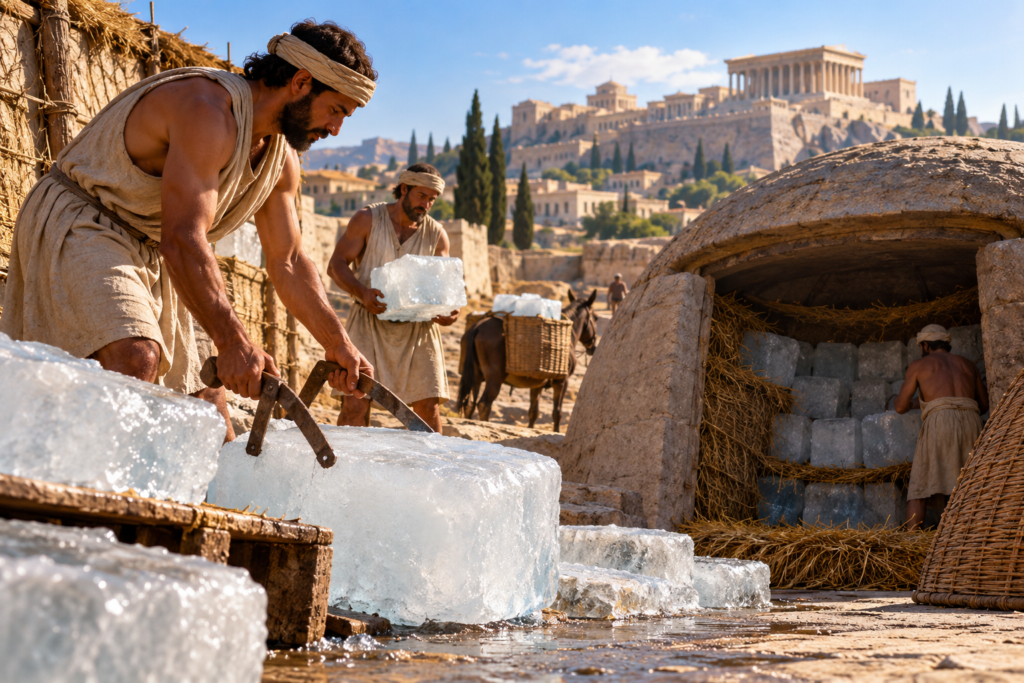
Ice seems like a simple product of a freezer. Put water inside, wait, and collect the result. Before mechanical refrigeration, obtaining ice required a different relationship with the environment.
People had to find cold conditions, exploit them, and protect the resulting ice from heat. Architecture and organization could make seasonal cold available long after winter ended.
The story is impressive without assuming that ancient people possessed machines capable of freezing water anywhere, at any time. Their solutions depended on climate, geography, materials, and labor.
Collecting natural ice solved a different problem from freezing water
In a place with freezing winters, ponds and other water bodies could supply ice directly. Workers could cut or break it into pieces and transport it to storage.
In mountainous regions, ice and snow could provide another source. Transport then became part of the challenge: the material had to reach its destination before too much melted.
Producing ice on-site was different. Water had to lose enough energy to cool and freeze under the available environmental conditions.
These methods could coexist. A community might use nearby natural ice when available and operate freezing basins when local conditions allowed.
Persian ice houses combined storage with environmental design
Iranian ice houses are commonly known as yakhchals, a term meaning “ice pit.” Historical examples include underground storage and structures protected by substantial walls or domes.
Encyclopaedia Iranica describes a range of forms rather than one identical design. Some installations included shallow outdoor basins where winter water could freeze.
Ice was then collected and transferred into storage for later distribution. The storage chamber and the freezing basin performed different jobs.
An important correction concerns their use: Iranica identifies these facilities as stores for ice, not rooms where food was routinely refrigerated.
The distinction prevents a common exaggeration. Calling a yakhchal an “ancient refrigerator” may communicate its association with cold, but it can misrepresent what the building actually stored.
A clear winter night can help a shallow pool lose heat
Cold air helps water lose energy. Under suitable conditions, a shallow layer of water can freeze during the night.
Radiative cooling can contribute too. A surface emits thermal radiation, and a clear sky can provide favorable conditions for a net outward loss of energy.
Engineers at Max Fordham investigated the physics of Iranian ice-making systems using heat-transfer modeling. Their analysis considers production and storage as related but separate processes.
Shallow water is useful because less depth must cool before a layer freezes. Shade and the timing of exposure also influence the energy balance.
None of this means that a hot desert afternoon automatically freezes water. “Desert” describes dryness, not a guarantee of high temperatures every hour of the year.
Remove energy from water
Favorable winter conditions allow liquid water to become ice.
Limit incoming heat
Protected storage slows the melting of ice already obtained.
Preserving ice meant slowing heat transfer
Ice does not have to remain in freezing air to survive for a useful period. It must avoid receiving too much heat too quickly.
Shade, insulation, and limited exposure can slow the process. Underground storage also moderates temperature swings compared with an exposed surface.
Later ice houses provide clear surviving examples of these principles. National Trust records describe winter ice packed with insulating material for use during warmer months.
Those later buildings should not be labeled ancient. They are useful comparisons showing how long the basic storage problem persisted.
Imagine two identical blocks: one in direct sunlight, the other protected inside a well-insulated store. Both can melt, but the rates can be very different.
Maintaining an ice supply therefore required planning: collecting enough, protecting it, and managing its use.
Ice could serve comfort, refreshment, and display
Chilled drinks and cold preparations made ice desirable where access was difficult. Its availability could reflect wealth and organized labor.
Ancient cooling vessels also demonstrate interest in serving drinks at lower temperatures. The Metropolitan Museum of Art, for example, catalogs a Greek bronze psykter designed for cooling wine .
A cooling vessel alone does not establish exactly which coolant was used on every occasion. Object function and a specific historical recipe require different evidence.
Later Chinese imperial practice offers another documented example. The Palace Museum describes winter ice stored for summer use in the Forbidden City, including cooling food and preparing chilled refreshments.
That account concerns imperial China in a later period, not proof that every ancient Chinese household enjoyed the same supply.
| Stage | Practical question |
|---|---|
| Obtaining | Where can ice or sufficiently cold water be found? |
| Transporting | How can it reach storage with limited loss? |
| Storing | How can heat entry be reduced? |
| Distributing | Who receives the limited supply, and when? |
Claims about the first ice makers need careful wording
Popular histories often assign a precise invention date to ancient ice technology. Surviving evidence is not always that straightforward.
A long tradition, an early written reference, and a surviving domed building are different kinds of evidence. They need not share the same date.
In particular, later monumental yakhchals should not automatically be treated as unchanged buildings from the earliest period of ice storage.
It is more accurate to describe a developing tradition than to attach every later feature to one supposed ancient invention.
This approach preserves the achievement. Seasonal cold, local materials, and organized work made a difficult resource available beyond its natural moment.
Frequently asked questions
Could people make ice without electricity?
Yes, when environmental conditions allowed water to lose enough heat. Mechanical refrigeration is not required for natural freezing.
Did desert ice houses freeze water all summer?
That is not the general explanation. Many systems produced or collected ice in winter and preserved it for warmer weather.
Was a yakhchal a room full of stored food?
Encyclopaedia Iranica describes these facilities as stores for ice intended for distribution, rather than food-refrigeration rooms.
Did everyone have access to ice?
Access varied with climate, transport, infrastructure, cost, and social position. A palace supply does not demonstrate universal household access.
Did ancient frozen treats exactly resemble modern ice cream?
That should not be assumed. Chilled drinks, snow-based preparations, and modern churned ice cream are different products with different histories.