
Imagine needing another copy of a long book when every page must be written again by hand. The cost is not only paper or parchment. It is the time and skill required to repeat the text.
Printing changed that relationship between preparation and repetition. Once a page was ready to print, a workshop could reproduce it many times. That practical change helped transform who could encounter a text and how widely an argument could travel.
Printing did not begin with one European inventor
Johannes Gutenberg is central to the history of European printing, but he did not invent the idea of printing itself. East Asian printing traditions preceded his work by centuries.
The Library of Congress’s guide to Gutenberg explicitly warns against the myth that all printing began with him.
This broader history matters because technologies develop through combinations, adaptations, and local circumstances. Recognizing Gutenberg’s achievement does not require erasing earlier innovations.
In fifteenth-century Europe, manuscript copying, block printing, and emerging movable-type printing could coexist. New methods did not cause every older practice to disappear immediately.
Movable type separated a page into pieces that could be reused
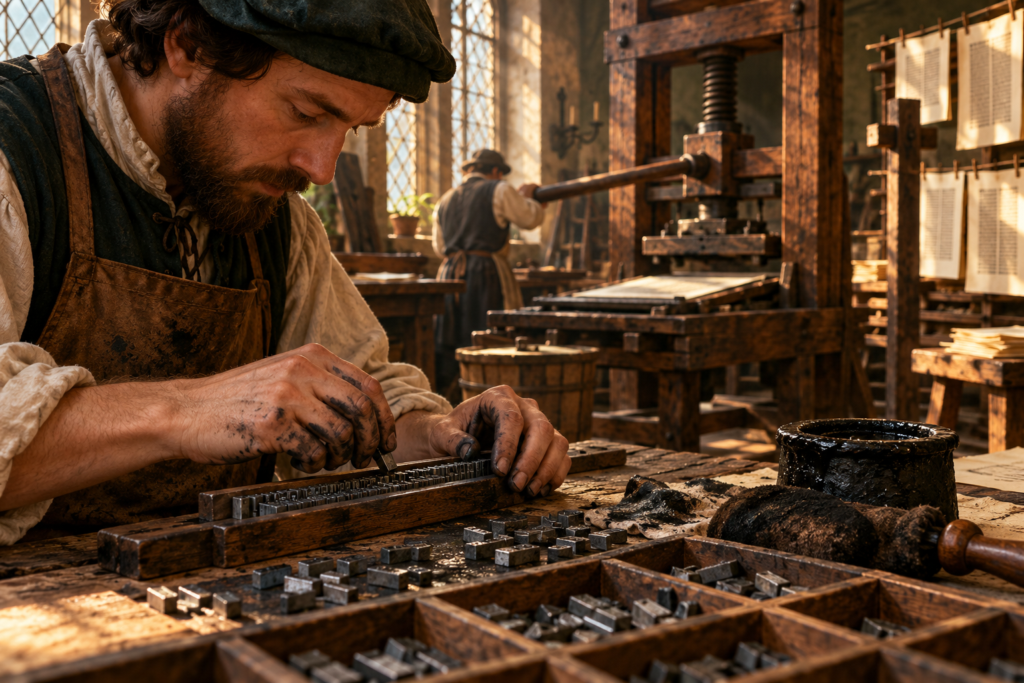
With a carved printing block, the text of a page is fixed in that block. Movable type uses separate characters that can be assembled into words and lines, then rearranged for another page.
The system requires more than the idea of loose letters. The pieces must be made consistently enough to sit together, receive ink, and produce a legible impression under pressure.
The Gutenberg Museum’s account of the invention describes the casting of individual characters and their assembly into printable pages.
Reusability changes the economics of preparation. A workshop invests effort in making and arranging the type, then draws on that prepared arrangement to produce multiple impressions.
Pressure transferred the inked arrangement onto a sheet
Printers arranged type, secured it, applied ink, and pressed a sheet against the prepared surface. After an impression, another sheet could be printed from the same arrangement.
The National Library of Australia’s introduction to the press describes the repeated sequence and the division of work around it.
The crucial difference was that each copy no longer required someone to redraw every letter from the beginning. Much of the work was concentrated in preparing the page and managing the print run.
This did not make production effortless. Typesetting, inking, handling sheets, correcting mistakes, and binding still required time, materials, and specialized skills.
More readers could encounter closely related versions of a text
A print run allowed many copies to share the same prepared layout and wording. That made it easier for a text to circulate across institutions and places.
Printed copies were not always perfectly identical. Corrections during a run, differences in finishing, and errors could still introduce variation.
Even so, repeated impressions changed the scale at which written material could be reproduced. Readers separated by distance had a greater chance of consulting copies from the same edition.
The Royal Collection’s account of early printed books connects mechanical printing with the wider availability of books and the intellectual developments of the Renaissance.
Printing expanded the reach of debate as well as instruction
More available books and shorter printed works could carry religious arguments, political claims, practical information, and scholarly writing to additional readers.
People did not need to agree with a text for its wider circulation to matter. Printing could spread competing positions and give controversy a larger audience.
The University of Arizona’s exhibition on printing and the Reformation shows how print became part of religious debate and publishing for broader audiences.
The effect was not limited to a single category of knowledge. The same reproductive machinery could support learning, persuasion, official announcements, or polemic.
Repeat a prepared text
A workshop could make multiple impressions from one arrangement.
Reach additional readers
Copies could travel through markets, institutions, and social networks.
A cheaper copy still needed a reader and a route
Printing did not instantly make everyone literate or give every household a library. A book still had to be produced, transported, purchased or borrowed, and understood.
Language, education, income, and institutional access continued to shape who encountered written material. Greater production and universal access are different claims.
It is therefore more accurate to describe a long expansion of opportunities than a single moment when knowledge became equally available to everyone.
The technology changed the possibilities for sharing. Societies, businesses, schools, and readers determined how those possibilities developed.
Workshops were collective enterprises
The familiar image of one inventor can hide the labor required to produce and distribute books. Printers, compositors, financiers, booksellers, and other workers contributed to the system.
The University of Chicago Library’s history of printing also highlights women who played significant roles in printing and publishing, despite historical restrictions on their participation.
Knowledge moved through a network of people as well as through a machine. Better equipment could increase capacity, but capacity became meaningful through actual work and distribution.
That perspective makes the history more concrete: communication changed because a repeatable process could be organized and sustained across many workshops.
Preparation and distribution remain central to publishing
Modern digital publishing works differently from a handpress, but a useful comparison remains: a text is prepared once and then distributed to many readers.
The comparison should not erase the differences. Digital files do not require the same physical repetition, transport, and material costs as printed sheets.
What the early press reveals is how changing the cost and effort of copying can change communication. It does not guarantee accuracy, agreement, or wise use of what gets copied.
Frequently asked questions
Did Gutenberg invent all printing?
No. Printing existed in Asia long before his European work.
Did printed books immediately replace manuscripts?
No. Different methods coexisted, and the transition developed over time.
Did printing make information automatically reliable?
No. A printing process can reproduce errors and persuasive claims as well as accurate information.