
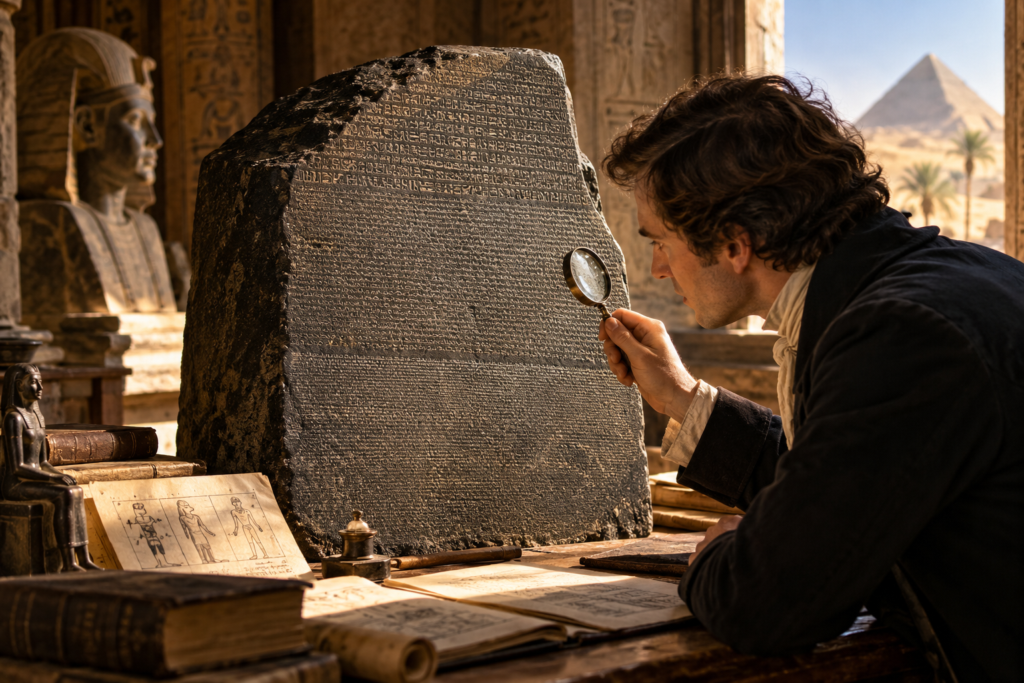
Imagine finding a document written in an unfamiliar script. You cannot tell whether its signs represent letters, words, ideas, or some combination of these. Now imagine discovering a version of the same message in a language you can read.
You would not suddenly understand every unfamiliar sign, but you would have something invaluable: a way to compare the unknown with the known.
That is what made the Rosetta Stone so important. It did not contain a ready-made dictionary or an explanation of Egyptian grammar. It supplied evidence that scholars could use to test their ideas about a writing system.
The stone contains an official decree
The Rosetta Stone is a broken section of an inscribed stone monument. Its text records a decree issued by Egyptian priests at Memphis in 196 BCE, during the reign of Ptolemy V.
The decree concerns the king and the honors associated with his rule. It was an official religious and political text, not a message created to help future historians.
The surviving stone was found in 1799 by French soldiers near the Egyptian town of Rashid, known in European usage as Rosetta. Its inscriptions soon attracted scholarly attention.
Its later importance came from the combination of writings it preserved. A text that had served an administrative and ceremonial purpose became a tool for investigating the distant past.
Three scripts provided a bridge between known and unknown
The stone is often described as containing “three languages,” but the more accurate description is three scripts representing two languages.
Hieroglyphs and Demotic record Egyptian. The third section records the decree in ancient Greek, which scholars already knew how to read.
| Script | Language | Why it mattered |
|---|---|---|
| Hieroglyphic | Egyptian | Preserved the formal picture-like signs scholars wanted to understand. |
| Demotic | Egyptian | Supplied another Egyptian version in a different writing form. |
| Greek | Ancient Greek | Provided readable content against which the Egyptian versions could be investigated. |
Knowing the Greek text gave researchers expectations about the Egyptian sections. A royal name mentioned in Greek, for example, could guide the search for corresponding groups of Egyptian signs.
This was not a simple exercise in matching each line or word. Different languages organize information differently, and the surviving monument is incomplete.
The pictures were part of a writing system, not just symbols
Hieroglyphs resemble recognizable things: people, animals, plants, and objects. That appearance can encourage a misleading assumption that each picture directly expresses an idea.
In reality, the script combines different kinds of signs. Some represent sounds, some represent words, and others help clarify a word’s meaning.
Understanding those roles was essential. Looking at a bird sign and asking only “What does this bird symbolize?” could miss the possibility that the sign was being used for its sound value.
A picture can help spell a word
A sign can represent a sound or group of consonants rather than the object it resembles.
A sign can help identify a word
Other signs can represent a word or indicate the kind of meaning intended in context.
Decipherment therefore required discovering the system’s logic, not merely assigning an English label to every picture.
Royal names offered a useful starting point
Names are valuable clues in decipherment because their approximate sounds may already be known from another language. They provide a more constrained problem than an entirely unfamiliar sentence.
Egyptian royal names could appear inside oval enclosures called cartouches. Identifying a likely name group gave scholars a specific sequence of signs to investigate.
The name Ptolemy was particularly important on the Rosetta Stone. Researchers could compare its known Greek form with the Egyptian signs believed to represent it.
A proposed sound value then needed testing. If a sign appeared in another name or inscription, did that reading still make sense? Repeated success would strengthen the interpretation.
Young made important advances; Champollion developed the breakthrough
The decipherment was a cumulative effort. Two especially important figures were Thomas Young, an English physician and scientist, and Jean-François Champollion, a French scholar of languages.
Young investigated the Rosetta Stone and recognized phonetic values in the hieroglyphic spelling of Ptolemy. He also contributed to understanding the relationship between Egyptian writing forms.
Champollion pushed the investigation toward a broader explanation of the script. A crucial step was recognizing that phonetic writing was not restricted to foreign royal names.
Hieroglyphic writing could combine sound-based and meaning-based elements in its wider use. That insight made it possible to move beyond isolated identifications toward reading Egyptian.
Champollion announced a major advance in 1822 and developed his explanation further in subsequent work, including a substantial publication in 1824. Those dates mark stages of a developing understanding, not an instant translation of every Egyptian text.
Coptic connected written signs with the Egyptian language
Comparing scripts was powerful, but Champollion also needed linguistic knowledge. His study of Coptic was particularly important.
Coptic represents a later stage of the Egyptian language, written mainly with letters derived from the Greek alphabet, supplemented by additional signs.
It offered a connection to Egyptian words and language structure. This helped Champollion evaluate proposed readings as language, rather than treating them as arbitrary combinations of sounds.
The British Museum’s account also highlights the Coptic grammars and dictionaries compiled by medieval Arab scholars that he studied. The breakthrough drew on knowledge preserved and developed by others.
It is useful to imagine decipherment as several tools working together: readable Greek, Egyptian names, Coptic knowledge, and comparisons with additional monuments.
The stone supplied a key, not the entire answer
A successful decipherment must work on more than one document. Other inscriptions helped researchers test sign values, recognize patterns, and refine their understanding.
That is why describing the Rosetta Stone as a “key” is more accurate than imagining it as a complete translation manual.
Once Egyptian writing could be read systematically, inscriptions became evidence in a new way. Researchers could investigate names, titles, religious texts, and historical statements through the words recorded by Egyptians.
- Names could be read and compared. Royal and personal names helped connect objects with individuals.
- Texts could be studied as language. Researchers could analyze vocabulary and grammar rather than relying only on visual interpretation.
- Interpretations could be tested. A proposed reading could be checked against additional inscriptions.
- Egyptian accounts became more accessible. Monuments could provide written testimony alongside their images and archaeological settings.
Reading a text still does not make every historical question easy. Inscriptions can be damaged, ambiguous, or written to praise a ruler. Decipherment makes investigation possible; it does not remove the need for interpretation.
Frequently asked questions
Does the Rosetta Stone contain three languages?
More precisely, it contains three scripts representing two languages. Hieroglyphic and Demotic record Egyptian, while the third version is written in ancient Greek.
Was every hieroglyph a letter?
No. The script includes signs representing sounds, words, and meaning categories. Sound signs can represent more than one consonant, so the system is not simply an illustrated alphabet.
Did Champollion solve everything in 1822?
No. His 1822 announcement was a major milestone, followed by further development and testing. Understanding Egyptian writing continued beyond that breakthrough.
Why could scholars read the Greek section?
Ancient Greek was already a language studied and understood by scholars. Its readable version supplied information about the decree that could guide comparisons with the Egyptian texts.
Was the stone the only evidence used?
No. Other inscriptions, monuments, earlier scholarship, and Coptic knowledge were important. Decipherment depended on testing ideas across evidence rather than studying one object alone.