
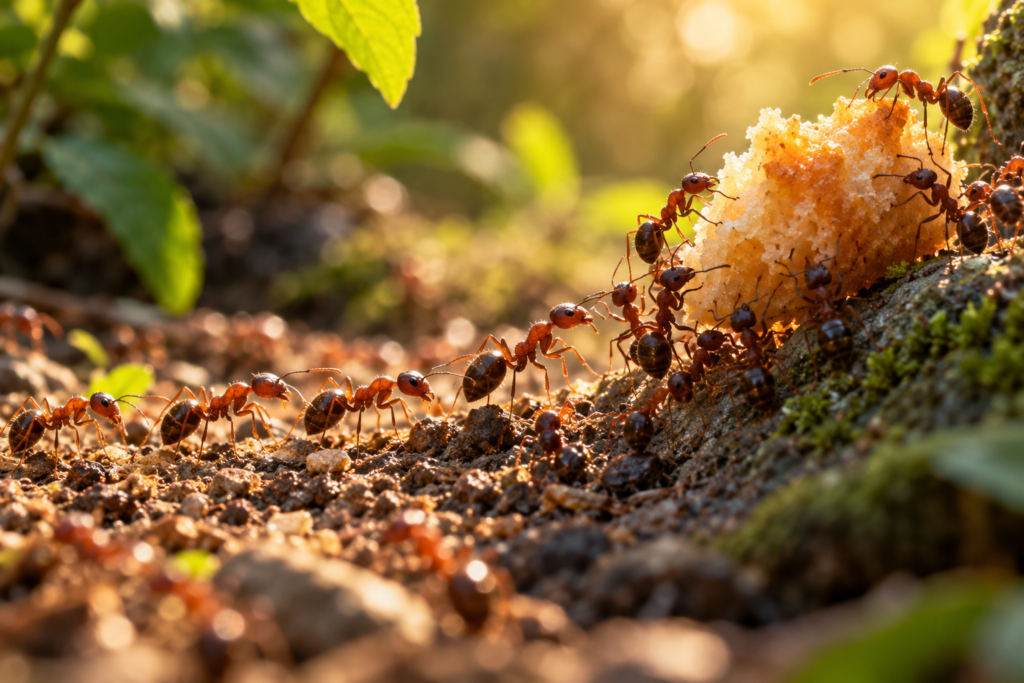
A crumb lands on the ground. At first, one ant investigates. A little later, a line of workers stretches between the food and a hidden nest. The transformation looks as though someone issued instructions to the whole colony.
Usually, the coordination emerges from interactions among workers and signals in their surroundings. To understand the line, it helps to separate discovery, recruitment, navigation, and collection.
A trail needs a discovery before it can recruit anyone
The first useful step is exploration. Foraging workers move through the environment and encounter potential resources. They can use chemical and physical information to investigate what they find.
Ants have sensory structures on their antennae that help detect chemical cues. These cues can provide information about food and about other ants, but they are not a universal long-distance detector for every crumb.
The initial search and the later trail are different stages. A successful worker may bring information back to the colony, changing where additional effort is directed.
A useful way to picture the process is a search party leaving signs for others. The signs are chemical, and the response depends on the species and situation rather than on a shared human-style map.
Pheromones place information along a route
A pheromone is a chemical signal that influences other members of the same species. In many trail-forming ants, a worker deposits pheromone as it travels between a resource and the nest.
Other workers detect the signal and are more likely to travel along the marked route. As successful foragers add further chemical deposits, the route can become easier for nestmates to follow.
The University of Colorado Boulder’s explanation of ant trails describes the role of antennal sensing and reinforcement. The orderly line is therefore connected to information on the surface beneath the ants.
Repeated successful trips can strengthen recruitment
Suppose a worker finds a resource worth collecting. A trail attracts additional workers, some of those workers also succeed, and further signaling encourages more traffic. This is a form of positive feedback.
No individual needs to count all the colony’s workers or oversee the entire route. Local responses can produce a large-scale pattern.
The pattern is not unlimited, however. Food can be depleted, traffic can change, and chemical signals can fade. A system that only amplified past success without responding to new conditions would waste effort.
Imagine a footpath becoming easier to notice as more people use it. That analogy captures reinforcement, although ants are responding to chemical signals rather than worn grass.
A temporary signal helps prevent outdated directions
Pheromone does not necessarily remain effective for long. Its persistence differs among chemicals, species, surfaces, and conditions. A rapidly fading signal can keep recruitment tied to a recently discovered opportunity.
Researchers at the University of Sussex studied trails in the Brazilian ant Pheidole oxyops. Their field research found very short-lived trails that recruited workers already outside the nest as well as workers leaving it.
In that study, recruitment could work like a chemical net, drawing nearby foragers toward the resource. The signal’s short lifetime was part of its usefulness.
This does not mean every ant trail disappears on the same schedule. A finding about one species explains a particular strategy, not a timer shared by all ants.
Following a scent does not mean an ant has no memory
Chemical trails are only part of the story. Individual workers can learn routes and use familiar information from previous trips.
A study of route learning in Lasius niger examined how private memory interacts with trail pheromones. On simple routes, ants could prioritize what they had learned over the chemical trail.
It is therefore misleading to imagine every worker as a vehicle that can move only along a scented rail. The balance between learned information and social signals depends on the task and species.
Researchers can investigate that balance by arranging routes where the worker’s previous experience and a chemical cue point in different directions. Which route it chooses provides evidence about how the information is used.
Some ants recruit a follower rather than a whole column
In tandem running, one ant guides another, with contact helping keep the pair together. The leader can pause when the follower falls behind.
Arizona State University’s Pratt Lab describes tandem recruitment in Temnothorax ants, including recruitment to sugary food. It is a different arrangement from mass recruitment along a busy trail.
Even chemical systems can be more complex than a single attractive scent. Sussex research on colony organization describes Pharaoh’s ants using both attractive signals and a repellent signal associated with unrewarding branches.
Signals left by nestmates
Trails can recruit workers and convey useful information about routes.
Experience from previous trips
Learned routes can help a worker navigate beyond simply following a fresh scent.
Watch the sequence, not just the final line
If you watch ants outdoors, notice whether workers arrive singly or in groups, whether they carry material, and whether traffic changes as the resource disappears. Those observations can help distinguish searching from recruitment and transport.
A line alone does not identify the species or reveal every signal being used. It is a visible outcome of behavior whose details may differ substantially between colonies.
That is what makes a small trail interesting: the same familiar-looking pattern can emerge from several interacting kinds of information.
Frequently asked questions
Does the queen direct each foraging trip?
The trail systems described here emerge from worker behavior and local signals, without the queen assigning each worker a route.
Do all ants use the same recruitment method?
No. Mass trails, tandem guidance, and other strategies differ among species and circumstances.
Can ants remember a route?
Yes. Studies show that some foragers learn routes and combine that information with chemical cues.