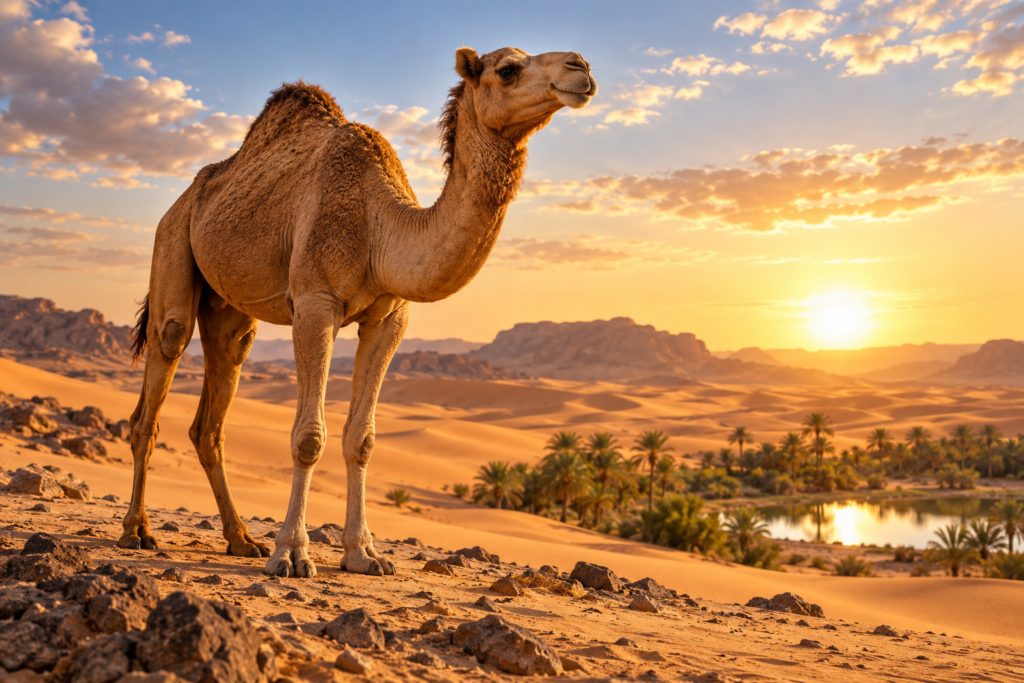
A camel crossing a dry landscape can seem almost independent of water. That impression has encouraged a persistent myth: somewhere inside its hump, it must carry a private drinking supply.
The real explanation is more interesting. A camel survives by reducing losses, tolerating difficult conditions, and making effective use of food and water when they become available. No single feature does the whole job.
The hump is an energy reserve, not a water tank
The familiar hump contains stored fat. When food is scarce, the camel can use that reserve for energy. A dromedary has one hump; Bactrian camels have two.
San Diego Zoo identifies fat, not water, as the hump’s contents. This distinction matters because a reserve of fuel and a reserve of drinking water solve different problems.
Think of the hump as a pantry rather than a bottle. It helps bridge a shortage of food, but it does not eliminate the animal’s need to replace water lost from its body.
The hump can change shape as its fat reserves are used. A smaller or leaning hump is therefore not a visible water gauge.
A camel saves water through several body systems
Much of desert survival depends on spending water carefully. Camels produce concentrated urine and dry dung, reducing the amount of water lost while removing waste.
Their nasal passages help conserve moisture too. Air leaving the body can cool as it passes over nasal surfaces, allowing some water vapor to be recovered rather than escaping with every breath.
The Natural History Museum’s camel guide describes these mechanisms. They are small savings repeated continuously, not one spectacular trick used only during a drought.
Heat management helps limit the need for sweating
Sweating cools an animal by allowing water to evaporate. In a desert, that can become an expensive way to maintain a rigid body temperature.
Camels can allow their body temperature to vary more than many familiar mammals do, especially when water is limited. This reduces the immediate need to spend water on evaporative cooling. They can sweat, so saying that camels never sweat would be incorrect.
Their long legs also hold the body farther above hot ground. The San Diego Zoo Wildlife Alliance fact sheet lists this alongside water-retaining adaptations.
A coat is not automatically a disadvantage in the sun. Fur can insulate against incoming heat as well as against cold. The benefit depends on the animal and conditions, not simply on whether a surface looks warm to a human observer.
Broad feet spread weight over loose ground
Walking across shifting sand presents a different problem from staying hydrated. A narrow contact area sinks more easily, making travel harder.
Camels have broad feet with thick pads and two toes. Their spreading support helps distribute weight over the surface rather than concentrating it into a small point.
Sydney Zoo’s dromedary profile compares this spreading support to built-in snowshoes. The comparison is useful: spreading a load makes a soft surface less likely to give way beneath it.
The feet do not make sand firm. They make the animal better equipped to move across it. That difference is easy to overlook when watching a camel travel smoothly over terrain that makes human footsteps tiring.
Eyes and nostrils have their own protective features
Wind can turn loose desert particles into an abrasive cloud. Long eyelashes and hair around sensitive areas help limit the amount of sand reaching them.
A camel can also close its slit-like nostrils, reducing exposure during blowing sand. These structures protect the animal while it continues living in an environment that cannot always be avoided.
Denver Zoo’s Bactrian camel profile describes these defenses alongside the animal’s padded feet. Water conservation alone would not solve the daily problems of grit, movement, and exposure.
Save and tolerate
Physiological adaptations reduce water loss and help maintain function during shortages.
Support and protect
Feet, eyelashes, and nostrils address the physical demands of sand and wind.
Camels still need food and water
There is no single number of days that describes every camel’s ability to go without drinking. Temperature, activity, access to moist food, and the animal’s condition all change the calculation.
When water becomes available, camels can drink substantial amounts and rehydrate. That does not mean they are filling their humps. They are replacing water throughout the body.
It is more useful to ask how quickly an animal is losing water and what it can replace than to imagine an unchanging countdown. Resting in cool conditions is different from carrying a load through intense heat.
Deserts also include cold environments. Bactrian camels have substantial seasonal coats and inhabit landscapes with severe temperature contrasts. “Adapted to deserts” does not mean “adapted only to permanent heat.”
Frequently asked questions
Do camels keep water in their humps?
No. Their humps store fat, which provides an energy reserve when food is limited.
Do camels ever sweat?
Yes. Their heat-management adaptations can reduce the need for sweating, but do not remove that ability.
Are one-humped and two-humped camels the same?
No. Dromedaries and Bactrian camels are different kinds of camel, with different geographic histories and adaptations.