
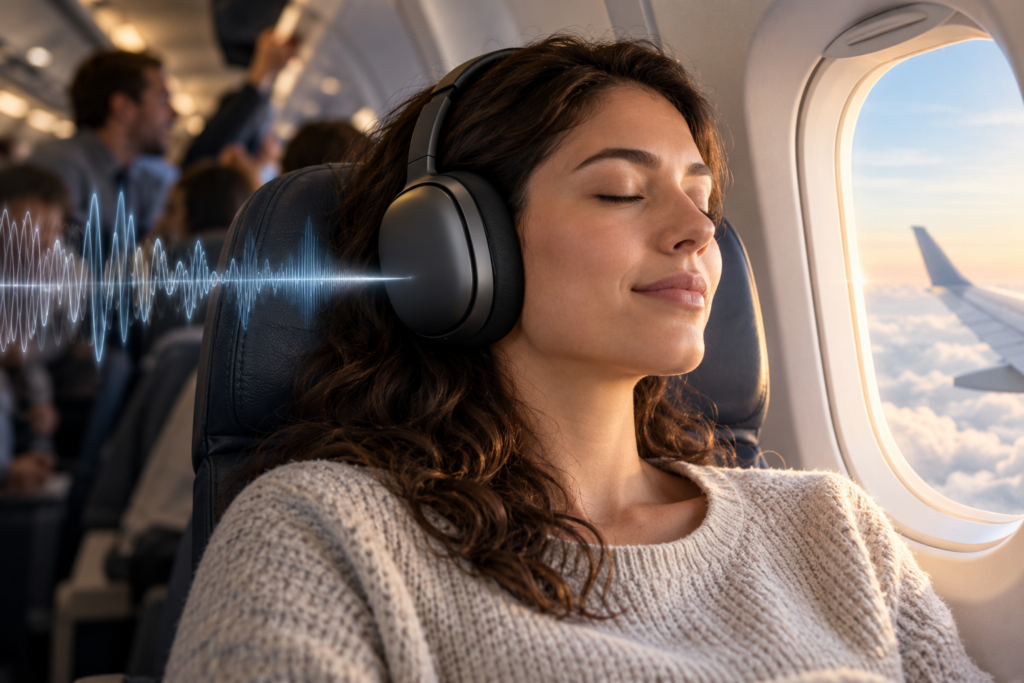
Put on noise-canceling headphones during a flight, and the engine drone may fade dramatically. Yet a nearby announcement or conversation can remain audible.
That difference is not necessarily a malfunction. Active noise cancellation works within physical and engineering limits, and some sounds are easier to reduce than others.
Understanding the system starts with a surprising idea: headphones can reduce unwanted sound by producing additional sound.
Sound waves can combine to produce a smaller pressure change
Sound involves pressure variations traveling through a medium such as air. When sound waves overlap, their pressure contributions combine.
If one contribution has a positive pressure change where another has a corresponding negative change, the combined variation can be smaller. This is destructive interference.
Active noise cancellation uses this principle to reduce unwanted sound at the listener’s ears.
The challenge is not merely generating an inverted recording. The system must account for timing, amplitude, and the acoustic path between its loudspeaker and the ear.
Microphones measure sound so the system can respond
Noise-canceling headphones contain microphones that supply information about the acoustic environment. Processing circuitry uses that information to calculate a cancellation signal.
The headphone drivers reproduce this signal along with any music or other audio you have chosen to hear.
Designs differ. Some microphones monitor outside sound, some monitor sound inside the listening cavity, and some systems combine these approaches.
These arrangements are commonly described as feedforward, feedback, and hybrid active noise cancellation. The number of microphones alone does not establish performance.
Sony’s explanation of noise cancellation describes the basic process as sensing noise and producing a counteracting signal.
In practice, the system must continue responding while sound and fit change. The experience comes from ongoing measurement and control rather than one calculation made when the headphones are switched on.
The physical seal does a different part of the job
Headphones can reduce outside sound even without powered electronics. Ear cups and cushions form a physical barrier, while in-ear tips can seal the ear canal.
This is usually called passive isolation. Its effectiveness depends on materials, construction, and fit.
Active cancellation adds an electronically generated response. Good isolation and good cancellation can complement each other.
Reduce transmission physically
Cushions, shells, and ear tips limit how much outside sound reaches the listening space.
Reduce sound through interference
Microphones and processing generate an acoustic signal that counteracts part of the unwanted sound.
This distinction explains why an unpowered pair may still block some noise, while switching cancellation on changes the remaining low-frequency background.
Low-frequency sounds are generally easier to cancel
Active cancellation is often especially effective against low-frequency components such as engine rumble, ventilation noise, and transport drone.
Lower-frequency waves have longer wavelengths and longer cycles. The system has a less demanding timing and spatial problem than it faces at higher frequencies.
At higher frequencies, small delays or changes in the acoustic path can produce substantial phase differences. Maintaining the correct cancellation becomes harder.
Sudden and complex sounds also pose challenges. Speech contains changing components across a broad frequency range, so reducing a background drone does not mean eliminating every nearby word.
| Sound characteristic | Typical challenge |
|---|---|
| Low-frequency rumble | Often well suited to active reduction. |
| Higher-frequency sound | More sensitive to timing, fit, and acoustic-path changes. |
| Changing speech | Contains varied frequencies and rapid changes. |
| Noise entering through a poor seal | Changes the conditions the system is trying to control. |
These are general tendencies, not identical performance promises for every model or environment.
A small gap can change what reaches your ears
Ear tips and cushions influence both passive isolation and the acoustic conditions for active cancellation.
An earbud that fits loosely may allow sound to leak around the tip. An over-ear cushion may seal differently depending on its position or interference from other objects.
That changes the sound the system must counteract. Some headphones adapt their processing, but adaptation does not make physical fit irrelevant.
If performance seems weak, checking the manufacturer’s fit guidance can be more useful than immediately assuming the electronics have failed.
Several headphone features use microphones for different purposes
A product may advertise noise cancellation, environmental sound, and clearer calls. These features are related to sound processing, but they do different jobs.
Listening-focused ANC reduces unwanted sound for the wearer. Call processing attempts to make the wearer’s voice clearer to another person.
Transparency or awareness modes deliberately reproduce some external sound through the headphones. Depending on the design, that can help the wearer hear surroundings without removing the product.
A device can perform strongly in one task and differently in another. A clear call does not automatically demonstrate excellent listening-side cancellation.
What happens when no music is playing?
Many headphones can run active cancellation without music. The counteracting signal still operates, although product settings and power behavior vary.
With no music masking the remaining sounds, you may notice voices, faint electronic noise, or other residual sounds more clearly.
- ANC changes the sound field near the ear. It does not need a song to supply its cancellation signal.
- Music can mask what remains. A quieter-feeling experience may combine two different effects.
- Residual sound is expected. Partial reduction is different from complete acoustic isolation.
Ordinary consumer ANC should not be assumed to provide certified hearing protection for hazardous noise. That requires equipment and guidance appropriate to the setting.
Frequently asked questions
Do noise-canceling headphones remove all sound?
No. Performance depends on frequency, fit, sound conditions, and design. Some outside sound normally remains.
Why can I still hear people talking?
Speech contains rapidly changing components across a broad range of frequencies. ANC often reduces low-frequency background noise more strongly.
Does ANC make the room quieter for other people?
No. Its cancellation is designed around the listening position near your ears, not throughout the room.
Is noise isolation the same as ANC?
No. Isolation uses physical barriers and sealing. ANC uses powered measurement and an acoustic counteracting signal.
Do all models use the same microphone arrangement?
No. Designs vary in microphone placement, processing, adaptation, and physical construction.