
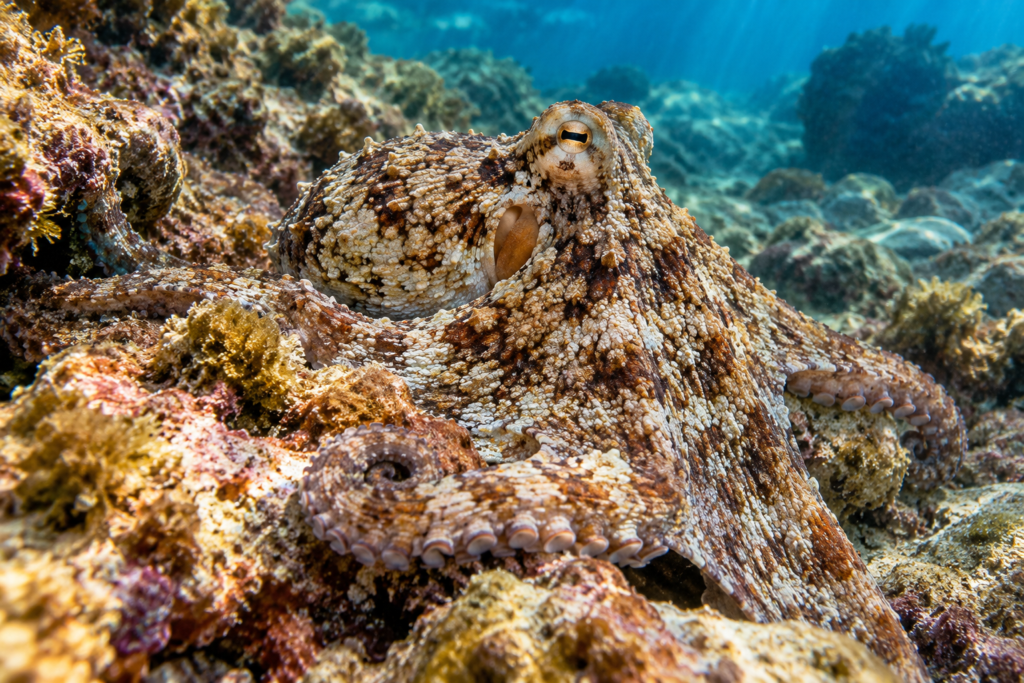
An octopus moves across the seafloor, settles beside a rock, and seems to disappear. Its skin becomes mottled, its outline changes, and a smooth surface develops bumps.
The transformation is not a slow process of growing new pigment. Much of the equipment is already present, waiting for muscular and nervous-system control to change its appearance.
Understanding this ability requires looking beyond color. Effective camouflage also involves brightness, pattern, texture, shape, and the way an animal positions its body.
Tiny muscles change how much pigment you can see
An octopus’s skin contains many chromatophore organs. Each includes an elastic pigment-containing sac connected to small muscles arranged around it.
When those muscles contract, they spread the sac outward. A larger patch of pigment becomes visible. When they relax, the sac retracts and its visible area becomes smaller.
The animal is therefore changing the display of existing pigment, rather than manufacturing a new skin color from scratch during every transformation.
Coordinated activity across many chromatophores creates patches, bands, spots, and broader changes in appearance. Nervous-system control allows these adjustments to occur rapidly.
The Smithsonian’s explanation of cephalopod color change describes these pigment structures as a central part of the transformation.
Pigment works alongside light-reflecting structures
Pigments are only part of cephalopod skin optics. Structures that reflect incoming light can contribute colors and brightness that pigment alone does not explain.
Two important terms are iridophores and leucophores. Their presence, arrangement, and properties vary among cephalopods.
Iridophores can produce structural optical effects, including iridescent appearances. Leucophores scatter light more broadly and can contribute pale or white regions.
An overlying pigment layer can modify what is visible from reflective structures below. The resulting appearance is an interaction between layers and illumination.
Change the visible colored area
Muscles expand and retract chromatophores, altering the pattern seen at the surface.
Change how light is returned
Reflective and scattering structures contribute to the skin’s final optical appearance.
This is not ordinary bioluminescence. Reflecting environmental light differs from producing light through a chemical reaction.
The octopus can change its surface texture too
Matching a rough rock with perfectly smooth skin could leave an animal conspicuous. Many octopuses address that problem with structures called papillae.
These muscular skin projections can be raised or flattened, changing the surface from relatively smooth to uneven or spiky.
The animal is not growing permanent spikes in seconds. It is changing the configuration of existing tissue.
A roughened surface can resemble features of nearby rocks or other seafloor structures. Flattening the projections produces a different outline.
The Marine Biological Laboratory describes papillae as part of three-dimensional camouflage in octopuses and cuttlefish. Detailed mechanisms studied in one species should not automatically be assumed identical in every other species.
Breaking up the body outline can be as important as matching color
Camouflage does not always require copying every detail of a background. An animal can become harder to recognize by disrupting the visual clues that reveal its body.
Imagine a plain silhouette against a patterned surface. Even if its average color is close, its continuous edge may remain obvious. Irregular patches can make that edge more difficult to follow.
Octopus camouflage can combine such pattern changes with arm placement, body posture, and the choice of where to settle.
| Feature | Possible contribution |
|---|---|
| Color and brightness | Reduce contrast with the surroundings. |
| Skin pattern | Make the body outline harder to recognize. |
| Surface texture | Resemble an uneven background. |
| Posture and position | Hide recognizable shapes or use nearby cover. |
These components help explain why a still photograph sometimes reveals an octopus only after someone points out its eye or arm.
Vision guides camouflage, but color vision presents a puzzle
Octopuses use visual information to respond to their surroundings. Features such as contrast, edges, and the scale of nearby patterns can supply useful information.
Interestingly, many studied octopuses appear to lack conventional color discrimination of the kind humans possess.
That does not mean they see nothing. Brightness and structure can guide a useful camouflage response without a human-like experience of color.
Researchers continue investigating how sensory information and skin optics combine to produce effective matches. Proposed mechanisms should not be presented as though every part of the puzzle has been solved.
A useful distinction is between detecting illumination and recognizing a scene. Those are different sensory capabilities.
Camouflage is effective, but not perfect invisibility
Whether a disguise works depends on the observer, distance, lighting, and movement. A pattern convincing to a person watching a video may appear different to a predator.
Researchers can therefore measure reflected light and model the visual systems of potential observers rather than judging success only by human impressions.
Color change also serves purposes beyond hiding. Depending on the species and situation, conspicuous patterns can participate in signaling or defensive displays.
- A changing pattern is not always camouflage. The surrounding behavior helps reveal its possible role.
- Species differ. Their skin structures, habits, and available patterns are not identical.
- Movement can reveal a hidden animal. Camouflage must work within an ongoing interaction, not just one frozen frame.
An octopus’s success comes from a flexible combination of tools, not a guarantee that it can copy any object perfectly.
Frequently asked questions
Does an octopus make new pigment every time it changes color?
No. Rapid changes mainly involve controlling existing pigment organs and other skin structures, rather than manufacturing a new pigment supply for each transformation.
Can an octopus change texture as well as color?
Yes. Many octopuses use muscular projections called papillae to alter the skin’s three-dimensional surface.
Does color blindness make camouflage impossible?
No. Contrast, pattern, and reflective skin properties can contribute to camouflage. The full relationship between sensory abilities and color matching remains an active research question.
Are all octopus color changes deliberate messages?
That should not be assumed. A change can occur in different behavioral contexts, and identifying its function requires evidence beyond the color alone.