
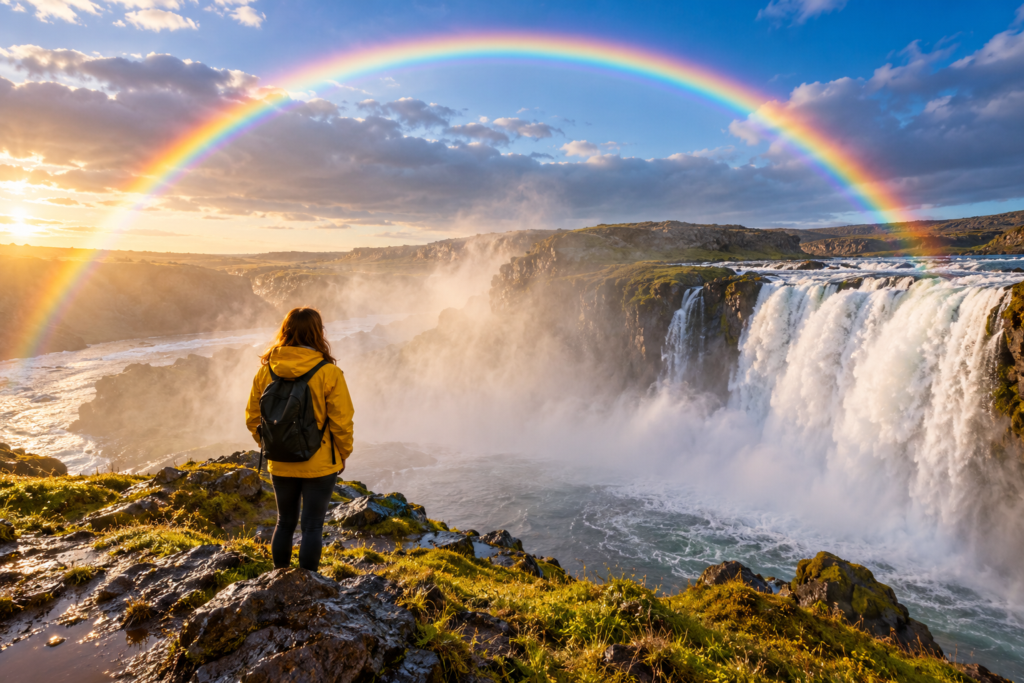
A rainbow looks like a colored bridge stretched across the landscape. Yet there is no solid arch suspended between two fields, and its ends do not mark places you could reach on foot.
What you see depends on a precise relationship between sunlight, water droplets, and your position. Understanding that geometry explains the curve, the colors, and why a second rainbow sometimes appears outside the first.
A water droplet redirects sunlight in several steps
Sunlight changes direction when it passes from air into water. This bending is called refraction. Inside a droplet, part of the light reflects from the inner surface and heads back toward the side where it entered.
When that returning light leaves the water, it refracts again. For the primary rainbow, the familiar bright inner bow, the important path includes one internal reflection between those two refractions.
Not every ray follows exactly the same route, and not all light entering a droplet returns toward you. The visible bow comes from the combined behavior of huge numbers of droplets, each contributing a small amount of light.
The National Weather Service’s rainbow explanation follows this path through a drop. Thinking of entry, reflection, and exit as separate steps makes the result easier to picture.
Sunlight already contains the colors
Water does not add colored dye to sunlight. White sunlight contains a range of visible wavelengths, and water bends those wavelengths by different amounts. This wavelength-dependent separation is called dispersion.
In a primary rainbow, red appears along the outer edge and violet toward the inner edge. The sequence is continuous: the familiar list of color names divides a smooth spectrum into convenient labels rather than seven sharply separated physical stripes.
The Optical Society’s educational explanation describes the different angles associated with different colors. A droplet’s position relative to your eye helps determine which part of that spectrum reaches you most strongly.
The curve comes from a circle of equal angles
Imagine a line pointing directly away from the Sun, passing through your head. The point where that direction meets the sky is called the antisolar point. The primary rainbow is centered on that direction.
Its red outer edge lies about 42 degrees from the antisolar direction, with violet closer to 40 degrees. Those numbers describe angular positions in your view, not a fixed distance to a colored object.
Now imagine all the directions that make the same angle with a central line. Together they form a cone. Seen from its tip, that cone outlines a circle. This is the geometry behind the rainbow’s round shape.
The World Meteorological Organization’s International Cloud Atlas describes this observer-centered arrangement. A rainbow is not curved because raindrops are arranged in a curved row or because it traces Earth’s surface.
Opposite the Sun
The antisolar direction provides the center of the rainbow’s circular geometry.
A particular viewing angle
Droplets near the right angular positions send the concentrated colored light toward you.
The ground usually hides the rest of the circle
A complete rainbow can form a circle, but a person standing on ordinary ground usually cannot see the lower part. The required viewing directions extend below the horizon, where terrain blocks the view or suitable illuminated droplets are absent.
From an aircraft or another elevated position, droplets can be visible below the observer as well as above. Under the right conditions, much more of the circle, sometimes the entire ring, becomes visible.
The Sun’s height matters too. As the Sun rises, the antisolar point moves farther below the horizon, lowering the rainbow. Near sunrise or sunset, a primary bow over level terrain can approach a semicircle.
This is why “sun behind you, droplets ahead” is a useful starting point when searching for a daytime rainbow. It specifies the arrangement, rather than promising that any shower will produce a visible bow.
You cannot walk to a rainbow’s endpoint
The light reaching your eyes is selected by your location. Move sideways, and the set of droplets sending that light toward you changes. The landscape may provide a convenient backdrop, but it does not anchor the bow.
Two people standing apart can describe almost the same rainbow while receiving light from different droplets. Their views share a pattern without sharing one physical colored arch.
Imagine pointing a flashlight through a room full of tiny reflective objects. Which ones shine toward you depends on where you stand. The details differ from a rainbow, but the comparison helps separate an illuminated object from a viewing-dependent pattern.
A spray from a fountain can also supply the droplets. Rain falling from a cloud is a common setting, not the only possible source of water drops.
A second reflection produces the outer rainbow
Some light reflects twice inside the droplets before emerging. This creates the secondary rainbow, which appears outside the primary bow and is usually fainter.
The extra reflection changes the outgoing geometry and reverses the color order. Red lies toward the inner edge of the secondary bow, while violet lies toward its outer edge.
NOAA’s guide to rainbow formation explains why that second bow appears at a different angle. It is another optical path through water droplets, rather than a reflection of the first rainbow off a cloud.
Frequently asked questions
Does every droplet produce only one color?
No. A droplet redirects different wavelengths along different paths. Your viewing position determines which of those rays reaches your eye.
Is a rainbow always a perfect semicircle?
No. How much is visible depends on the Sun’s height, your vantage point, and where illuminated droplets are present.
Why is there no reachable end?
The apparent endpoint belongs to your view. Changing your position changes the droplets contributing to the rainbow.