
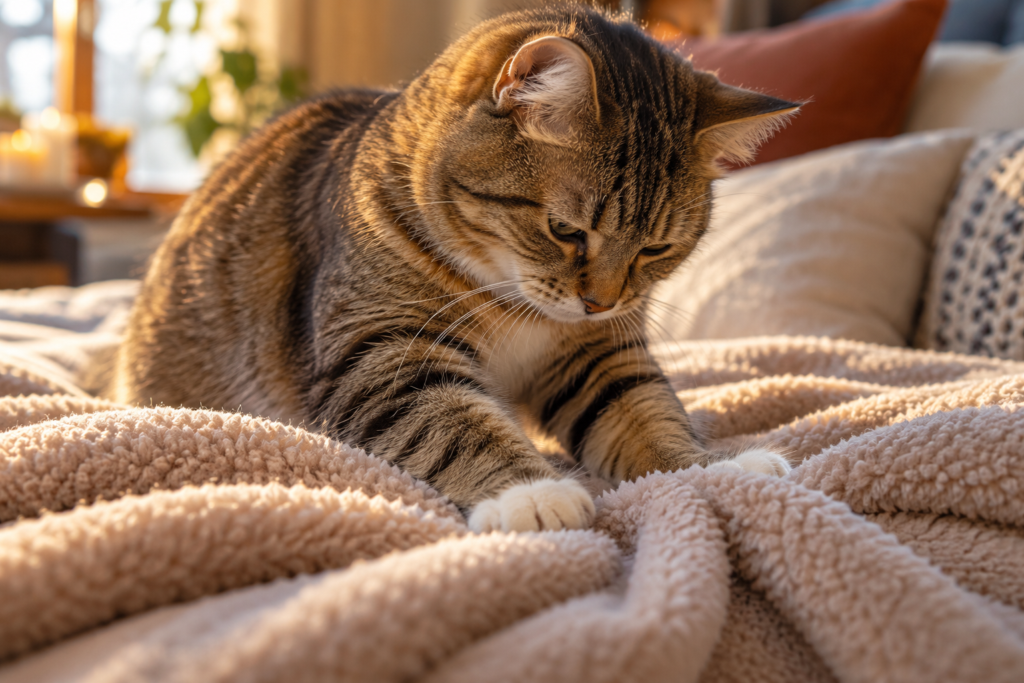
Your cat climbs onto a blanket, pauses, and starts pressing one front paw down, then the other. The movement becomes rhythmic, sometimes accompanied by purring, stretching toes, or a sleepy expression.
People often call this behavior “making biscuits” because it resembles kneading bread dough. Cats perform it on bedding, cushions, clothing, and occasionally a person’s lap.
The behavior has a clear connection with early life, but explaining every adult episode requires more care. A familiar movement can persist without having one obvious purpose in every situation.
Kneading is a repeated pressing movement
A kneading cat alternates pressure between its paws, most commonly the front pair. The toes may spread, and the claws may extend and retract during the movement.
The pattern can be gentle or vigorous. Some cats perform a short sequence before lying down; others continue for longer.
Kneading should be distinguished from scratching. Scratching involves a different pattern and serves functions such as maintaining claws and leaving signals on surfaces.
It is also different from a playful swipe or a defensive strike. Understanding the movement helps avoid treating every extended claw as an attempt to attack.
The movement starts during nursing
Kittens knead their mother’s abdomen while feeding. The action is associated with nursing and helps stimulate milk flow.
That gives the behavior an early connection with food, warmth, and contact. It also explains why adult kneading is often discussed as a retained kitten behavior.
But retaining a movement does not mean an adult cat mistakes every blanket for its mother. An early association and a literal belief are different ideas.
Consider a familiar human routine, such as wrapping yourself in a favorite blanket. The action can feel reassuring without requiring you to confuse your present surroundings with an earlier time.
The comparison is only an illustration. It does not establish exactly what a cat experiences internally.
Soft surfaces may invite a familiar settling routine
Adult cats commonly knead soft places where they are preparing to rest. Veterinary and welfare organizations describe the behavior as normal and often associated with contentment.
A blanket offers a yielding surface against which the paws can press. A cushion or covered lap can provide a similar opportunity.
Comfort is therefore a reasonable interpretation when a cat approaches voluntarily, kneads, and settles down calmly.
Still, context supports an interpretation rather than translating a gesture into one exact sentence. “My cat seems relaxed here” is more defensible than claiming to know its precise thoughts.
A familiar behavior
The cat presses its paws, chooses a surface, and may settle afterward.
A possible emotional context
Relaxed behavior can suggest comfort, without proving one universal motivation.
Other explanations are possible, but not equally established
Several theories appear in discussions of adult kneading. They should be presented as possibilities rather than combined into a definitive explanation.
One proposes a connection with preparing a resting place. Another concerns scent signals, because cats have scent glands associated with their paws.
Those ideas can be biologically plausible without proving what motivates a particular cat pressing a fleece blanket.
Cats Protection emphasizes that the reason adult cats continue kneading remains uncertain. The kittenhood connection is clearer than a single demonstrated purpose for every adult occurrence.
Does kneading you mean your cat loves you?
A cat voluntarily settling on your lap can be a reassuring sign that it feels comfortable in that setting.
However, kneading is not a scientific test of affection. Cats differ in how they interact, and some prefer particular fabrics or resting places.
A cat that kneads a blanket but not your lap is not automatically less attached to you. Likewise, a cat that rarely kneads may show social comfort through other behaviors.
Imagine two cats choosing the same room to rest. One kneads a cushion first; the other lies down immediately. The difference alone does not rank their relationships with the people nearby.
Observe the broader pattern rather than making one gesture carry every possible meaning.
How to respond when kneading becomes uncomfortable
Normal kneading can still hurt when claws reach bare skin. You do not need to tolerate pain to allow your cat a comfortable routine.
- Use a protective layer. A thick blanket or cushion on your lap can provide a suitable surface between paws and skin.
- Offer another resting spot. Place a comfortable blanket beside you so the cat has an alternative.
- Reposition gently. If the pressure hurts, calmly adjust the situation instead of shouting or startling the cat.
- Avoid punishment. Kneading is usually normal. Punishing it can make an otherwise relaxed interaction unpleasant.
Choose bedding that remains intact and does not shed loose strands your cat can swallow. Providing an appealing surface is more useful than insisting on one particular blanket.
Look at changes and accompanying behavior
Kneading alone is usually not a cause for concern. A change becomes more informative when considered alongside the cat’s overall behavior.
For example, kneading and swallowing fabric are not the same thing. Ingesting nonfood material is a separate issue that deserves veterinary advice.
Similarly, a cat that appears painful, distressed, or unable to settle needs a broader assessment rather than a diagnosis based on kneading.
| Observation | Useful response |
|---|---|
| Kneading before resting. | Allow a comfortable, suitable surface. |
| Claws pressing into your skin. | Add a thick layer or redirect gently. |
| Swallowing blanket fibers. | Remove access to that material and seek veterinary advice. |
| A sudden change with apparent discomfort. | Discuss the broader change with a veterinarian. |
Frequently asked questions
Does kneading mean a cat was weaned too early?
Not by itself. Adult kneading does not provide enough evidence to reconstruct a cat’s early history. It occurs as a normal behavior in many cats.
Why does my cat prefer one blanket?
Texture, location, and familiar associations may contribute. A preference does not reveal one certain explanation without considering the individual cat.
Is kneading the same as scratching?
No. Kneading is typically an alternating pressing movement. Scratching involves a different action, even though both can involve extended claws.
Should I stop my cat from kneading?
Usually, there is no need to stop comfortable kneading. If it hurts or damages fabric, offer protection or another surface without punishment.
Is it a problem if my cat never kneads?
Not on its own. Cats vary, and kneading is not required to demonstrate comfort or a bond with a person.