
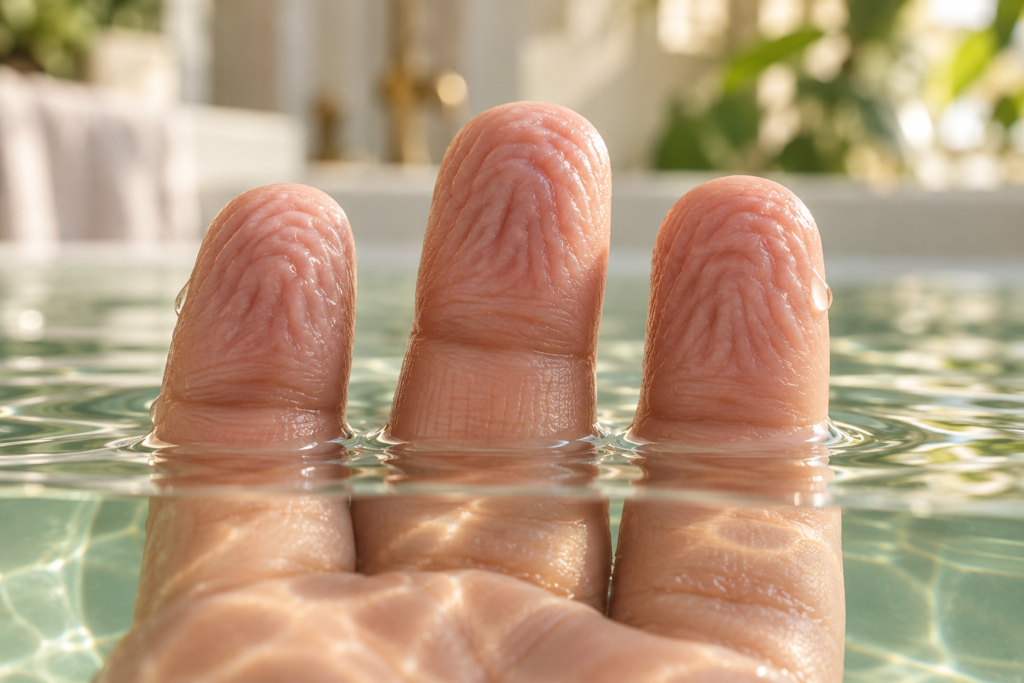
After a long bath or swim, your fingertips can look as though they have aged in fast-forward. Dry them, wait, and the distinctive ridges gradually disappear.
The obvious explanation is that the skin simply soaked up water and expanded. Water does affect skin, but the patterned wrinkles of immersed finger pads involve a more interesting interaction between nerves, blood vessels, and tissue mechanics.
Fingertip wrinkling is more than passive water absorption
Skin is not an inert waterproof sheet. Immersion changes its physical environment, and the outer layers can interact with water. However, that alone does not account for every feature of water-induced fingertip wrinkling.
Evidence that nerve function matters led researchers to investigate an active physiological response. The characteristic wrinkling can be altered when the relevant nerve supply is disrupted.
A research paper on immersion and grip reviews this evidence while examining the possible function of the wrinkles.
The distinction is important: water exposure starts the situation, but the body participates in producing the visible pattern.
Narrowing vessels changes the support beneath the surface
The sympathetic nervous system helps regulate the small blood vessels in the finger pads. During prolonged immersion, vasoconstriction, or vessel narrowing, contributes to a reduction in the volume of the tissue beneath the skin.
As that underlying support changes, the surface can buckle into folds. The result is the familiar pattern of ridges and channels.
Binghamton University’s account of fingertip research explains the relationship between blood vessels and the visible wrinkles.
Think of a flexible covering supported by material underneath. Changing the support can change the covering’s shape without requiring the covering to have independently grown into every ridge. The comparison illustrates the mechanics rather than reproducing all the biology.
The pattern is influenced by the structures underneath
If you have ever wondered whether the same finger makes the same wrinkles after another bath, researchers have asked that question too.
A 2025 study of wrinkle topography compared patterns after separate immersions. It found correspondence in the orientation of wrinkles across the two observations.
The researchers connected this repeatability to the relatively stable organization of the blood vessels beneath the skin. The pattern is not simply a fresh random crumpling every time.
That finding does not mean every line will look perfectly identical under every possible condition. It supports a relationship between the underlying anatomy and the folds that appear during comparable immersion.
Some experiments suggest an advantage when handling wet objects
One hypothesis proposes that the channels help manage water at the contact surface, somewhat like tread on a tire. If water is displaced more effectively, handling a wet object might become easier.
A Newcastle University study reported faster handling of submerged objects with wrinkled fingers than with unwrinkled fingers, without a corresponding improvement for dry objects.
This made the grip hypothesis attractive because it offered a functional explanation as well as a mechanism. Instead of being an incidental side effect, wrinkling might provide an advantage in watery conditions.
But a plausible analogy and one positive finding are not enough to establish an evolutionary explanation. Other tasks and independent experiments need to be considered.
Not every experiment has found the same benefit
A Max Delbrück Center study did not reproduce the claimed advantage in a dexterity task. It also found no improvement in the touch-sensitivity measures tested.
By contrast, the 2021 grip-force study found that wrinkled fingers handled wet conditions with more efficient force coordination than wet, unwrinkled fingers.
Those experiments did not measure exactly the same outcome. Moving objects quickly, detecting a tactile pattern, and choosing an economical grip force are related but distinct abilities.
A careful conclusion is that wrinkles may help certain aspects of wet handling under some conditions. Saying that they have been proven to improve every kind of grip would go beyond the evidence.
How the folds form
Nervous-system activity and vessel narrowing help change the tissue beneath the skin.
What benefit they provide
Wet-grip experiments test a separate question, and their results require qualification.
Bath wrinkles are different from permanent skin aging
The short-lived folds after immersion are a reversible response to a particular condition. They should not be equated with the longer-term structural changes involved in aging skin.
After exposure ends and the tissues return toward their usual state, the pronounced pattern fades. Your fingertips have not permanently aged during a swim.
The University of Texas Medical Branch’s discussion of pruning distinguishes the water-induced response and its relationship to vasoconstriction.
This is another reason to avoid explaining every kind of wrinkle with one mechanism. Similar-looking surface folds can arise through very different processes.
A simple bath observation contains several scientific questions
The phenomenon invites at least three separate questions: what initiates the response, how the tissue changes shape, and whether the resulting pattern provides a useful function.
An experiment that answers one does not automatically settle the others. Finding repeated wrinkle patterns helps explain structure; measuring grip addresses performance.
Keeping those questions separate gives a more accurate story than the familiar claim that fingers wrinkle only because they absorb too much water, or the equally sweeping claim that every wrinkle is a proven adaptation for swimming.
Frequently asked questions
Are the wrinkles just water swelling the skin?
Water affects skin, but the characteristic fingertip pattern also involves an active response associated with nerves and blood-vessel narrowing.
Do wrinkles definitely make wet objects easier to hold?
Some experiments find benefits, while others do not. Results depend in part on the specific task and measurement.
Are these the same as age-related wrinkles?
No. Ordinary immersion wrinkles are temporary and arise in a different physiological context.