
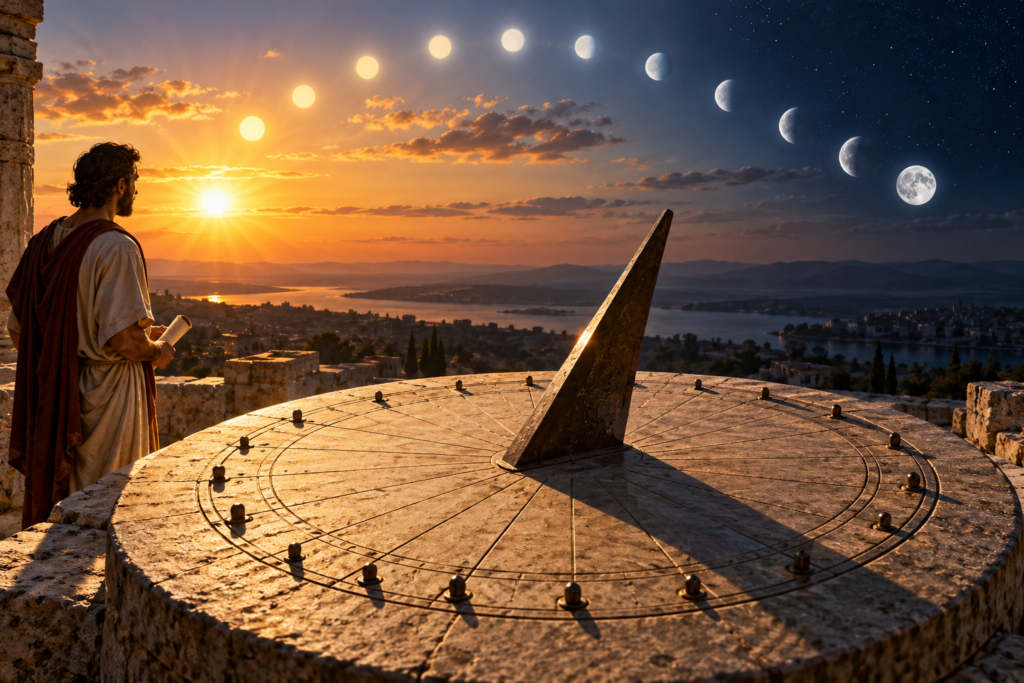
A day has 24 hours, an hour has 60 minutes, and a minute has 60 seconds. We learn these numbers so early that they can seem like unavoidable facts of nature.
But Earth does not rotate in twenty-four visible steps. The repeating cycle of daylight and darkness is natural; dividing that cycle into named units is a human convention.
Our system developed gradually. Its history connects Egyptian observations of the sky, astronomical calculations, and the practical need to measure time consistently. It also contains a surprise: an ancient “hour” could change length with the seasons.
Earth supplies the cycle, but not the number 24
Earth’s rotation produces the familiar alternation of daylight and darkness. Observing the Sun gives people a repeating reference for organizing activities.
That reference does not come with numbered divisions. People must choose how to describe the intervals within it and how to measure them.
Consider dividing a circular diagram into sections. You could draw ten equal sections, twelve, or twenty-four. The underlying circle remains the same; only the measurement scheme changes.
Dividing a day works similarly. A different number of hours would not make the day physically longer or shorter. It would change the duration assigned to the unit called an hour.
Ancient Egyptian timekeeping supplied an important foundation
Ancient Egyptian practices are central to the history of the 24-hour day. Egyptian timekeeping developed divisions of daylight and nighttime associated with twelve parts each.
During daylight, shadows could provide information about the Sun’s progress. At night, observations of stars offered another way to follow time. Water clocks supplied an additional measuring method.
The Metropolitan Museum of Art describes Egyptian timekeeping through surviving objects and records, including shadow clocks, water clocks, and astronomical evidence.
These practices developed over a long period. It would be misleading to imagine one inventor unveiling the complete modern system, with twenty-four identical hours and digital-style precision.
The key inheritance is the pairing of two twelve-part divisions. That provides a historical route toward the total of twenty-four.
Why use twelve parts in the first place?
Several explanations are proposed for the importance of twelve. One concerns counting the finger segments of one hand with the thumb: four fingers, each with three segments, provide twelve positions.
Another points to the roughly twelve lunar phase cycles within a year. These are possible influences, rather than proof that one simple observation caused the entire system.
Twelve also has useful arithmetic properties. It divides evenly by two, three, four, and six. That makes it convenient when people want halves, thirds, or quarters.
However, convenience is not the same as historical evidence of a specific decision. We should distinguish “twelve is useful” from “we know exactly why every ancient timekeeper chose it.”
Once a division becomes established, later users can inherit it without independently choosing the same number for the same reason.
An ancient hour could be longer in summer
Dividing daylight into twelve parts creates an interesting consequence. Where daylight length changes with the seasons, the length of each daylight part changes too.
A summer day with more daylight produces longer daylight hours. Its shorter night produces shorter nighttime hours when darkness is also divided into twelve.
These are often called seasonal or unequal hours. They differ from today’s expectation that a one-hour appointment lasts the same duration in July and January.
| Available daylight | Division | Length of each daylight part |
|---|---|---|
| 12 modern hours | 12 equal parts | 60 modern minutes |
| 14 modern hours | 12 equal parts | 70 modern minutes |
| 10 modern hours | 12 equal parts | 50 modern minutes |
The table illustrates the arithmetic, not a claim that all Egyptian instruments measured these exact examples. Ancient methods and conventions varied.
Astronomy benefited from hours of equal length
Seasonal hours can describe the progress of daylight, but they complicate comparisons. An interval measured as two daytime hours need not have the same duration in different seasons.
Equal units are more convenient for calculations involving observations made at different times of year.
Greek astronomy used equal divisions known as equinoctial hours. Hipparchus, working in the second century BCE, is associated with this development. The name refers to the equinox, when daylight and darkness are approximately equal.
Using twenty-four equal parts preserves the familiar total while removing seasonal differences in the unit.
The unit follows daylight
Dividing changing daylight into twelve parts makes the duration of each part change.
The unit stays consistent
Dividing the full daily cycle into equal parts supports consistent comparisons.
Equal hours in astronomical work did not instantly replace every everyday custom. The spread of mechanical clocks later helped make regular hours a practical part of daily timekeeping.
Minutes and seconds come from another numerical tradition
The day uses twenty-four hours, but its smaller divisions use sixty. That mixture reflects a history assembled from more than one tradition.
Babylonian mathematics and astronomy used a base-sixty, or sexagesimal, system. Related astronomical practices influenced the subdivision of measurements into sixtieths.
Sixty has many convenient divisors: two, three, four, five, six, ten, twelve, fifteen, twenty, and thirty. Fractions of sixty can therefore be expressed neatly in many situations.
But we should not project a modern clock backward onto ancient Egyptian life. The Met notes that there is no evidence Egyptians tracked minutes and seconds as we do.
Today’s arrangement combines a twenty-four-part day with smaller units whose development followed a different path.
Could we use ten hours instead?
Mathematically, yes. Imagine dividing the same full day into ten equal units called hours. Each would last 2.4 of our current hours.
Nothing about Earth’s rotation would change. An event would take the same physical interval, but its numerical description would be different.
The challenge would be coordination. Consider how many familiar arrangements assume the current system:
- Daily schedules. Work periods, appointments, and transport timetables use shared clock conventions.
- Measuring equipment. Devices and software display and calculate durations using established units.
- Written records. Historical timestamps need interpretation within their original conventions.
- Everyday expectations. People have learned what “half an hour” or “five minutes” feels like.
This thought experiment shows why a system can be conventional without being arbitrary in everyday use. A shared definition makes communication possible, even when other definitions could have been chosen.
Frequently asked questions
Who invented the 24-hour day?
No single person created the complete modern system. Egyptian divisions of day and night supplied an important foundation. Later astronomy and clockmaking contributed to equal-hour timekeeping.
Were ancient Egyptian hours always sixty minutes long?
No. Dividing daylight and darkness separately could produce hours of different durations as the seasons changed. Modern minutes should not be assumed for every ancient use of the word “hour.”
Does a twelve-hour clock mean the day has only twelve hours?
No. A twelve-hour display repeats its numbering twice during the full day. A twenty-four-hour display numbers the same cycle without that repetition.
Is twelve important because of finger counting?
Counting finger segments is one proposed explanation for the usefulness of twelve. It should not be treated as a proven, complete account of how the hour system originated.
Did people always need precise minutes?
No. Timekeeping methods and required precision depended on the activity. Dividing daylight into broad intervals is a different task from timing a modern experiment or coordinating a train departure.