
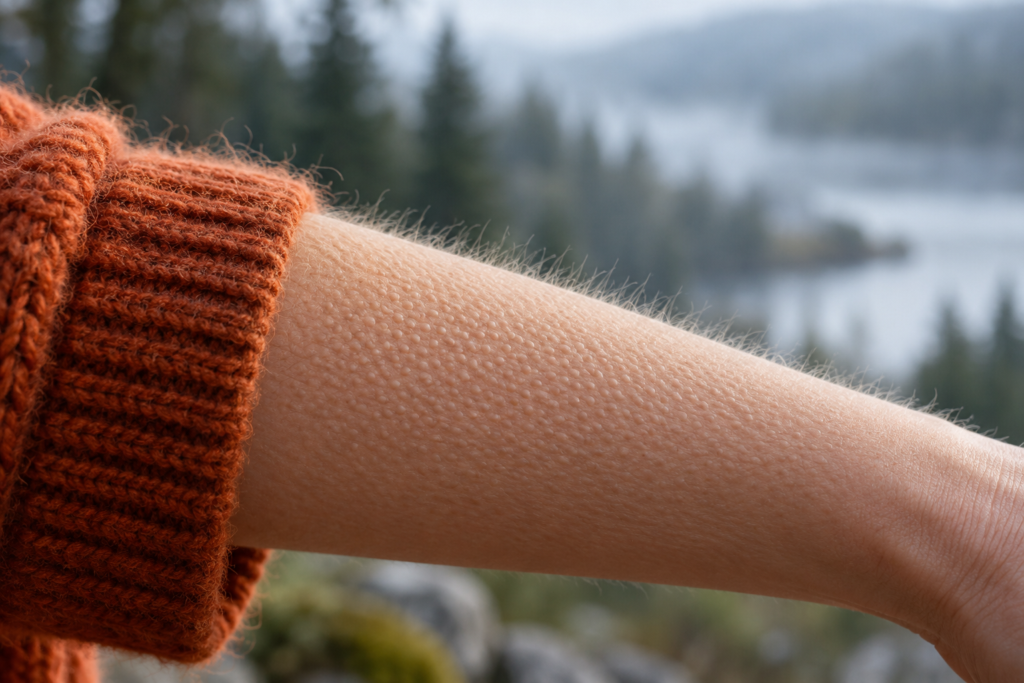
A cool breeze reaches your bare arm, and the surface changes within moments. Small bumps appear around the hairs, which stand more upright than before.
You have not consciously flexed those muscles. The response is automatic, and it makes more sense when viewed as part of the biology of hair-covered mammals rather than as a powerful substitute for a sweater.
Tiny muscles change the position of individual hairs
Each relevant hair follicle is associated with a small smooth muscle called an arrector pili muscle. When it contracts, it changes the angle of the follicle and raises the hair.
Because the muscle also interacts with the surrounding skin, its contraction produces a small raised area. Many follicles responding together create the familiar bumpy texture.
The Smithsonian’s Human Origins Program describes the cold response as an inherited feature of our mammalian history.
The bump and the raised hair are therefore two visible parts of one mechanical event. They are not separate structures suddenly growing on your arm.
Sympathetic nerves activate the muscles
The muscles are controlled through the sympathetic nervous system, a division involved in regulating many involuntary body responses.
Cold-related signals can lead to their contraction without a deliberate command from you. You notice the result rather than planning the movement hair by hair.
Harvard Health’s explanation connects the skin muscles with sympathetic nerve activity.
The word “sympathetic” here is anatomical, not emotional. It identifies a part of the nervous system; it does not mean that your skin is expressing sympathy or that every goosebump signals fear.
A thicker layer of still air can reduce heat loss
In an animal with dense fur, raising the hairs changes the coat’s structure. Air held among the hairs can provide insulation, reducing heat transfer from the skin to the surroundings.
The effect depends on having enough hair to form a meaningful layer. Raising a thick coat is different from lifting scattered fine hairs on a human forearm.
The Society for Neuroscience’s discussion of piloerection explains the relationship between raised hair and the retention of warm air.
Insulation does not create heat from nothing. It helps preserve warmth by changing how readily heat escapes. That distinction is the same reason a warm coat is useful without being a heater.
Our body hair is sparse, but the associated machinery remains
Humans have much less dense body hair than many other mammals. The same basic hair-raising response therefore produces conspicuous bumps without building a comparably thick insulating layer.
That makes goosebumps a useful example of an inherited response whose visible form can outlast a major change in the surrounding anatomy.
It would be too strong to claim that the system has no biological role at all. The limited insulation offered by human body hair is one question; the other functions of its muscles and nerves are another.
Cleveland Clinic’s account describes the physical reaction and its occurrence under several kinds of stimulation.
A substantial coat changes shape
Raising many hairs can improve the layer of air held near the skin.
The bumps are easier to notice
Sparser hair makes the muscle response visible without creating a thick fur layer.
The same neighborhood also helps regulate hair growth
Research has revealed a connection between this system and hair follicle stem cells, the cells involved in regenerating hair.
A 2020 study published in Cell investigated relationships among sympathetic nerves, arrector pili muscles, and hair follicle stem cells. Experiments in mice showed that these components form an interacting system.
Under cold conditions, increased sympathetic activity was linked with both the immediate hair-raising response and changes in stem-cell activation associated with producing a new coat.
The Harvard Stem Cell Institute’s explanation presents this as a connection between an immediate response and longer-term tissue regulation.
Mouse findings should not be turned into a promise that repeatedly getting cold will regrow human hair. The experiment explains a biological relationship, not a home treatment.
Different muscle systems produce different responses
Goosebumps involve tiny smooth muscles at hair follicles. Shivering involves contractions of larger skeletal muscles and is a different way the body responds to cold.
They can occur in the same broad situation without being identical. One changes the position of hairs; the other involves a much more noticeable pattern of muscle activity.
Keeping the distinction clear helps explain why an arm can develop goosebumps without the whole body visibly shaking. The presence of one response does not tell you that every other cold response is occurring at the same intensity.
Other stimuli can reach the same final pathway
Fear, excitement, and emotionally moving experiences can also accompany goosebumps. The final contraction of the follicle-associated muscles may look similar even when the initiating situation differs.
A systematic review of emotional piloerection distinguishes the measurable skin response from related subjective experiences such as chills.
That distinction matters because people sometimes use “chills” to describe several sensations. Feeling a wave of emotion does not guarantee that a camera would record raised follicles at the same moment.
For cold-induced goosebumps, the straightforward explanation remains the automatic muscle response. Emotional triggers show that the same visible machinery can participate in more than one context.
Frequently asked questions
Do goosebumps mean I am frightened?
No. Cold is a common trigger, and other situations can produce them too.
Do the hairs grow longer when they stand up?
No. The immediate change is mainly their angle and the position of the follicle, not sudden growth in hair length.
Are goosebumps enough to keep a person warm?
No. Sparse human body hair cannot provide the insulation of a dense fur coat.
Does the hair-growth study prove a treatment for people?
No. The reported experiments investigated biological mechanisms, including work in mice, rather than establishing a human treatment.