
Seven days feels like a natural interval. We plan work, lessons, shopping, and rest around it, often without asking why the cycle contains seven parts.
Earth does not complete a special seven-day movement. Neither the month nor the year divides neatly into whole weeks. Yet the cycle continues across their boundaries without restarting.
Understanding that persistence requires separating possible early influences from the traditions that made the week an enduring social institution.
A week is different from a day or a year
A day relates to Earth’s rotation and the apparent daily movement of the Sun. A seasonal year follows the repeating cycle of the seasons.
Seven days does not correspond to an equally direct planetary cycle. It is a recurring division that people maintain.
The Moon offers a possible connection. A full cycle of lunar phases lasts about 29.5 days. Dividing it into four parts gives intervals of roughly 7.4 days.
That resemblance helps explain why lunar phases enter discussions of the week’s origins. But a continuous seven-day cycle does not remain synchronized with the Moon.
The number seven had important ancient associations
Accounts of the week’s development commonly discuss Mesopotamian traditions, including Babylonian astronomy and the cultural importance of seven.
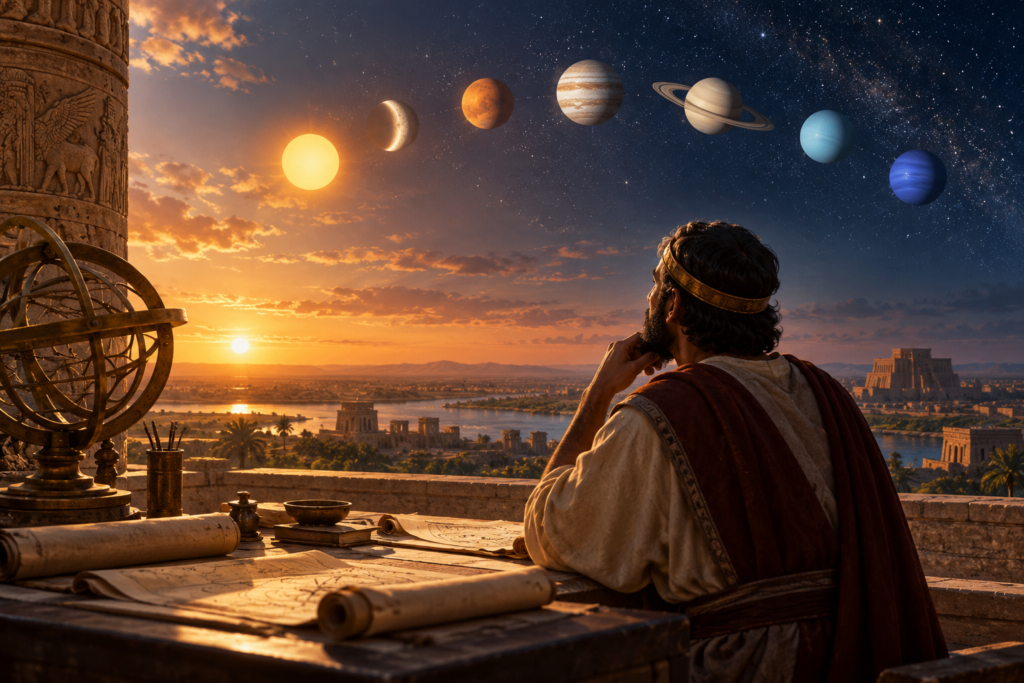
Ancient observers distinguished seven prominent moving heavenly bodies: the Sun, the Moon, Mercury, Venus, Mars, Jupiter, and Saturn.
In historical astrological usage, the Sun and Moon could be grouped with the five visible planets. That is different from the modern scientific definition of a planet.
However, the connection should not be turned into an overly precise invention story. Ancient observances associated with particular days are not automatically identical to the uninterrupted week used today.
It is more accurate to describe several contributing traditions than to claim that one ruler created the complete modern arrangement on a securely documented afternoon.
Jewish practice preserved a repeating seven-day rhythm
The Jewish Sabbath, or Shabbat, is central to the history of the week. Jewish tradition describes six days of work followed by a seventh day of rest.
This cycle has religious meaning beyond its usefulness for scheduling. The seventh day is identified through an ongoing weekly sequence.
The Jewish Museum in Prague identifies Shabbat as the seventh day, dedicated to prayer and rest. Jewish observance runs from Friday evening to Saturday evening.
An important consequence is continuity. A new month does not require the weekly sequence to begin again. Religious observance gives the cycle a reason to persist across other calendar divisions.
Describing this role does not settle every question about the earliest relationship between Jewish and neighboring timekeeping traditions. It identifies a major historical institution that maintained the pattern.
The planetary week connected days with celestial figures
Another important tradition assigned days to the seven classical celestial bodies. This planetary week circulated in the ancient Mediterranean world.
Surviving art provides evidence of these associations. The archaeological site of Itálica presents a planetary mosaic through its Days of the Gods exhibition .
The familiar order of weekday associations was not simply the order in which the planets appear by distance from Earth or the Sun. Astrological schemes included assignments to successive hours.
You do not have to accept those beliefs to recognize their influence. Historical systems can leave durable names and conventions after their original explanations cease to guide everyday life.
A recurring sacred day
Sabbath observance gives meaning to a continuing sequence of seven days.
Days linked with heavenly bodies
Ancient astrological traditions connect the days with seven celestial figures.
These strands belong to a connected history, but they should not be collapsed into one identical practice.
Roman and Christian institutions helped reinforce the cycle
Roman society did not always organize recurring activities around the same seven-day pattern. An older market cycle operated alongside later developments.
The seven-day week became increasingly established within the Roman world. Christianity also attached particular importance to Sunday.
In 321 CE, Emperor Constantine issued legislation establishing Sunday rest for specified activities, with exceptions. This was an important institutional milestone, not the invention of the seven-day cycle.
The distinction matters because a government can reinforce an existing practice without originating every part of it. Religious observance, custom, and civil regulation can influence one another.
Later adoption across societies extended the week’s practical reach. Its widespread use should not be mistaken for evidence that every culture independently invented the same arrangement.
The week persists because people coordinate around it
Once institutions share a repeating schedule, changing the cycle affects much more than a calendar’s appearance.
Imagine a hypothetical community switching to six-day weeks while its neighbors retain seven. A gathering scheduled for every seventh day would no longer align consistently with the new local cycle.
The difficulty is coordination, not a mathematical impossibility. Other cycle lengths can be imagined, but maintaining a shared rhythm has value.
| Interval | Relationship to seven-day weeks |
|---|---|
| 28 days | Exactly four weeks. |
| 30 days | Four weeks plus two days. |
| 31 days | Four weeks plus three days. |
| 365 days | Fifty-two weeks plus one day. |
This arithmetic explains why the same date normally falls on a different weekday the following year. The week continues while the year boundary moves through the cycle.
A weekend is a separate convention
Having a seven-day week does not automatically specify which days are workdays or how many days form a weekend.
Likewise, choosing which day appears first on a printed calendar does not change the underlying sequence. Presentation, religious significance, and work arrangements are related but distinct.
Frequently asked questions
Does Earth complete a special movement every seven days?
No astronomical motion requires the familiar seven-day week. It is a historical convention maintained through continuous use.
Is a week exactly one-quarter of a lunar month?
No. One-quarter of a roughly 29.5-day lunar cycle is about 7.4 days, not exactly seven.
Did Constantine invent the week?
No. His Sunday legislation reinforced an existing seven-day cycle within a much longer history.
Does a new month restart the weekdays?
No. The sequence continues across month and year boundaries without resetting.
Does every seven-day week imply the same weekend?
No. Work schedules and days of religious observance are separate arrangements within the cycle.