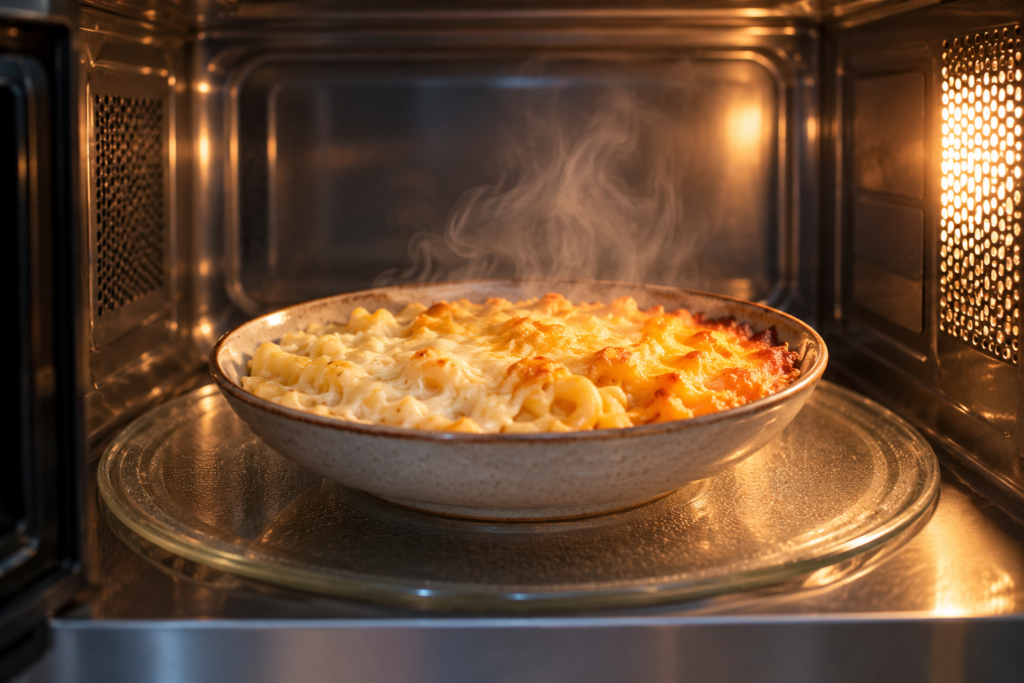
You take a bowl out of the microwave, taste a spoonful, and discover that it is barely warm. After another heating cycle, one mouthful is scorching while a different section still feels cold.
This familiar problem is not explained by a single defect. Microwave cooking combines electromagnetic energy with the physical properties of food, and neither is perfectly uniform.
Understanding those two parts explains why a spinning plate helps without solving everything, why a thick frozen portion can be especially difficult, and why pausing to stir is often more useful than simply adding another uninterrupted minute.
Microwaves transfer energy into food
A microwave oven generates electromagnetic waves that interact with food. Its changing electric field influences polar molecules, including water, and dissolved ions. Energy absorbed through these interactions becomes heat.
Water is important, but “microwaves only heat water” is an oversimplification. The way a food absorbs energy depends on its overall composition and physical condition.
Unlike a conventional oven, which heats food largely through its surroundings and surfaces, a microwave can deposit energy beneath the surface. However, that does not mean it heats an entire portion equally or reaches an unlimited depth.
Think of microwave heating as energy being absorbed in a pattern, followed by heat spreading within the food. An uneven absorption pattern can therefore produce uneven temperatures.
The energy inside the oven is not evenly distributed
The metal cooking cavity reflects microwaves. As waves travel and reflect, they overlap, creating a spatial pattern with stronger and weaker electric fields.
Under suitable conditions, these patterns are described as standing-wave modes. Their practical consequence is that different locations can deliver different heating effects. The food itself also influences the field and absorbs energy.
A meal positioned in that environment does not receive a perfectly even shower of energy. Some regions may absorb more than others.
Why the turntable helps
A rotating plate moves food through different positions relative to the field pattern. Other oven designs use mechanisms that redistribute the microwave field.
These approaches improve uniformity, but they do not eliminate differences within the meal. Rotation cannot make a thick piece of meat and a thin layer of sauce behave identically.
Your meal is a mixture of different materials
A plate of leftovers might contain rice, vegetables, sauce, and pieces of chicken. Even when everything starts at the same refrigerator temperature, the ingredients do not necessarily warm at the same rate.
Water content, dissolved salts, fat, and food structure affect microwave interactions. Ingredients also differ in the energy needed to raise their temperature and in how readily heat moves through them.
This creates two separate questions: how much microwave energy does a region absorb, and what happens to that energy after absorption?
How much energy enters?
Composition and local field conditions help determine how strongly a region interacts with the microwaves.
Where does the heat go?
Heat can move into neighboring regions, but the speed and pattern depend on the food’s properties.
Because these factors interact, there is no universal rule that the wettest-looking ingredient must always finish hottest. A mixed dish is more complicated than that.
A thick mound creates a different problem from a thin layer
Imagine reheating the same amount of mashed potato in two arrangements: one tall mound and one shallower, more even layer. The ingredients have not changed, but the geometry has.
In a thick portion, heat has farther to travel between regions. Parts receiving less direct heating can remain cool while other areas become excessively hot.
Irregular shapes create another challenge. Thin edges, bulky centers, and differently sized pieces do not offer the same heating conditions.
| Factor | How it can affect heating |
|---|---|
| Field distribution | Different locations receive different heating effects. |
| Ingredient composition | Regions absorb energy and distribute heat differently. |
| Thickness | Thick portions can require more heat redistribution to warm throughout. |
| Starting temperature | Frozen, chilled, and warmer regions begin with different heating requirements. |
| Arrangement | Overlapping pieces and deep piles can make uniform heating harder. |
This is why arranging food in reasonably even portions can help. However, a particular arrangement is not a substitute for the instructions supplied with a packaged meal.
Frozen food adds another layer of unevenness
A partly frozen meal contains regions in different physical states. Ice and liquid water do not interact with microwaves in the same way, and melting also requires energy.
As some areas thaw, the heating pattern can become increasingly uneven. A softened outer region may heat rapidly while another section remains frozen.
That helps explain the frustrating combination of cooked edges and an icy center during defrosting. Increasing the power does not automatically resolve the mismatch.
Use the defrosting or cooking method specified for the food. Some products are designed to be cooked directly from frozen, so thawing everything first is not a universal rule.
When microwave-defrosting raw meat or poultry, follow food safety guidance to cook it immediately afterward. Defrosting can leave some areas warm or partly cooked while others are still cold.
How to help the heat spread more evenly
The most useful adjustments address both sides of the problem: uneven energy absorption and the time required for heat to redistribute.
- Stir when the food allows it. Move food from the edges toward the center and mix different layers. Stirring redistributes warm and cool portions rather than merely moving the container.
- Rearrange or turn solid pieces. Where appropriate, change their positions during heating. Follow package directions about when to turn or separate them.
- Avoid unnecessarily deep piles. For ordinary leftovers, a shallower, reasonably even arrangement can be easier to heat throughout.
- Cover as directed. A suitable microwave-safe cover helps retain moisture and steam. Leave the required venting space rather than sealing food in an airtight container.
- Use the recommended power and timing. Lower-power programs can allow more time for heat redistribution. Many ovens achieve reduced power by cycling the energy on and off; others regulate it differently.
- Include the standing time. After heating stops, energy already in the food continues to redistribute. Follow the specified standing time instead of treating the beep as the end of the process.
Use containers labeled microwave-safe and open covers carefully, directing escaping steam away from your face and hands.
A steaming surface does not prove the center is ready
Uneven heating affects more than eating quality. A cold spot can remain below the temperature needed for safe preparation, even while another part is visibly steaming.
For leftovers, USDA guidance recommends reheating to 165°F (74°C) throughout. Check the temperature in several locations with a food thermometer, following the recommended standing time.
Other foods and cooking situations have their own requirements. Follow the relevant safety guidance and the package instructions rather than applying one cooking time to every meal.
Do not judge readiness by a single bite, the temperature of the bowl, or whether the surface is bubbling. Those observations cannot establish the temperature everywhere inside the food.
Frequently asked questions
Does uneven heating mean my microwave is broken?
Not necessarily. Some unevenness results from normal microwave heating and the food itself. If performance changes noticeably, the turntable stops working, or the appliance behaves abnormally, consult the manufacturer’s troubleshooting guidance.
Why is the bowl hot while the food is still cold?
A container can absorb microwave energy to varying degrees and can also receive heat from the food. Its temperature is not a reliable measurement of the meal’s internal temperature. Use an appropriate microwave-safe container.
Will maximum power always heat food more evenly?
No. Faster energy delivery can overheat some regions before heat spreads into others. Appropriate power, stirring, and standing time can matter more than using the highest setting.
Does the rotating plate remove every cold spot?
No. Rotation changes the food’s position relative to the field, but differences in thickness, composition, and starting temperature remain. Stirring or rearranging may still be necessary.
Can the inside be hotter than the outside?
Yes. Temperature patterns depend on the food. A filling can be much hotter than the surrounding pastry, for example. A surface that feels only warm does not guarantee that the interior is comfortable to eat.