
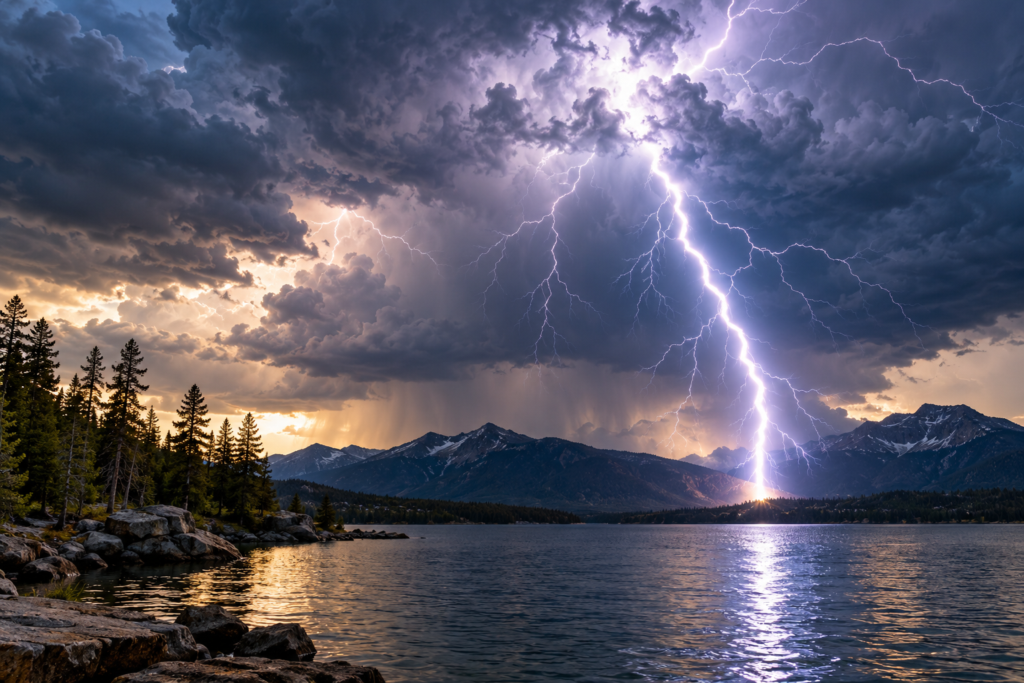
A flash lights up the clouds. A few seconds later, a sharp crack or rolling rumble follows. The two events feel separate, but they come from the same electrical process.
Lightning creates the light and the rapid heating. Thunder is the sound produced as the heated channel expands.
Understanding the sequence also explains why the flash arrives first, why thunder can rumble, and why a storm does not need to be directly overhead to matter.
A thunderstorm can separate electrical charge
Thunderstorm clouds contain strong air movements, liquid droplets, and ice particles. Collisions among particles can transfer electrical charge.
Updrafts and gravity help move different particles into different regions. This contributes to charge separation within the storm.
A common simplified picture places positive charge toward the upper cloud and negative charge in a middle or lower region. Real storms can have more complicated structures.
The resulting electric fields extend through parts of the cloud and can influence charge distribution at the ground.
NOAA’s overview of lightning science describes particle collisions and storm motion as important parts of this process.
Air must become part of a conducting channel
Air normally resists the flow of electrical current. Lightning requires the development of a path through that insulating medium.
Strong electric fields support ionization processes that help create conducting channels. Their initiation and development are complex, not simply a spark jumping across an empty gap.
In a common negative cloud-to-ground flash, a branching leader progresses downward in steps. Upward streamers can develop from objects or the surface below.
When a connection forms, a strong current pulse called a return stroke travels through the established channel. That bright phase contributes to the flash we notice.
This is one important example, not a template for every form of lightning. Positive flashes and upward lightning have different details.
Branching and repeated strokes create a complicated flash
A lightning channel does not have to follow a straight line. Its growth depends on local electrical conditions, allowing branches to develop.
A visible flash can also contain several strokes. Additional current pulses may use an existing channel or develop along related paths.
To the eye, the result can appear to flicker. A photograph may compress part of that sequence into one image.
This helps explain why a still picture cannot reveal every stage of the event. The final bright shape is evidence of a rapidly evolving process.
A complete visible event
What looks like a single occurrence can include several stages.
Repeated current pulses
Successive pulses can contribute to visible flickering.
Thunder begins with extremely rapid heating
The large current in a lightning channel heats the air very rapidly. The air expands, producing a strong pressure disturbance.
Near the channel, this can begin as a shock wave. As the disturbance travels outward, it becomes the sound we hear as thunder.
It is not the sound of clouds colliding. Nor does thunder create the lightning: the electrical event produces the conditions that generate the sound.
NOAA’s National Severe Storms Laboratory explains this connection in its lightning questions and answers.
Why can thunder sound like a long rumble?
Lightning extends along a channel, not one mathematical point. Sound from different sections travels different distances to reach you.
Terrain, atmospheric conditions, reflections, and multiple strokes can further shape the result. A sharp crack and a rolling rumble can therefore be different acoustic views of related processes.
Light reaches you much faster than sound
At storm-viewing distances, the flash arrives effectively immediately compared with the sound. Sound takes much longer to cross the same distance.
In ordinary near-surface conditions, sound travels at roughly 340 meters per second, with temperature affecting the exact value.
That produces a useful approximation: about three seconds of delay per kilometer, or about five seconds per mile.
| Delay | Approximate sound-travel distance |
|---|---|
| 3 seconds | 1 kilometer. |
| 6 seconds | 2 kilometers. |
| 9 seconds | 3 kilometers. |
A long, branching channel makes this estimate approximate. It does not identify a safe outdoor distance from every possible strike.
Much lightning occurs without striking the ground
Electrical discharges can occur within a cloud or between cloud regions. Cloud-to-ground lightning is only part of the overall activity.
A hidden channel can illuminate a broad area of cloud, making the sky flash without showing a clear bolt.
Lightning can also occur far enough away that its light remains visible while the thunder is not audible at your location.
Visibility and audibility depend on different propagation conditions. Seeing one without hearing the other does not break the connection