
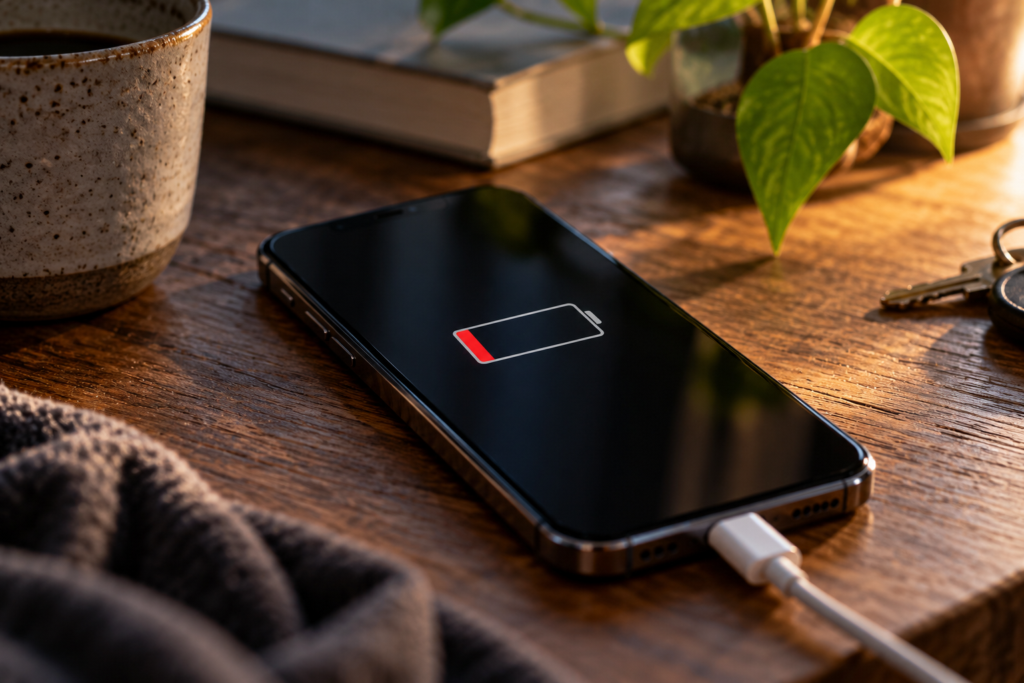
When your phone was new, one charge comfortably lasted through the day. A few years later, the same battery may need an afternoon recharge, even though the display still reaches 100 percent.
The battery has not simply forgotten its original capacity. Its ability to store and deliver energy has changed through physical and chemical processes.
Understanding that aging also explains why charging more carefully can help without making a battery last forever, and why a shorter-lasting charge does not always prove that the battery itself is failing.
A rechargeable battery moves lithium between electrodes
Most smartphones use rechargeable lithium-ion batteries, including cells often described as lithium-polymer. They contain two electrodes separated by an electrolyte and a separator.
During charging, lithium ions move through the electrolyte toward one electrode while the charger drives electrons through the external circuit. During discharge, the overall process reverses and supplies electrical energy to the phone.
The separator helps prevent direct electrical contact between the electrodes while allowing ionic transport. The battery’s useful operation depends on these internal pathways remaining functional.
In an idealized rechargeable system, charging and discharging would reverse perfectly. Real batteries also undergo side reactions, which gradually change their condition.
Some changes reduce the amount of usable lithium
One important process involves a protective layer called the solid electrolyte interphase, usually shortened to SEI.
In common battery designs, this layer forms on the negative electrode and helps limit further electrolyte reactions. It is useful, but continued growth can consume lithium that would otherwise participate in cycling.
Other degradation mechanisms can include electrode particle cracking, loss of electrically connected active material, and changes to the electrolyte. Their importance varies with cell chemistry and operating conditions.
Research on battery aging therefore distinguishes several mechanisms rather than assigning every worn battery one identical failure. A study published in Nature Communications illustrates why identifying degradation modes matters when modeling lifetime.
Aging can also increase internal resistance. That affects how readily the cell delivers power, especially during demanding tasks. Capacity and power capability are related, but they are not the same measurement.
Batteries age while being used and while simply existing
Cycle aging describes degradation associated with charging and discharging. Calendar aging describes changes that accumulate over time, including when a battery is not actively powering a device.
These categories interact. A battery used heavily in a hot environment experiences both elapsed time and operating stress.
A charge cycle also does not necessarily mean one connection to a charger. Partial discharges can accumulate toward an equivalent full cycle.
For example, using an amount equivalent to half the battery’s capacity on two occasions adds up to roughly one full cycle of discharge. Plugging in twice is not automatically two full cycles.
Changes associated with use
Repeated movement of charge and changes in electrode state contribute to wear.
Changes associated with time
Internal reactions can continue even when the phone is rarely used.
This is why keeping a phone unused does not preserve its original battery condition indefinitely.
Heat and charging conditions influence the rate of aging
Elevated temperatures can accelerate unwanted reactions. Repeated exposure to excessive heat can therefore reduce battery lifespan.
Apple, for example, advises avoiding use or charging above its specified ambient-temperature range and explains that excessive heat can permanently affect capacity.
Time spent at a high state of charge can also influence aging. This is one reason some phones offer optimized charging or a configurable charge limit.
Charging speed is more nuanced than “fast charging always ruins batteries.” Current, temperature, chemistry, and the phone’s control system all matter.
The charging rate displayed in an advertisement is not a complete description of what the cell experiences throughout a session. Phones can adjust charging as conditions change.
An older battery can reach 100 percent and still store less
The charging percentage estimates how full the battery is within its current operating range. It is not a promise that the cell still holds its original amount of energy.
Imagine two water containers, one large and one smaller. Both can be completely full while containing different quantities. An aging battery is not literally shrinking like a container, but the analogy helps explain the percentage.
Battery-health information addresses another question: how the estimated maximum capacity compares with an earlier reference, often the battery’s original condition.
| Measurement | What it describes |
|---|---|
| Charge percentage | How full the battery is estimated to be now. |
| Maximum capacity estimate | How much charge the battery can hold relative to a reference. |
| Runtime | How long the phone operates under its current workload. |
These are estimates and observations, not interchangeable labels for one underlying quantity.
Shorter runtime does not always mean sudden capacity loss
A phone uses energy differently depending on screen brightness, network conditions, applications, navigation, recording, and other tasks.
A demanding day can drain a healthy battery quickly. Conversely, reducing the workload can extend runtime without repairing the cell.
If battery life changes abruptly, examining usage information can help separate increased consumption from longer-term aging.
Think of runtime as the relationship between available energy and the rate at which the phone uses it. Either side of that relationship can change the result.
Useful habits reduce avoidable stress without demanding perfection
- Avoid excessive heat. Do not leave the phone baking in a parked car or another hot location.
- Use the phone’s charging features. Optimized charging and supported charge limits can reduce unnecessary time at a high charge.
- Follow the manufacturer’s temperature guidance. Operating and storage recommendations vary between devices.
- Do not deliberately empty the battery every day. Modern lithium-ion batteries do not require routine full discharge to avoid the classic memory effect associated with older technologies.
- Distinguish maintenance from repair. A charging habit may slow future wear; it does not restore lost active material.
The practical goal is sensible use, not constant anxiety about an exact percentage. When aging significantly affects the phone, professional battery replacement may be more useful than repeatedly changing charging rituals.
Frequently asked questions
Does leaving a phone unused stop battery aging?
No. Calendar aging continues over time. Storage temperature and charge level influence how the battery changes.
Can an application restore the battery’s original chemistry?
No. Software can estimate condition or reduce energy use, but it cannot reverse all physical degradation inside the cell.
Is every charging session one full cycle?
No. A cycle generally concerns an accumulated amount of use, rather than each occasion when the charger is connected.
Does fast charging always cause the same amount of wear?
No. The result depends on temperature, charging management, cell design, and other conditions. One universal aging rate cannot describe every phone.