
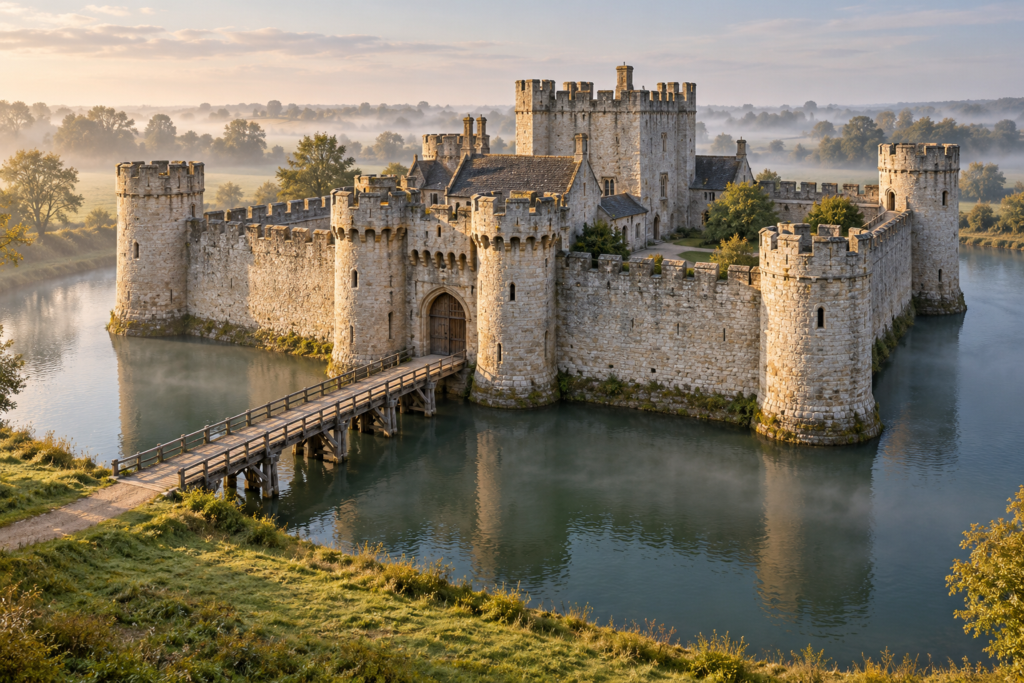
The classic castle picture includes towers, a gatehouse, and a broad ring of water. But that picture hides an important fact: a moat did not need water to be useful.
Its central purpose was to make the ground around a defended place harder to cross. The ditch, the walls, and the entrance worked together, turning a short walk toward a building into a sequence of obstacles.
Defense began before an attacker reached the stonework
A wall is easier to approach when the ground beside it is level and accessible. A deep ditch changes that situation.
Anyone crossing must deal with its sides and bottom before reaching the wall. Equipment that depends on a firm approach also faces a more complicated route.
English Heritage’s Carisbrooke Castle educational guide describes the moat or ditch as a first line of defense.
The important point is not that a ditch makes entry impossible. It adds difficulty and time while allowing the rest of the defensive system to matter.
A dry moat could still create a substantial barrier
Water adds a particular set of challenges, but the basic obstacle can be the excavation itself. A wide, steep-sided dry ditch does not become ordinary open ground just because its bottom is visible.
Historic England’s record for Goodrich Castle describes a substantial dry moat on two sides, with steep natural slopes contributing to defense elsewhere.
This example shows why a moat did not always need to form a complete water-filled ring. Builders could combine excavated defenses with the advantages of the existing landscape.
When looking at a castle, the useful question is therefore not simply “where did the water go?” It is “what kind of obstacle was intended here?”
Distance made direct attacks and undermining more difficult
A broad moat kept attackers away from the curtain wall and complicated attempts to work close to its foundations.
At the Tower of London, Historic Royal Palaces explains that Edward I’s expanded moat was intended both to keep attackers at a distance and to prevent undermining of a new wall.
Undermining involved attacking a structure’s support from below. Making access to the base more difficult added protection against that kind of approach.
The moat was still one element of a larger system. Its value depended on the surrounding walls, defenders, entrances, and local conditions rather than on depth alone.
A defended obstacle still needed a usable entrance
Residents, supplies, and authorized visitors had to enter. A bridge provided a route across the ditch, while the gatehouse concentrated control at the crossing.
A drawbridge could interrupt that route when raised. Gates, a portcullis, and other features could add further barriers.
The English Heritage teaching material for Portchester Castle places the moat within a sequence of defenses around the inner castle.
Not every castle had the same bridge arrangement. The broader principle was selective access: make ordinary entry possible without leaving the whole perimeter equally approachable.
Make the approach harder
A ditch separates the defended structure from surrounding ground.
Concentrate the crossing
A bridge and gatehouse provide a route that can be watched and controlled.
A wet moat could require a managed water system
Digging a hole did not guarantee a dependable supply of water. The site’s slope, nearby watercourses, and methods of controlling flow all mattered.
Historic England’s record for Corfham Castle describes a supply channel, a water-control feature, and an outlet associated with its moated enclosures.
The remains show that the visible ditch could be only part of a larger engineered landscape. Maintaining a wet moat might involve directing water into and out of it.
Water could also change with season and later alterations. A modern photograph captures one state of a feature with a much longer history.
The approach affected how the building was experienced
A moat can make a castle appear isolated from the surrounding landscape. The bridge, reflected walls, and controlled approach contribute to the visual impression.
That does not mean every moat was primarily decorative, nor that every impressive-looking castle was equally effective militarily. Appearance and practical function need to be investigated together.
The National Trust’s description of Bodiam Castle emphasizes its wide encircling moat, towers, and gatehouse. Those features explain why the site remains such a recognizable image of a medieval castle.
Different places require their own evidence. A general explanation should not replace the archaeological and documentary history of a particular site.
Moats could be drained, adapted, or given new uses
A castle landscape did not stop changing when its first defenses were completed. Later owners could modify water systems, fill sections, or use the ground differently.
The Tower of London’s moat, for example, was drained in the nineteenth century and later used for purposes far removed from its original defensive role.
At other sites, later landscaping transformed dry moat areas into gardens. The Royal Collection’s account of Windsor’s Moat Garden illustrates this change in use.
A moat visible today can therefore tell several stories: military design, water management, later maintenance, and the choices made to preserve or reuse a historic landscape.
Frequently asked questions
Did every moat contain water?
No. Dry moats were useful obstacles too, and some sites combined ditches with steep natural slopes.
Was a drawbridge the only defense?
No. It formed part of a wider arrangement that could include gates, a gatehouse, walls, and other obstacles.
Does a dry ditch today prove it was always dry?
No. Water supply, drainage, and later modifications can change a moat’s appearance.